Federico García Lorca al piano en Granada, 1919
Spain calls Federico García Lorca its greatest poet of the twentieth century and has done so for decades. For most of that time, it did so while leaving out the fact that he was gay, that the men he loved shaped some of his best-known work, and that his homosexuality was one of the stated reasons a fascist death squad decided he should die at thirty-eight. Lorca’s biographer Ian Gibson put the omission bluntly: Spain “couldn’t accept that the greatest Spanish poet of all time was homosexual,” so for nearly half a century, editors, family members, and even sympathetic scholars quietly wrote that fact out of his story. Reading Lorca through a queer lens isn’t a revisionist project layered onto his work after the fact. It’s reading the work as he wrote it, before the redactions started.
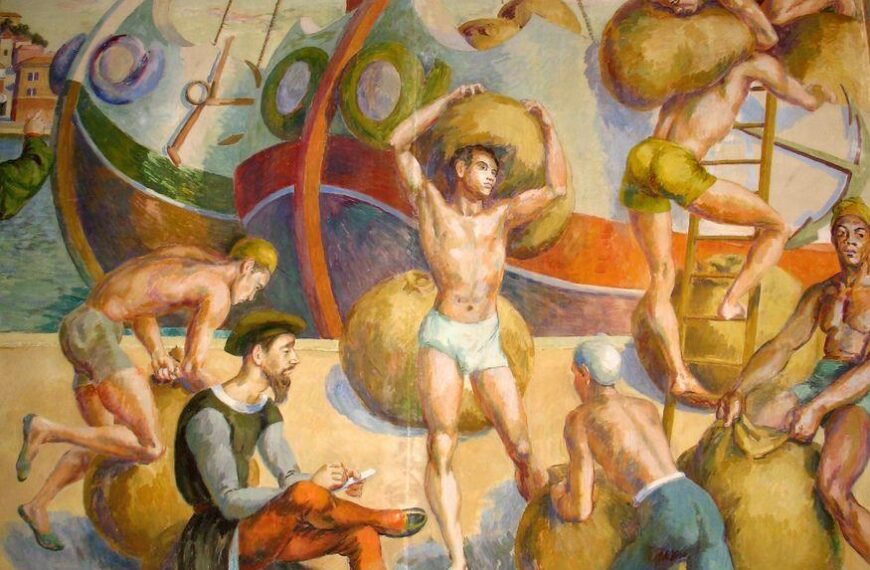
While Lorca was primarily a poet and a writer, his work, connection and contribution to 20th century “art” was invaluable.
The Residencia, and falling for Dalí

Salvador Dalí and Federico García Lorca, Turó Parc, Barcelona, 1925
Català: Fotografia dedicada per Salvador i Federico a les germanes del poeta, realitzada com a record del Turó Parc de la Guineueta, 1925
Lorca arrived in Madrid in 1919 to study at the Residencia de Estudiantes, a progressive dormitory-university that functioned as a kind of incubator for the Spanish avant-garde. There he fell in with Luis Buñuel, the future filmmaker, and Salvador Dalí, an eighteen-year-old painter still finding his style. The three of them became, in short order, the nucleus of a generation.
What happened between Lorca and Dalí over the next several years still gets argued over, but the outline isn’t in dispute. Their friendship strained when Lorca developed an intense, ultimately unrequited crush on Dalí, right as Lorca was becoming famous for Romancero Gitano. By his own later account, Dalí resisted Lorca’s physical advances more than once; some biographers describe attempted encounters that Dalí allowed to happen but didn’t reciprocate, then pulled away from. Dalí described Lorca as “the poetic phenomenon incarnate,” the only person whose talent ever made him jealous, but stopped short of naming what he felt for him. Lorca had no such trouble naming it. He was convinced, and modern biographers largely agree, that Dalí’s discomfort wasn’t indifference so much as fear of what accepting it would mean.
The two collaborated seriously before the friendship curdled: Dalí designed the sets and costumes for the 1927 premiere of Lorca’s play Mariana Pineda in Barcelona, a production that made Lorca’s name as a playwright and that he considered, ever after, his real theatrical debut. By 1928 the two men were personally and artistically estranged. They saw each other only once more, briefly, in 1935, the year before Lorca’s death.
Emilio Aladrén, and the flight to New York
The man who came after Dalí left a harder mark. Lorca’s relationship with the sculptor Emilio Aladrén Perojo ended sometime around 1929, and by every account the breakup devastated him, leaving him depressed for months afterward. It was in the wake of that collapse that Lorca’s family arranged for him to travel to New York, ostensibly to study English at Columbia University. He arrived in June 1929 and stayed nine months.
New York cracked something open in him. He wrote to his family in awe of the skyscrapers and the scale of the city, but the poems that came out of the trip, later collected as Poeta en Nueva York (Poet in New York), are full of alienation, industrial menace, and grief — not the voice of a tourist. Part of that grief has only recently been traced to its source. In August 1929, Lorca left the city for ten days to stay with a young American named Philip Cummings at a rented cottage on Lake Eden in rural Vermont. According to the biographer Patricia Billingsley, whose 2019 book Lorca in Vermont is built on more than a decade of archival research, the two men were lovers, and theirs was an affair that spanned three years and two continents — one in which, as Billingsley frames it, Lorca sought a sustained relationship while Cummings, eight years his junior, had no interest in long-term commitment. Roughly a quarter of Poet in New York — eight poems — grew directly out of that stay at Lake Eden.
For decades, none of this was public. Ángel del Río, the Columbia professor who had chaperoned Lorca in New York and who became a gatekeeper of his literary legacy after the execution, is documented to have censored a 1941 letter Lorca had sent him from Vermont, cutting a line about Cummings before allowing it to be published. The Vermont chapter of Lorca’s life was, quite literally, edited out of the record by the people entrusted with protecting it.
La Barraca, Blood Wedding, and a decade of hidden feeling
Lorca returned to Spain in 1930 as the Second Republic was taking shape, and the 1930s became his most productive years. He founded and directed La Barraca, a government-funded student theater troupe that toured rural Spain performing classic Spanish drama, often for audiences who had never seen a play. In the same years he wrote the rural tragedies that made him internationally famous as a dramatist — Blood Wedding (1932), Yerma (1934), and The House of Bernarda Alba, finished weeks before his death and staged only after it.
Read plainly, these plays are about women: arranged marriage, thwarted desire, a mother who locks her daughters away rather than let the world touch them. Read against what Lorca could not say openly about his own life, they’re also studies in what happens to desire when a society refuses to let it exist. Critics have made that connection for decades, not as a stretch but as the most coherent explanation for why Lorca, a gay man surrounded by openly gay and bisexual friends in Madrid’s avant-garde circles, kept returning obsessively to stories of women crushed by honor codes and family expectation. He was writing about the only kind of repression Spanish theater in the 1930s would let him put on a public stage.
The sonnets that took nearly fifty years to see daylight
Lorca did write about his own desire directly — he simply didn’t get to publish it. Between 1935 and 1936 he wrote eleven sonnets, later called the Sonetos del amor oscuro (Sonnets of Dark Love), openly homoerotic poems addressed to a male lover, widely believed to be a younger man named Juan Ramírez de Lucas. Lorca read them to friends and reportedly intended to publish them, but he was murdered before he could, and his family, along with the literary establishment that inherited his papers, sat on them for decades.
They finally surfaced in the strangest possible way: in November 1983, an anonymous, unauthorized edition of 250 numbered copies — printed in red ink on pink paper, with no publisher or printer credited anywhere, distributed by mail in red envelopes with typed labels — began circulating among Spanish literary figures with no explanation of who had sent it. The text of the eleven sonnets was corrupted enough that scholars suspected it had been copied down from a second- or third-generation photocopy of the originals. The stunt worked. Three months later, a more reliable, authorized edition arrived, and in March 1984 the newspaper ABC published all eleven sonnets officially for the first time, with the family’s blessing — forty-eight years after Lorca wrote them, and roughly the same span of time it took Spain to admit, out loud, why he’d been killed.
Granada, August 1936
Lorca did not fight in the Spanish Civil War. He wasn’t a member of any political party. But he was a known leftist sympathizer, his brother-in-law was the Republican mayor of Granada, and he was gay in a way that, however carefully managed in public, was not exactly a secret among people who knew him. When Nationalist forces took Granada in the summer of 1936, that combination was enough. In the early morning of August 19, 1936, Lorca was driven with a schoolmaster and two bullfighters to a field near the Sierra Nevada foothills, shot, and dumped in an unmarked grave that has never been located. One of the men involved in his arrest was recorded describing the killing to a bar afterward, boasting that he’d put two bullets in Lorca “for being a queer.” A police report from the period justified his death by citing, among other things, his participation in “homosexual and abnormal practice.” His books were later publicly burned in Granada’s Plaza del Carmen, and his work was banned in Franco’s Spain for years afterward, kept alive largely by actors and publishers working outside the country.
Best-known works and collaborations
| Work | Year | Type | Key collaborators | Notes |
|---|---|---|---|---|
| Concurso de Cante Jondo | 1922 | Flamenco festival | Composer Manuel de Falla | Two-day event at the Alhambra co-organized with Falla to preserve endangered Andalusian flamenco song forms; laid groundwork for later projects like La Barraca |
| Canciones | 1927 | Poetry collection | — | Early lyric poetry drawing on Andalusian folk song |
| Mariana Pineda | Written 1923–25, premiered 1927 | Play | Sets and costumes by Salvador Dalí; lead role by actress Margarita Xirgu | Lorca considered this his true theatrical debut; the Dalí-Lorca collaboration that marked the height of their closeness |
| Romancero Gitano (Gypsy Ballads) | 1928 | Poetry collection | — | Made Lorca internationally famous almost overnight |
| Poeta en Nueva York (Poet in New York) | Written 1929–30, published 1940 | Poetry collection | Inspired in part by Lorca’s relationship with American Philip Cummings in Eden Mills, Vermont | Roughly a quarter of the collection grew directly out of the Vermont stay; published posthumously |
| La Barraca | 1932–1935 | Traveling theater company | Founded and directed by Lorca under a Republican government grant | Brought classic Spanish drama to rural audiences who had rarely or never seen live theater |
| Bodas de Sangre (Blood Wedding) | 1933 | Play | — | First of Lorca’s major rural tragedies; established his reputation as Spain’s leading dramatist |
| Yerma | 1934 | Play | — | Continued the trilogy of tragedies centered on thwarted female desire |
| Sonetos del amor oscuro (Sonnets of Dark Love) | Written 1935–36; first (clandestine) edition 1983, authorized edition 1984 | Poetry collection | Believed addressed to Juan Ramírez de Lucas | Explicitly homoerotic sonnets suppressed by Lorca’s estate for nearly half a century after his death |
| La casa de Bernarda Alba (The House of Bernarda Alba) | Written 1936, published and premiered 1945 | Play | — | Finished weeks before Lorca’s execution; widely read as his most powerful statement on repression |
Why he still matters
Lorca’s work hasn’t needed rescuing from obscurity — it was never obscure. What’s changed is how honestly it gets discussed. Osvaldo Golijov’s opera Ainadamar, which had its Metropolitan Opera premiere during the 2024–25 season after two decades of international productions, tells Lorca’s story explicitly through the lens of a gay, politically outspoken artist murdered by fascist forces, sung, in a deliberate piece of casting, by a mezzo-soprano in a trouser role rather than a tenor. A Los Angeles Blade review of a 2025 production put the contemporary resonance plainly: the opera arrives at a moment when governments are still trying to silence queer voices politically and artistically, and no one in the audience needs an interpreter to connect Lorca’s persecution to the present.
That’s really the case for reading Lorca as a queer artist rather than around the fact of it. He wrote some of the most enduring Spanish-language literature of the twentieth century while living inside a set of constraints that forced a huge amount of his most personal feeling into disguise — into gypsies and sailors standing in for outsiders, into suffering women standing in for a longing he couldn’t name onstage, into eleven sonnets that had to wait fifty years and an anonymous mailing to reach print. Understanding that isn’t a footnote to the work. It’s most of the reason the work carries the emotional weight it does, and it’s why a poet killed for who he loved keeps getting restaged, translated, and set to music by artists who see their own moment reflected in his.
Sources
- Colorado State University English Department: LGBT History Month — Federico Garcia Lorca
- The Gay & Lesbian Review: The Love Song of Lorca and Dalí
- The Gay & Lesbian Review: What Lorca and Dalí Almost Had
- Queer Portraits in History: Federico García Lorca
- Wikipedia: Federico García Lorca
- The Gay & Lesbian Review: Lorca in Vermont — The Untold Story
- University of New Mexico Press: Lorca in Vermont, by Patricia A. Billingsley
- Out.com: Federico García Lorca — Poet in New York
- World Socialist Web Site: Spain — Controversy Surrounds Opening of García Lorca’s Grave
- Wikipedia: Sonetos del amor oscuro (Spanish)
- Poets.org: A Brief Guide to “La Generación del 27” — Dalí, Buñuel, and Lorca
- Wikipedia: Mariana Pineda (play)
- Wikipedia: Concurso de Cante Jondo
- Universo Lorca: The Flamenco Song Contest of 1922
- Metropolitan Opera: The Soul of Spain — Ainadamar
- Los Angeles Blade: Opera Is Alive and Well, Keeping the Queer Voice in Arts Strong with LA Opera’s Ainadamar