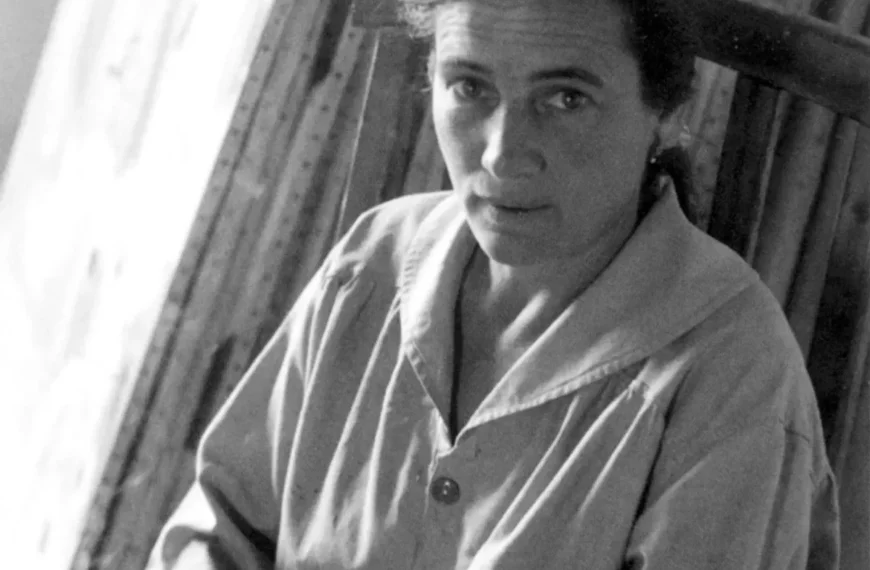
Lizzy Ansingh, by Therese Schwartze, 1902
Lizzy Ansingh (1875 – 1959) spent eighty-four years in a household that never once contained a husband. She wasn’t unusual for that — an entire circle of Amsterdam women built careers on the same refusal — but she took the arrangement further than most, filling her studio with dolls instead of children and painting them with the seriousness other artists reserved for royalty. Read her only as a quaint footnote to Dutch Impressionism and you miss the point. Read her as a woman who structured her entire adult life around female company, professional ambition, and a fantasy world she controlled completely, and the paintings start to look less eccentric and more deliberate.
Raised by her aunt, not her mother
Maria Elisabeth Georgina Ansingh — Lizzy to everyone who knew her — was born in Utrecht on 13 March 1875, the daughter of a pharmacist and a minor painter, Clara Theresia Schwartze, whose poor health meant Lizzy spent much of her childhood elsewhere. “Elsewhere” turned out to be the household of her aunt, the far more successful portraitist Thérèse Schwartze, with whom she lived for sixteen years. Schwartze gave her niece drawing lessons, introduced her to Breitner and the young Mondriaan, and pushed her toward a professional career at a moment when “professional” and “female artist” rarely appeared in the same sentence.
That push landed her at the Rijksakademie van Beeldende Kunsten in 1894, in the academy’s separate class for women, alongside a cohort who would go on to become lifelong collaborators: Coba Ritsema, Nelly Bodenheim, Jacoba Surie, Ans van den Berg, and several others. Critic Albert Plasschaert later gave the group a name — the Amsterdamse Joffers, roughly “the young ladies of Amsterdam” — and it stuck, though the women themselves mostly just called each other friends.
A feminist network, whether or not they used the word

Lizzy Ansingh, by Therese Schwartze, 1909
It’s worth being precise about what the Joffers were. They came from wealthy families, studied together at the Rijksakademie between the 1890s and 1900s, and met weekly — often at Thérèse Schwartze’s house — to critique each other’s work and, less formally, to keep each other unmarried and painting. One dealer specializing in their work places them squarely inside the first feminist wave, roughly 1870 to 1920, and the description holds up: this was a generation of Dutch women testing whether a woman could support herself through art rather than through a husband.
The stakes of that choice were higher than they sound now. Until 1957, a married Dutch woman was legally incapacitated — no property in her own name, no bank account, no independent signature. An Amsterdam Museum profile of Betsy Repelius, a painter one generation older who moved in the same overlapping circle of independent Amsterdam women, spells this out bluntly: Repelius never married, shared a house with a female doctor and a female music teacher, and wrote to a friend that she didn’t believe any man could love her better than she did. Ansingh herself joined the Amsterdam chapter of the Association for Women’s Suffrage. Staying single wasn’t an accident of these women’s biographies — it was closer to a professional strategy, and sometimes an emotional one.
What the record does and doesn’t say
Here is where a queer reading has to be honest about its limits. There is no surviving letter, diary entry, or contemporary account establishing that Ansingh had a romantic or sexual relationship with a woman. What exists instead is a life built, almost without exception, around female company: sixteen years with her aunt, a permanent home shared with her sister Aletta until 1939, decades of collaboration with Bodenheim, and a social world — Arti et Amicitiae, Sint Lucas, the weekly Joffer gatherings — that was overwhelmingly, structurally female. She never married. Whether that reflects attraction, ambition, circumstance, or some mixture no biographer can now separate, is a question the sources simply don’t answer, and any piece that claims otherwise is inventing rather than reporting.
What the sources do support is a milieu that historians of sexuality now recognize as adjacent to queer social history even where individual orientations go undocumented: circles of unmarried, financially independent women who built households, careers, and intimacies together, outside the marriage economy that structured everyone else’s life. Ansingh lived inside that milieu for her entire adult life. That’s a fact about her world, not a claim about her bed, and the two shouldn’t be collapsed into each other — but it’s also not nothing. A life spent almost entirely in the company of women, by choice, in a period when that choice carried real legal and social cost, is itself a piece of queer and feminist history, independent of what happened or didn’t happen behind closed doors.
The dolls, which were never really about dolls
Ansingh painted portraits and still lifes for most of her career, but what made her name — and what still makes her strange to look at — were the doll paintings, a genre she more or less invented for herself starting in 1906. In 1910 she bought an eighteenth-century display cabinet at an Amsterdam auction and converted it into a dollhouse with twenty inhabitants, Dutch dolls and wayang puppets and a Japanese doll named Piepje that became her favorite model. She used the dollhouse to stage compositions the way another painter might use a live model, and the resulting canvases are not cute. Dolls stand in judgment of one another, act out the seven deadly sins, get cast out, get married, drown in symbolist ponds. One contemporary writer called the paintings a private mythology dressed up as still life, closer in spirit to Redon or de Chirico than to anything else being produced in the Netherlands at the time.
It’s tempting, and probably too neat, to read the dollhouse as a substitute domestic world — a household Ansingh built, populated, and ruled entirely on her own terms, in a life that otherwise had no husband and no children to organize it around. The paintings themselves resist easy allegory; they’re too strange and too controlled for that. But the fact that an unmarried woman spent five decades constructing an alternate family out of porcelain and cloth, and painting that family with more psychological intensity than she ever brought to a formal portrait, is hard to look at as coincidence.
Major works, and where to find them now
| Work | Year | Now |
|---|---|---|
| Portrait of her mother | 1899 | Private collection |
| Het gele gevaar (The Yellow Peril) | 1906 | Private collection |
| Verstoten (Cast Out) | 1913 | Stedelijk Museum Amsterdam |
| Zeven hoofdzonden (Seven Deadly Sins) | 1914 | Dordrechts Museum, Dordrecht |
| Ontwaakt (Awakened) | 1915 | Private collection |
| Poppenhuis (the dollhouse, painted as subject) | 1943 | Museum Arnhem (Erfgoedcentrum Rozet) |
| The dollhouse itself | acquired 1910 | Museum Arnhem, since 1963 |
| Poppenbruiloft (Doll Wedding) | 1936 | Singer Museum, Laren |
| Voor de spiegel (Before the Mirror) | 1944 | Private collection |
| Self-portrait | undated | Stedelijk Museum Amsterdam |
| Portrait of Coba Ritsema | undated | Stedelijk Museum Amsterdam |
| Steeplechase (Olympic art competition entry) | 1928 | Untraced |
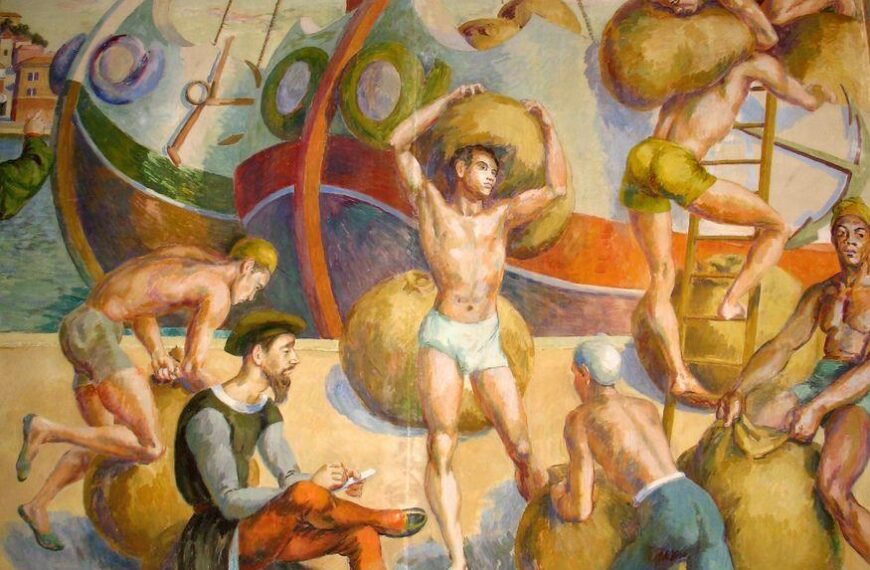
Further works are held by the Rijksmuseum, the Amsterdam Museum, the Kunstmuseum Den Haag, and the Centraal Museum Utrecht, according to the artist monograph maintained by the Vereniging Vrienden Nieuwe Kunst 1900. Beyond painting, she wrote two illustrated children’s books with Bodenheim, ‘n Vruchtenmandje (1927) and Tante Tor is jarig (1950), and the pair designed a porcelain children’s tableware set, the “Familie Kakelbont,” produced by Société Céramique in Maastricht in 1924.
War, decline, and a slow rediscovery

Lizzy Ansingh, 1950
On the night of 26–27 April 1943, a British bomber shot down over Amsterdam crashed into the Carlton Hotel and set fire to much of the Reguliersdwarsstraat — the worst fire the city had seen since 1659, an event grim enough that Anne Frank noted it in her diary. Ansingh’s studio on the Herengracht was badly damaged, along with the dollhouse itself, which a friend later rebuilt for her. She kept working through her seventies, was made a Knight of the Order of Orange-Nassau in 1935, and died in Amsterdam on 14 December 1959, having outlived nearly every one of the Joffers who made up her original circle.
For decades afterward she was the footnote to her more famous aunt — the woman who painted dolls, mentioned in passing in surveys of Dutch Impressionism and largely absent from anywhere else. That’s shifted. The Historisch Museum Arnhem gave the doll paintings a dedicated exhibition in 2005, and in 2025, on what would have been her 150th birthday, Luther Museum Amsterdam mounted a full retrospective built around her paintings, her tableware, her poetry, and — pointedly — the network of women she spent her career building and defending. It’s the kind of attention that treats her the way this piece has tried to: not as an odd woman who liked dolls, but as an artist who used everything at her disposal, including a household with no room for a husband in it, to make work nobody else was making.
Sources
- Lizzy Ansingh — Wikipedia
- Amsterdamse Joffers — Wikipedia
- Ansingh, Maria Elisabeth Georgina (Lizzy) — Vereniging Vrienden Nieuwe Kunst 1900
- Ansingh, Maria Elisabeth Georgina (1875–1959) — Huygens Institute / Biografisch Woordenboek Nederland
- To the Joffers of Amsterdam (ode to Betsy Repelius) — Amsterdam Museum
- Verstoten, Lizzy Ansingh — Stedelijk Museum Amsterdam
- Poppenhuis van Lizzy Ansingh — Museum Arnhem
- Nelly Bodenheim — Wikipedia
- Lizzy Ansingh — Olympedia
- The Magical World of Lizzy Ansingh — Amsterdam Art / Luther Museum
- Lizzy Ansingh, artist profile — Mark Smit Kunsthandel
- Unsung: The Still Lifes & Illustrations of Lizzy Ansingh — Streamline Publishing