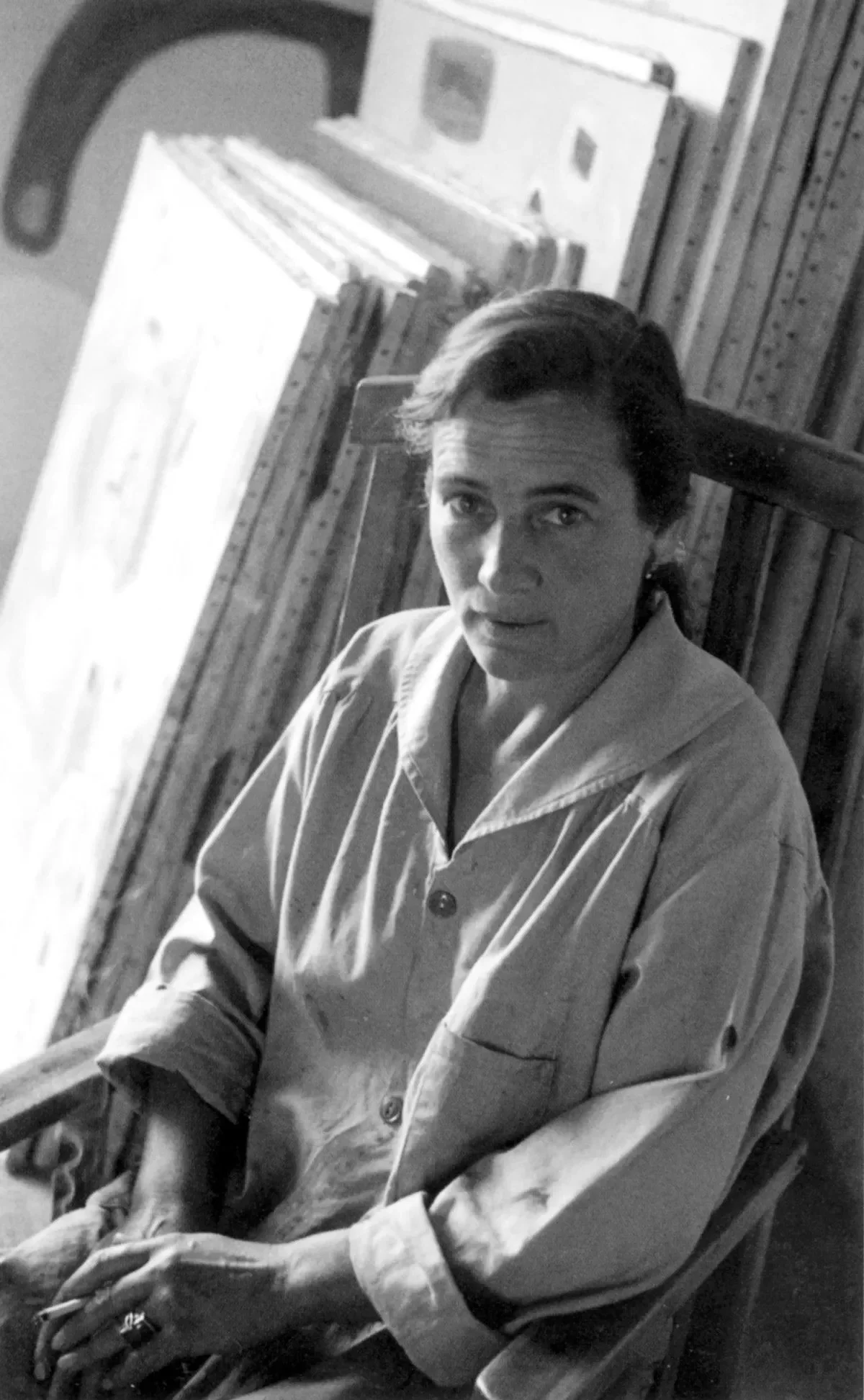
Agnes Martin, 1954
Agnes Martin (1912-2004) spent six decades building some of the most austere paintings of the twentieth century, then spent nearly as long refusing to explain what any of it had to do with her. She rejected the label “woman.” She rejected “feminist.” When pressed on the subject that biographers, critics, and now this piece keep circling back to, she once told a friend she “was not a woman but a doorknob” — a line meant, at least in part, as a joke, and one that has been picked over by scholars ever since for exactly the reason she probably feared it would be.
A life built around leaving places
Martin was born in 1912 in Macklin, Saskatchewan, to Scottish Presbyterian farmers, and grew up mostly in Vancouver after her father died when she was two. She crossed into the United States in 1931, ostensibly to help a pregnant sister in Bellingham, Washington, and never really went back. She trained as a teacher, then talked herself into art at Teachers College, Columbia, where lectures by the Zen scholar D.T. Suzuki gave her a framework — not religious exactly, more a code of conduct — that shows up in her work for the rest of her life.
In 1957, the New York dealer Betty Parsons talked her into moving to Coenties Slip, a strip of condemned sailmaking lofts in lower Manhattan that, for about a decade, housed an improbable cluster of young artists: Ellsworth Kelly, Robert Indiana, Jack Youngerman, Jasper Johns, and the textile artist Lenore Tawney, with whom Martin is widely believed to have had a romantic relationship. The Slip was cheap because the city planned to tear it down, and it was, by multiple accounts, one of the more openly queer pockets of the New York art world at the time — a fact that matters more to how Martin’s paintings get read today than it did to how she talked about them while she was alive.
She had her first solo show at Parsons’s gallery in 1958, developed the six-by-six-foot grid format that would define her, and by the mid-1960s was showing alongside Sol LeWitt and Donald Judd in the Guggenheim’s Systemic Painting exhibition — filed under Minimalism, a label she disputed for the rest of her career. She preferred “abstract expressionist,” on the grounds that her work was about feeling, not system, whatever the grid looked like from across the room.
Then, in 1967, she left. Her friend and mentor Ad Reinhardt had just died, the Slip’s buildings were being demolished out from under her, and — according to the 2018 biography Agnes Martin: Pioneer, Painter, Icon — she had recently broken up with the sculptor Chryssa, whom she had dated on and off through the decade. She bought a truck, camped across the American West and Canada for eighteen months, stopped painting entirely, and eventually built herself an adobe house by hand near Cuba, New Mexico. She would spend the rest of her life in New Mexico, painting again from 1974 on, dying in Taos in 2004 at ninety-two.
The account of Martin’s mental health is inseparable from this story, and it deserves to be told plainly rather than mythologized. She lived with schizophrenia, documented from around 1962, and was hospitalized more than once at Bellevue for electroconvulsive therapy. Her Coenties Slip neighbors — this is one of the better-attested facts of that community — organized to get her psychiatric help during one crisis. What caused what is not something the record settles, and it shouldn’t be settled here either: Henry Martin’s biography suggests a connection between the pressure of hiding her sexuality under mid-century conditions and her psychiatric history, but Martin herself never framed it that way, and the two things can be true — the illness real, the social conditions real — without one simply explaining the other.
The closet, argued over by other people
Here is the thing nobody disputes: Martin never publicly said she was a lesbian. Here is the thing almost everyone who has written seriously about her agrees on anyway: she was one, or close enough to it that the word applies more often than not. The art historian Jonathan D. Katz, in an essay written for the 2010 Smithsonian exhibition Hide/Seek, read her grid paintings — works like Night Sea (1963) — as a form of what he called queer self-realization, arguing that the tension in those paintings, the “unreconciled equilibrium” between rigor and softness, comes out of a life spent encoding rather than stating. The lesbian artist Harmony Hammond wrote her own account of visiting Martin, deliberately pushing back against the more ethereal, desexualized version of Martin that had become the standard critical line. Later scholarship — a 2016 piece titled “Doorknob in the Desert” — goes further still, reading Martin’s refusal of the category “woman” not as evasion but as its own kind of liberation, a deliberate step sideways out of the whole apparatus of gender rather than a closet in the ordinary sense.
It is worth taking Martin’s own resistance seriously rather than waving it off as false consciousness. She told a New Yorker writer in 1993 that she thought the women’s movement had failed. She avoided the word feminist even when critics like Jaleh Mansoor argued her working method was feminist whether she named it or not. None of that erases what the biographical record shows — relationships with Tawney, with Parsons, with Chryssa, all documented to varying degrees of certainty by Henry Martin’s book — but it should complicate any reading of her as a woman quietly waiting to be outed by history. She was not hiding so much as she was refusing the entire premise that her sexuality was information the public was owed, at a moment — the McCarthy-era Lavender Scare bled well into the decade she was working through — when that refusal was not paranoia but ordinary self-preservation. Reading her paintings as encoded queerness is a defensible critical move. Treating that reading as settled fact, as some very online summaries now do, gives Martin less credit than she deserves for having a considered position of her own.
What has shifted more recently is who claims her. The Italian performance artist Agnes Questionmark, a trans woman, took Martin’s first name as her own stage name specifically because of it — a small, direct line from Martin’s ambivalent relationship with gender to someone building an entirely different one.
The best-known works, and where to actually see them
Because Martin destroyed most of her pre-1957 output and rarely repeated a composition outright, her reputation rests on a fairly small number of paintings that keep surfacing in every retrospective. None of them can be reproduced here — every painting listed below remains under copyright to the Estate of Agnes Martin, managed through the Artists Rights Society, and will stay that way for decades. The links go to the museums’ own pages, where the actual images are viewable under each institution’s terms.
| Work | Year | Medium | Now held at |
|---|---|---|---|
| Harbor Number 1 | 1957 | Oil on canvas | Museum of Modern Art, New York |
| This Rain | 1958 | Oil on canvas | Solomon R. Guggenheim Museum, New York |
| White Flower | 1960 | Oil on canvas | Solomon R. Guggenheim Museum, New York |
| Friendship | 1963 | Incised gold leaf and oil on canvas | Museum of Modern Art, New York |
| Night Sea | 1963 | Crayon, gold leaf, and oil on linen | San Francisco Museum of Modern Art (Fisher Collection) |
| The Islands I–XII | 1979 | Acrylic and graphite on linen, 12 panels | Whitney Museum of American Art, New York |
| On a Clear Day | 1973 | Portfolio of 30 serigraphs | Multiple public collections, including MoMA and the National Gallery of Canada |
| With My Back to the World | 1997 | Synthetic polymer paint on canvas, 6 panels | National Gallery of Canada, Ottawa |
Two things are worth adding to the table. The San Francisco museum built an entire octagonal room around seven of her paintings, modeled on the gallery the Harwood Museum of Art in Taos designed at Martin’s own request in the 1990s; visitors and staff both have taken to calling it a chapel, and at least one couple has gotten engaged in it. The other is the market, which has its own way of registering what “best” means: her 1963 Loving Love sold for $2.95 million at Christie’s in 2007, and Orange Grove went for $13.7 million at auction in 2016, the same year the Guggenheim mounted its full retrospective.
What the record actually supports
The honest position is somewhere between two overreaches. It overreaches to insist Martin’s grids are a straightforward closeted-lesbian confessional, decoded at last — she resisted that reading in her own words, repeatedly, and the paintings are also demonstrably about Taoism, about the New Mexico desert, about a formal problem in painting that has nothing to do with anyone’s biography. It also overreaches to treat her sexuality as incidental, a private matter that tells us nothing about the work, when the community she built her career inside — Coenties Slip, Tawney, Parsons, the whole queer scaffolding of that decade — is not separable from how and where the work got made. Martin got to decide what her paintings were about. She did not get to decide, and probably knew she would not get to decide, what several generations of critics after her would do with the rest.
Sources
- Wikipedia: Agnes Martin
- Jonathan D. Katz, “The Sexuality of Abstraction: Agnes Martin”
- “Doorknob in the Desert: Agnes Martin’s Queer Becoming”, Journal of Curatorial Studies
- Henry Martin, Agnes Martin: Pioneer, Painter, Icon (Schaffner Press, 2018), via Out.com
- SFMOMA, “Angles on Agnes”
- MoMA collection record, Friendship
- Art Canada Institute, “Where to See” Agnes Martin
- Ocula Artist profile
- Speciwomen, “In Conversation: Agnes Questionmark”