Lincoln Cathedral, 1953-1958
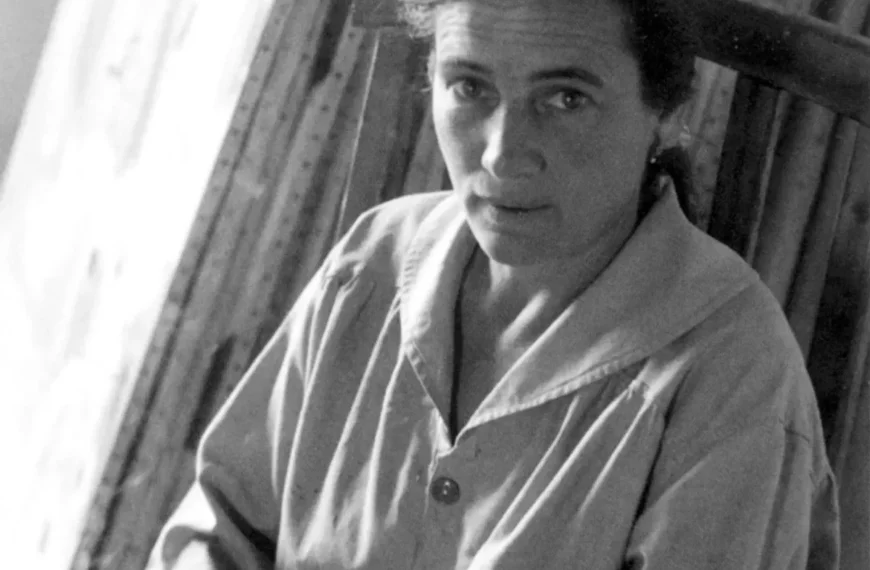
Duncan Grant (1885-1978) was born the same year the UK Parliament passed the Labouchère Amendment, the law that would make gay sex between men a criminal offense in Britain for the next eighty-two years. He died in 1978, eleven years after it was finally repealed, in the home of the man he loved, having spent most of the intervening decades doing more or less exactly as he pleased. That gap — between the law on the books and the life Grant actually lived — is the real subject of his biography, more than any single painting is.
A childhood in barracks, an adulthood in Bloomsbury
Grant was born in 1885 at Rothiemurchus in the Scottish Highlands, the son of an army major stationed mostly in India and Burma, which meant Grant spent much of his early childhood being raised by a governess while his parents were abroad. He came back to England for school, was taken in for several years by his aunt and uncle, Sir Richard and Lady Strachey — parents to a large brood of children who would later populate half of Bloomsbury — and it was through that household that he met his cousin Lytton Strachey, who became his first serious lover and, more consequentially, his entry point into the circle of writers and artists that would define his century.
He trained at the Westminster School of Art, studied briefly in Paris under Jacques-Émile Blanche, and by 1905 had been introduced to Vanessa Bell at the Friday Club. Bell would turn out to be the most important relationship of his adult life, though calling it a “relationship” undersells how strange, durable, and genuinely functional the arrangement was. Grant was, in the language of the period, “actively homosexual” — the phrase shows up in nearly every museum wall label — and he and Bell were never a couple in any conventional sense. They were also inseparable for over fifty years, ran a household together, decorated their own furniture together, and in 1918 had a daughter together, Angelica, whom Bell’s husband Clive Bell raised as his own without objection and without, for the first eighteen years of Angelica’s life, telling her the truth.
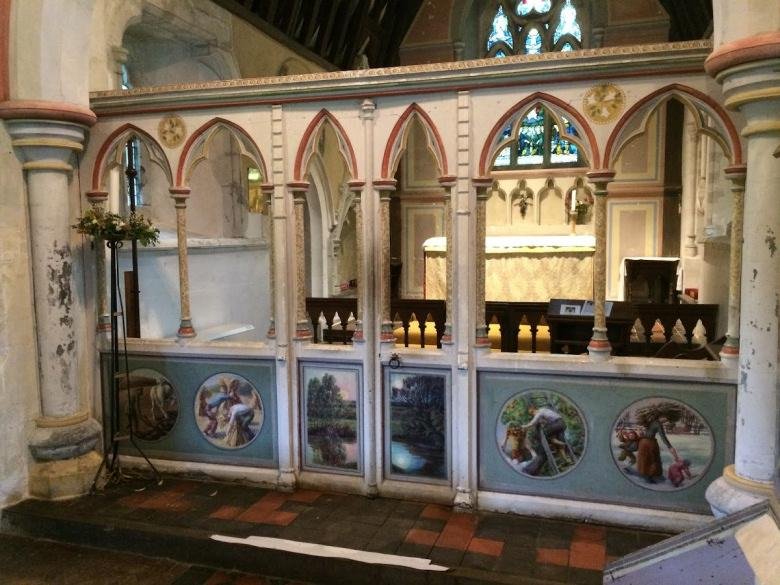
Berwick Church murals
Charleston, and an open secret that stayed open
In 1916, with Britain conscripting men for a war Grant refused to fight, he and his then-lover David Garnett needed agricultural work to qualify as conscientious objectors. Bell found them a farmhouse near Firle in Sussex called Charleston, moved in with them, and the three lived there together while Grant and Garnett worked the land. It is worth sitting with that sentence for a moment: a woman, her lover, and her lover’s lover, sharing a farmhouse as a matter of wartime bureaucratic convenience that somehow turned into forty years of cohabitation. Charleston Farmhouse is now a museum, preserved more or less as Grant and Bell left it, every door panel and lampshade and fire screen hand-painted by the two of them across five decades.
The household’s own account of itself, kept from outsiders, came apart from the inside in a way that still reads as almost too strange for fiction. David Garnett — the man Grant had lived with as a lover during the war — later married Angelica, Grant’s daughter, in 1942. Angelica did not learn that Grant, rather than Clive Bell, was her biological father until 1937, five years before that marriage, and by her own account in the memoir Deceived with Kindness (1984), the discovery reshaped how she understood everything about her childhood, including a marriage to a man who had once been her father’s lover. Simon Watney, a Charleston historian and co-founder of Brighton’s Gay Liberation Front chapter, has written that Grant spent the rest of his life periodically wounded by relationships with men — Garnett among them, along with the painter George Bergen — who were themselves bisexual and often unavailable in ways that caused him real and repeated grief. None of this was hidden from the Bloomsbury circle itself. It was hidden, carefully and out of necessity, from everyone outside it.
The murals nobody was supposed to see
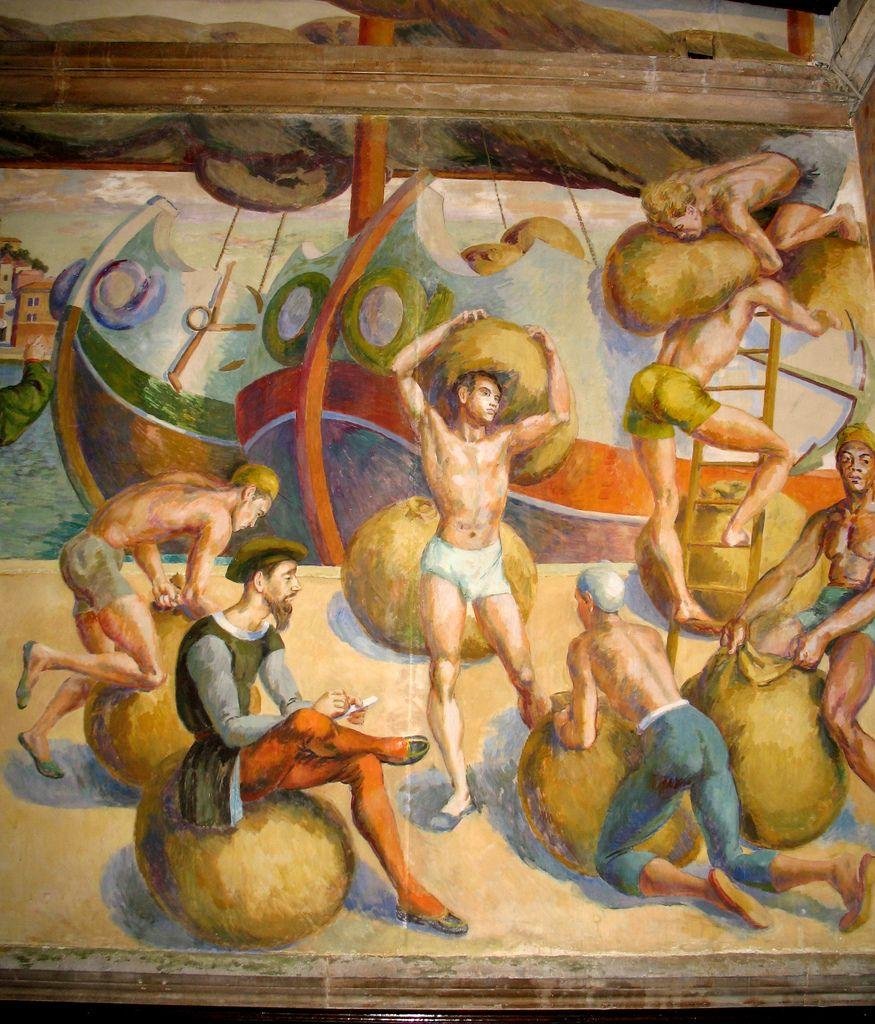
Grant painted a controversial and hidden set of murals in the Russell Chantry (St Blaise Chapel) at Lincoln Cathedral between 1953 and 1958. [1, 2, 3]
Overview of the Murals
- Subject Matter: The murals depict St Blaise (the patron saint of wool workers) and scenes from medieval Lincoln’s wool trade alongside Christ as the Good Shepherd. [1, 2]
- The Controversy: Church authorities and visitors later took exception to the near-nudity of the dock workers and the fact that Grant used his young lover and muse, Paul Roche, as the model for Jesus. [1, 2, 3]
- Covered Up: Due to the homoerotic undertones and mixing of contemporary life with religious themes, the chapel was locked away, used as a storeroom, and left out of cathedral guidebooks for over three decades. [1, 2, 3]
- Rediscovery: Following restoration, the murals were finally reopened to public view in 1990.
Grant’s most direct engagement with his own sexuality in paint came early. In 1911, Roger Fry recruited him to help decorate the dining hall of the Borough Polytechnic in south London on the theme “London on Holiday.” Grant produced Bathing: seven male figures, mostly nude, diving and swimming and hauling each other into a boat, drawing openly on Michelangelo’s nudes and on memories of watching men swim at the Serpentine in Hyde Park. The Times complained the work risked a “degenerative influence on the children of the working class.” The painting now hangs at Tate Britain, which uses it on its own website as an entry point into a guide on queer art and life — a fairly complete reversal of how the piece was received when it was new.
Grant did the same thing again, far more directly, near the end of his career, and the results took decades to be allowed into public view. In 1958, the Edwin Austin Abbey Memorial Fund — with Vanessa Bell sitting on its committee, which did not hurt Grant’s chances — commissioned him to decorate the Russell Chantry, a side chapel dedicated to St. Blaise in Lincoln Cathedral. Grant filled it with a wool-trade quayside scene featuring muscular, largely unclothed young dockworkers, and modeled the figure of Christ on his own partner, the poet Paul Roche. Cathedral officials found the nudity too much: the chapel was locked from around 1964 and used for years as a storeroom, cupboards pushed against the walls to hide the murals entirely, and guidebooks simply left the room out. It did not reopen properly until 1990, twelve years after Grant’s death. A photograph of the space, taken by Richard Croft and released under a Creative Commons license via Geograph, is one of the only openly licensed images of any Grant work currently online — everything else illustrated below remains under copyright to his estate, managed through DACS, and cannot legally be reproduced here.
Roche, and the last thirty years
Grant met Paul Roche outside Piccadilly Circus tube station in 1946; Roche was thirty, a poet and classics translator, and started modeling for Grant the day after they met. Roche married and moved to Massachusetts in 1954 to teach at Smith College, but stayed close to Grant throughout, and when Vanessa Bell died in 1961, Roche came back to England with his own family to look after Grant, who was by then seventy-six. He would go on doing that for the next seventeen years. Grant died of pneumonia in 1978 in Roche’s home in Aldermaston, Berkshire — not at Charleston, though he is buried beside Bell in the churchyard at Firle. It is a genuinely rare thing for a gay man born in 1885 to die surrounded by decades of documented, unbroken care from a partner thirty years his junior, and rarer still for that fact to be treated, in nearly every account of his life, as an unremarkable footnote rather than the point.
Where to see the work now
| Work | Date | Medium | Now held at |
|---|---|---|---|
| Bathing | 1911 | Oil on canvas | Tate Britain, London |
| The Queen of Sheba | 1912 | Oil on panel | Tate Britain, London |
| Interior at Gordon Square | c.1915 | Oil on board | Tate Britain, London |
| Landscape, Sussex | 1920 | Oil on canvas | Tate Britain, London |
| The White Jug | c.1919 | Oil on canvas | Southampton City Art Gallery |
| Self-Portrait | 1920 | Oil on canvas | National Galleries of Scotland, Edinburgh |
| Portraits of Vanessa Bell, Lytton Strachey and other Bloomsbury figures | 1910s–1950s | Various | National Portrait Gallery, London |
| Russell Chantry murals, St. Blaise Chapel | 1958–1959 | Fresco/mural | Lincoln Cathedral (in situ) |
| Decorated interiors, furniture, and ceramics | 1916–1978 | Mixed media, house-wide | Charleston Farmhouse, Firle, East Sussex (in situ, run by the Charleston Trust) |
Tate Britain and Charleston jointly mounted a major retrospective, Vanessa Bell & Duncan Grant: Inside Bloomsbury, pulling together more than three hundred works and reconstructing part of the pair’s actual studio inside the gallery — as complete a case as has ever been made that the two of them, whatever the precise terms of their partnership, were never really separable as artists any more than they were as people. Angelica Garnett donated more than eight thousand of her parents’ sketches and drawings to the Charleston Trust in 1994, which is most of the reason so much of this private, often explicitly homoerotic material survived at all rather than being quietly destroyed, as so much comparable material from the period was.
What the record actually supports
Grant is sometimes framed as a lucky exception — a gay man who simply floated above the Labouchère era on class privilege and a tolerant social circle. There is something to that; Bloomsbury’s insulated wealth bought its members a degree of latitude unavailable to most. But Lincoln Cathedral kept his murals locked in a broom cupboard for a quarter of a century, and Bell hid her daughter’s true parentage for eighteen years because the truth was still dangerous enough to require hiding. Grant’s privilege bought him a life he actually wanted to live. It did not buy him, or anyone around him, the right to say so out loud.
Sources
- Wikipedia: Duncan Grant
- Charleston Trust, “Duncan Grant and Queer Bloomsbury” (Simon Watney)
- Tate, “Duncan Grant 1885–1978”
- Tate Archive Journeys, “The Borough Polytechnic Murals”
- Art UK, “The Innate Talent of Duncan Grant”
- Art UK, “Duncan Grant’s Intimate Sketches of Queer Life in Bloomsbury and Beyond”
- Wikipedia: Angelica Garnett
- Historical Portraits, “A Young Man and a Mermaid, c.1950”
- “Duncan Grant in Lincoln”
- Geograph, Russell Chantry photograph by Richard Croft (CC licensed)