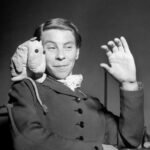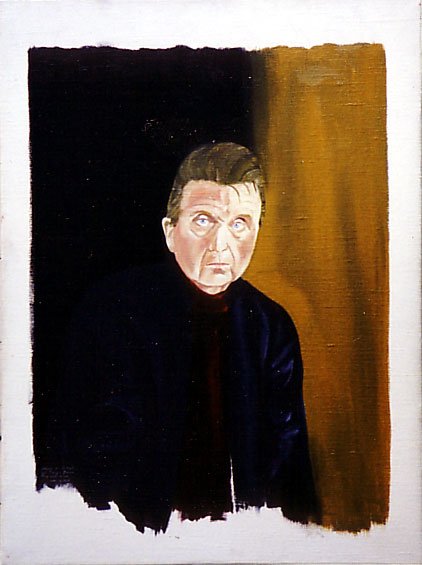
Francis Bacon, 1989, by Reginald Gray (1930– 2013)
Francis Bacon (1909–1992) was one of the most daring painters of the twentieth century. Sometimes confused with Sir Francis Bacon (1561–1626), an English philosopher, statesman, and lawyer known as the father of the scientific method, Bacon’s work, filled with distorted bodies and raw emotion, challenged what beauty, violence, and humanity could look like. But from an LGBTQ+ perspective, Bacon’s legacy is more than artistic genius—it’s a chronicle of queer existence under repression, grief, and desire.
He lived and painted openly as a gay man during decades when homosexuality was illegal in Britain and Ireland. His paintings, with screaming figures, twisted lovers, and mournful triptychs, channel the anxiety and intensity of queer life at a time when even visibility was dangerous. Bacon’s art isn’t explicitly political, yet his body of work stands as one of the most honest visual testaments to what it means to live, love, and suffer outside social norms.
A Life of Displacement and Defiance
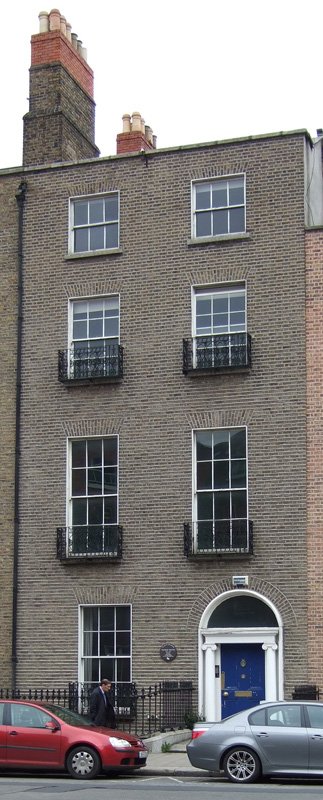
Francis Bacon’s birthplace at 63 Baggot Street in Dublin’s Southside was commemorated with a plaque in 1999 (“the first time Bacon’s Irish origins were given such public acknowledgment” (The Irish Times (Fri 12 Dec 1999)—Plaque marking birthplace of Bacon unveiled)).
Francis Bacon was born in Dublin in 1909 to English parents. His father, an ex–army officer and horse trainer, wanted a soldier for a son, not an asthmatic boy fascinated by fabrics and cosmetics. Bacon’s health and mannerisms clashed with his father’s expectations, and when his father discovered him wearing his mother’s lingerie as a teenager, he was thrown out of the family home (The Irish Times).
That exile defined Bacon’s life. He drifted through Europe in the late 1920s, living briefly in Berlin and Paris—cities with vibrant but precarious gay subcultures. There, he discovered surrealism, photography, and cinema. They taught him that distortion could be truth, and that the body could tell stories words could not.
By the time he settled in London in the 1930s, he was determined to paint in ways that no one else dared.
Queerness as Vision
Bacon’s queerness was not coded or disguised; it permeated his art. While other artists of his generation hid their sexuality, Bacon’s paintings scream it. His figures are often caught between ecstasy and torment—men wrestling on beds, lovers blurring into each other, bodies melting into flesh and void.
He once said, “We are meat, we are potential carcasses.” It wasn’t cynicism; it was candor. His view of life was shaped by desire and loss. Bacon lived through criminalization, through the AIDS crisis, through public scorn. His paintings transformed personal experience into universal emotion.
Where He Lived and Worked
Bacon spent much of his life in London, though he never felt settled. His most famous home was 7 Reece Mews, South Kensington, where he lived and worked from 1961 until his death in 1992 (English Heritage).
The studio was chaos incarnate: piles of photographs, rags, paints, dust, and torn reproductions. Out of that wreckage came some of the twentieth century’s most powerful images. After his death, the entire studio—every scrap, brush, and stain—was moved to the Hugh Lane Gallery in Dublin, where it has been meticulously reconstructed and is open to the public (Hugh Lane Gallery).
Love, Violence, and Loss
Bacon’s relationships were turbulent. His lover Peter Lacy, a violent ex-pilot, died of alcoholism in 1962. Later came George Dyer, a petty criminal turned muse and the love of Bacon’s life. Dyer’s suicide on the eve of Bacon’s major retrospective in Paris in 1971 shattered him.
The grief that followed produced some of his most devastating work: the Black Triptychs—paintings haunted by the presence and absence of Dyer. Bacon returned again and again to the moment of death, transforming private mourning into monumental art.
Key Works
| Painting | Year | What it means, especially in LGBTQ+ / queer terms |
|---|---|---|
| Three Studies for Figures at the Base of a Crucifixion | 1944 | A turning point in postwar art. The twisted, screaming figures evoke anguish and trauma—an emotional landscape familiar to anyone living under oppression or secrecy. Widewalls |
| Study after Velázquez’s Portrait of Pope Innocent X (series) | 1950s | Bacon’s screaming popes attack religious authority and repression. For queer viewers, they echo the suffocating power of moral judgment and internalized shame. Wikipedia |
| Two Figures | 1953 | Shows two men locked in an erotic struggle on a bed. Painted when homosexuality was illegal in Britain, it’s one of the earliest unapologetically queer images in modern art. Wikipedia |
| Three Studies for a Portrait of Muriel Belcher | 1966 | Belcher ran The Colony Room, a queer-friendly Soho club that became Bacon’s second home. These portraits capture the intimacy and defiance of queer friendship. Wikipedia |
| Triptych – August 1972 | 1972 | Part of the Black Triptychs, painted after George Dyer’s suicide. Bacon turns grief into abstraction, his private despair made painfully public. Wikipedia |
| Portrait of George Dyer and Lucian Freud | 1967 | Tense, intimate, and psychologically charged. It reflects Bacon’s personal connections and his recurring theme of emotional entrapment. Wikipedia |
The Queer Body and the Human Condition
Bacon’s art doesn’t beautify the body—it exposes it. The stretched faces, twisted limbs, and raw colors make the body into a battlefield where desire and mortality meet.
In Two Figures, the bodies blur into one another until it’s impossible to tell whether they’re fighting or making love. In the Pope series, spiritual authority collapses into terror. And in the Black Triptychs, love dissolves into death.
For queer viewers, this is not despair—it’s recognition. Bacon paints the costs of living honestly in a world that punishes honesty. He turns pain into evidence of existence.
Influence and Legacy
Bacon’s influence reaches deep into contemporary queer art. His unflinching confrontation with desire and loss inspired later artists like David Hockney, Derek Jarman, and Glenn Ligon. He refused to separate sexuality from art, insisting that both were expressions of the same human truth: the need to connect and to survive.
His legacy also lives in institutions. His reconstructed London studio at the Hugh Lane Gallery in Dublin serves as both museum and monument. His blue plaque at 7 Reece Mews in South Kensington marks the site of creation for masterpieces that once scandalized Britain.
Today, Bacon’s paintings hang in the Tate, the Pompidou, and the Metropolitan Museum of Art, their once-shocking imagery now revered as canonical. Yet they still feel alive, feral, uncontainable—much like the man himself.
Bacon’s Queer Testament
Francis Bacon never apologized for who he was. His art didn’t ask for acceptance; it demanded that the world look at the things it preferred to hide. In doing so, he gave later generations of LGBTQ+ people a language of flesh and emotion—one that said suffering could be art, and art could be survival.
Bacon’s paintings remain charged with the same paradox that defined his life: beauty and brutality, ecstasy and agony, exposure and secrecy. For queer viewers, they are mirrors that still burn.
Explore More
- Official Francis Bacon Estate: francis-bacon.com
- His reconstructed studio: Hugh Lane Gallery, Dublin
- Biography and archives: English Heritage
- Critical essays: Tate Modern on Bacon