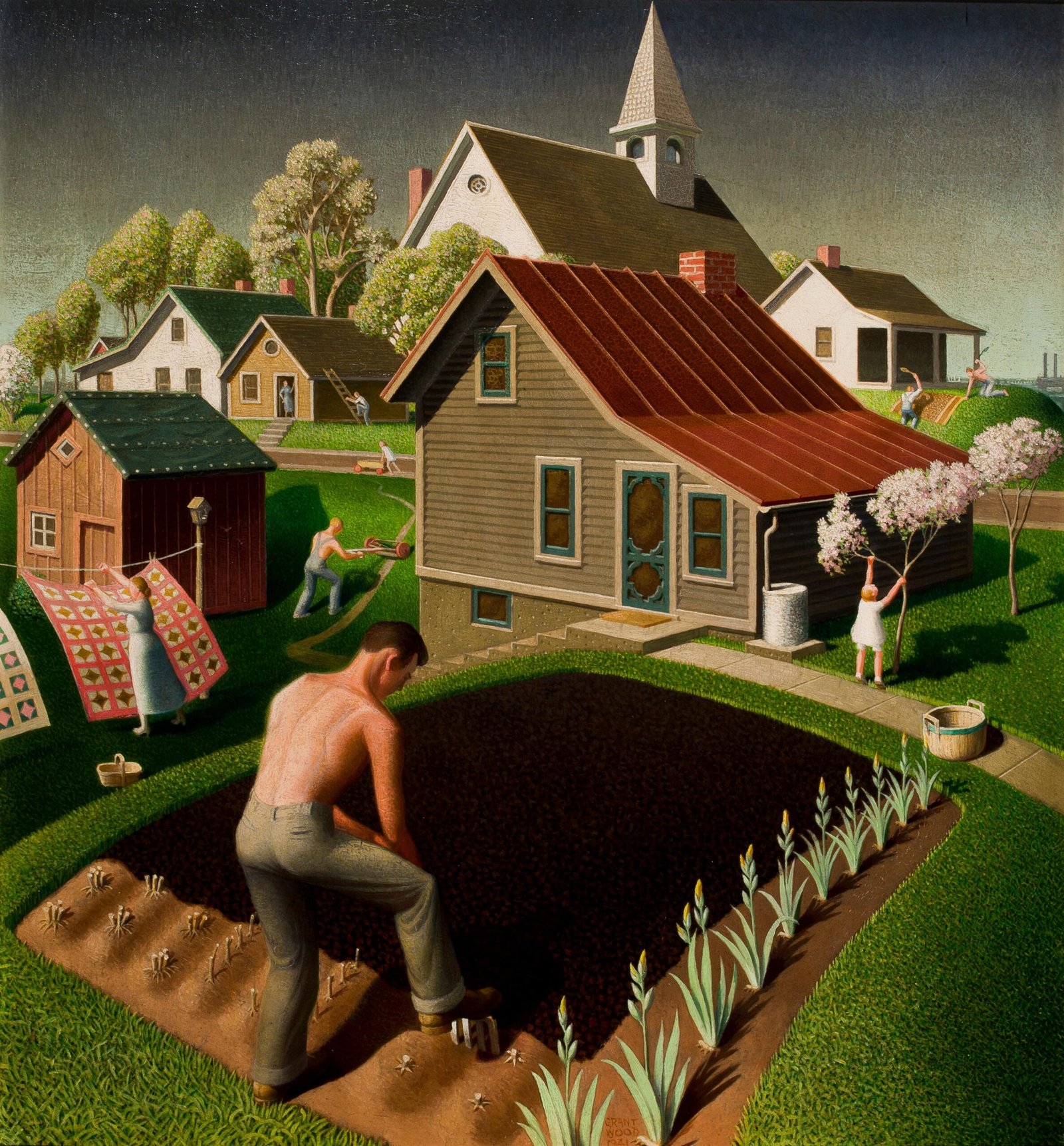
Spring in Town, 1941
Grant Wood was an American painter born February 13, 1891 in Iowa and died February 12, 1942 in Iowa City at age 50. He became a defining voice of American Regionalism, a style grounded in figurative realism and scenes of rural life that pushed back against abstraction and European modernism. He studied in Europe, especially in Paris and Munich, before developing his signature tight, detailed style after 1928. American Gothic (1930) brought him national fame, but his range of works goes far beyond that single icon. (Encyclopedia Britannica)
Wood lived and worked in the Midwest for most of his life. He taught at the University of Iowa and helped found the Stone City Art Colony for young artists. He was known for landscapes, portraits, historical scenes, and occasionally satirical pieces. (Encyclopedia Britannica)
From a LGBTQ+ historical view, scholars place Wood in the context of queer Midwestern life. He is widely described in biographies and archival research as a closeted homosexual who never publicly acknowledged his sexuality in his lifetime. Some of his paintings, particularly Arnold Comes of Age (1930), have been interpreted as containing homoerotic subtext or personal expression that reaches beyond his public image as a regionalist painter. (lgbtqiowa.org)
Why Most People Know Only American Gothic
American Gothic is one of the most reproduced paintings in American art. It depicts a stern farmer with a pitchfork alongside a woman, often interpreted as his daughter or wife. Wood said he aimed to portray types he knew well in the Midwest. Art historians note it can be read in many ways: both as celebration of rural values and as ambiguous commentary on Midwestern life. (Encyclopedia Britannica)
Because it became a cultural shorthand for “Americana,” other works by Wood are often overlooked in popular awareness.
Grant Wood Key Works Chart
| Painting | Year | Core Theme | Notes |
| American Gothic | 1930 | Rural portrait | Most famous icon of American art; complex reading of traditional life. (Encyclopedia Britannica) |
| Woman with Plants | 1929 | Personal portrait | Depicts Wood’s mother; marks his shift to Regionalist style. (Wikipedia) |
| Arnold Comes of Age | 1930 | Coming of age, possible queer reading | Depicts his assistant with background nude figures; interpreted by some as homoerotic and symbolic of queer identity. (Wikipedia) |
| The Midnight Ride of Paul Revere | 1931 | American history | Stylized view of a legend with whimsical elements. (Wikipedia) |
| Fall Plowing | 1931 | Rural landscape | Pays homage to farm technology and Midwest fields. (Wikipedia) |
| Daughters of Revolution | 1932 | Satire | Critiques patriotic societies, sometimes read with gender subtext. (Wikipedia) |
| Sentimental Ballad | 1940 | Group male scene | Men singing together in a bar setting. (Wikipedia) |
| Dinner for Threshers | 1934 (not in chart but noted by critics) | Social ritual | Long group scene at harvesttime (highlighted in retrospectives). (The New Yorker) |
Other works include lithographs and murals tied to New Deal art programs, wide landscapes, and historical scenes that reflect Wood’s varied interests. (artic.edu)
The Sultry Night Controversy and What It Reveals
In 1939, Grant Wood created a lithograph titled Sultry Night for Associated American Artists, a program that sold affordable original prints by American artists. The print shows a nude male farmhand bathing at night, pouring water over himself from a bucket near a trough. Wood said the scene came from his memories of farm life, where workers bathed outside because there were no indoor plumbing facilities.
The United States Postal Service banned the lithograph for mailing on the grounds it was “obscene.” That forced a reduced edition of 100 copies rather than the 250 originally planned, and it limited the print’s distribution mostly to sales in galleries rather than mail‑order catalogs.
Wood also made a large painting version of Sultry Night. When that painting was rejected from a major national exhibition, he reacted strongly. According to multiple accounts, he cut out and burned the section showing the nude figure, leaving only the landscape and trough behind. The cut canvas was later sold and stayed in private hands for decades.
This controversy was significant in Wood’s career because it drew attention to how his work engaged with the male body and masculinity in ways that were unusual for his public persona. The ban and reactions from some of his peers exposed tensions between his image as a modest Midwestern artist and the suggestive content in Sultry Night.
Cultural and Academic Response at the Time
Around the same period, Wood faced professional attacks from a colleague at the University of Iowa, where he taught art. That colleague reportedly tried to have Wood fired, citing “moral grounds” including alleged homosexuality, though the university ultimately did not remove him. Many scholars see this episode as part of the social pressures on Wood because of his private life and reputation.
Wood’s marriage from 1935 to 1939 ended the same year as the Sultry Night controversy. The marriage was widely seen as unsuccessful, and Wood’s personal life remained a private matter, rarely discussed publicly during his lifetime.
Wood died of pancreatic cancer on February 12, 1942, the day before his 51st birthday. At that time his sexuality was almost never a subject in official art histories.
How Modern Scholars View These Episodes
Scholars and LGBTQ+ historians now reflect on Sultry Night and other works like Arnold Comes of Age as images that contain homoerotic themes or intimate male subjects that go beyond simple pastoral scenes. Many see Wood’s creation of Sultry Night and the reaction to it as evidence that he was navigating personal desire and social constraint. Terms like “closeted homosexual” are used in later academic writings to discuss his life, while acknowledging that Wood never publicly identified with any sexual label.
This context enriches our understanding of Wood’s work. American Gothic may be the image most people know, but pieces like Sultry Night show how he explored the human figure, emotional depth, and identity. Modern exhibitions and scholarship have brought these works into conversation with broader American art history and queer histories of the 20th century.
LGBTQ+ Perspectives on Wood’s Life and Work
Wood’s sexuality was private in his lifetime and often suppressed in early art history. Recent scholarship and archives suggest he was a closeted gay man, living in a conservative region where public disclosure was risky. A few aspects pointed to this view:
- Contemporary accounts and later biographical research frame his personal relationships and camp life as part of a queer Midwestern cultural world. (glreview.org)
- Arnold Comes of Age is interpreted in some art history circles as containing subtext about sexual identity through symbolism (e.g., butterfly motifs) and figures in the composition. (thehistoryofart.org)
- Biographies note rumors of his homosexuality and a brief marriage that some historians say was a cover, as well as colleagues’ perceptions in his later university years. (Wikipedia)
These interpretations help humanize his work and show how personal identity can be read into his visual language, while still acknowledging gaps in concrete evidence.
Conclusion
Grant Wood’s reputation rests heavily on American Gothic, but his wider body of work shows a thoughtful, complex artist engaged with rural life, history, and psychology. Reading his art through an LGBTQ+ lens reveals layers of meaning that enrich understanding of his subjects and his own experience in early 20th‑century America. (Encyclopedia Britannica)