Want the drink the painting? https://gayriot.shop/
In Rome’s Flaminio district, just north of Piazza del Popolo, stands Villa Helene — once the home and studio of Norwegian-American sculptor Hendrik Christian Andersen (1872–1940). Today it’s the Museo Hendrik Christian Andersen, a calm, sunlit space filled with marble figures, utopian city plans, and unspoken stories of love between men.
Andersen’s art celebrates beauty, strength, and perfect form. His models are mostly men — idealized, timeless, and bare. The museum describes them as “allegories of human aspiration,” but look closer and you sense something more personal: a coded language of desire and tenderness that queer audiences today can easily recognize.
The Florence Connection: Hendrik Andersen and John Briggs Potter
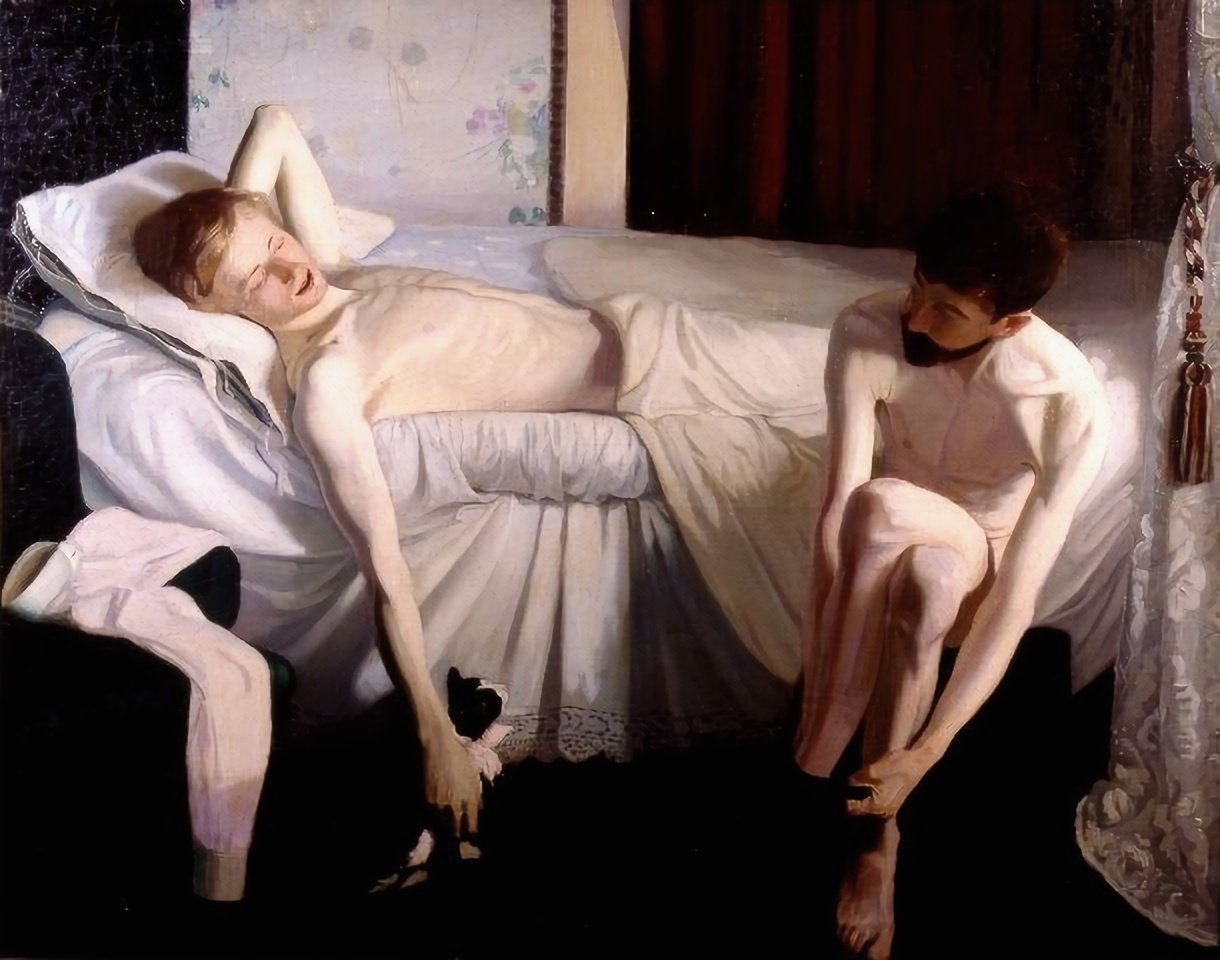
Before Rome, there was Florence. In 1894, Hendrik lived there with John Briggs Potter, an American artist and companion. Their relationship survives visually through the painting Interior with Hendrik Andersen and John Briggs Potter in Florence by Hendrik’s brother, Andreas Andersen.
It shows Hendrik reclining in bed, Potter reading beside him. It’s quiet and intimate, not erotic but deeply domestic — a moment of shared life between two men who clearly loved each other. In an age when homosexuality was criminalized or pathologized, that image stands as an act of quiet defiance.
The painting now circulates in queer art history circles as one of the few visual records of male intimacy from fin-de-siècle Florence. You can view it online through the Norwegian National Museum collection.
Key Works of Hendrik Christian Andersen
| Work | Year | Medium | Notes |
|---|---|---|---|
| Uomo e donna abbracciati (The Kiss) | c. 1910 | Plaster | Depicts a man and woman embracing, but the idealized forms echo same-sex pairs elsewhere in his work — suggesting unity beyond gender. |
| Fountain of Life (Fontana della Vita) | early 1900s | Models and bronze | Central to his utopian “World City” project, symbolizing brotherhood and shared joy. The intertwined figures blur erotic and spiritual connection. |
| World Centre of Communication | 1901–1911 | Drawings and architectural models | A plan for a global city where art and science unite. Many read it as a metaphor for belonging and inclusion beyond social labels. |
| Portrait bust of Henry James | 1907 | Gesso | Marks Andersen’s deep friendship with the writer Henry James. Their letters suggest emotional intimacy and mutual fascination. |
| The Angel of Life (Eternal Life) | 1920s–1930s | Sculpture | An enormous male nude rising heavenward, both sensual and transcendent — one of Andersen’s clearest statements on beauty and ideal love. |
Queer Themes and Readings
You can read Andersen’s art through three intertwined ideas:
- Embodied Idealism – His sculptures are love letters to the human body. Muscular, poised, serene. They suggest beauty as moral virtue and spiritual potential — but they also betray a fascination with male form and sensuality.
- Coded Desire – In letters and friendships with men like Henry James and John Briggs Potter, Andersen operated in the gray zone between friendship and romance. The art becomes a safe surface for feelings that society couldn’t name.
- Utopian Inclusion – His “World City” project, meant to unite humanity through art, now reads as an early dream of global connection. Queer scholars often see it as symbolic of the longing for a world without exclusion or stigma.
Why It Matters Today
The Museo Hendrik Christian Andersen gives us a space to revisit a queer life lived between public ideals and private truths.
Andersen never declared himself gay. He didn’t need to. His marble bodies and architectural fantasies speak for him — of beauty, longing, and a world big enough for love in all its forms.
For LGBTQ+ visitors, the museum offers a moment of quiet recognition: the history of queer art isn’t only about struggle. Sometimes, it’s about how tenderness and vision survived quietly within the world of “high culture.”
Visiting the Museo Hendrik Christian Andersen
- Address: Via Pasquale Stanislao Mancini 20, Rome
- Hours: Tuesday–Sunday, 9:30 AM–7:30 PM
- Admission: Free (part of Italy’s state museum network)
- Info: Museo Hendrik Christian Andersen – official site