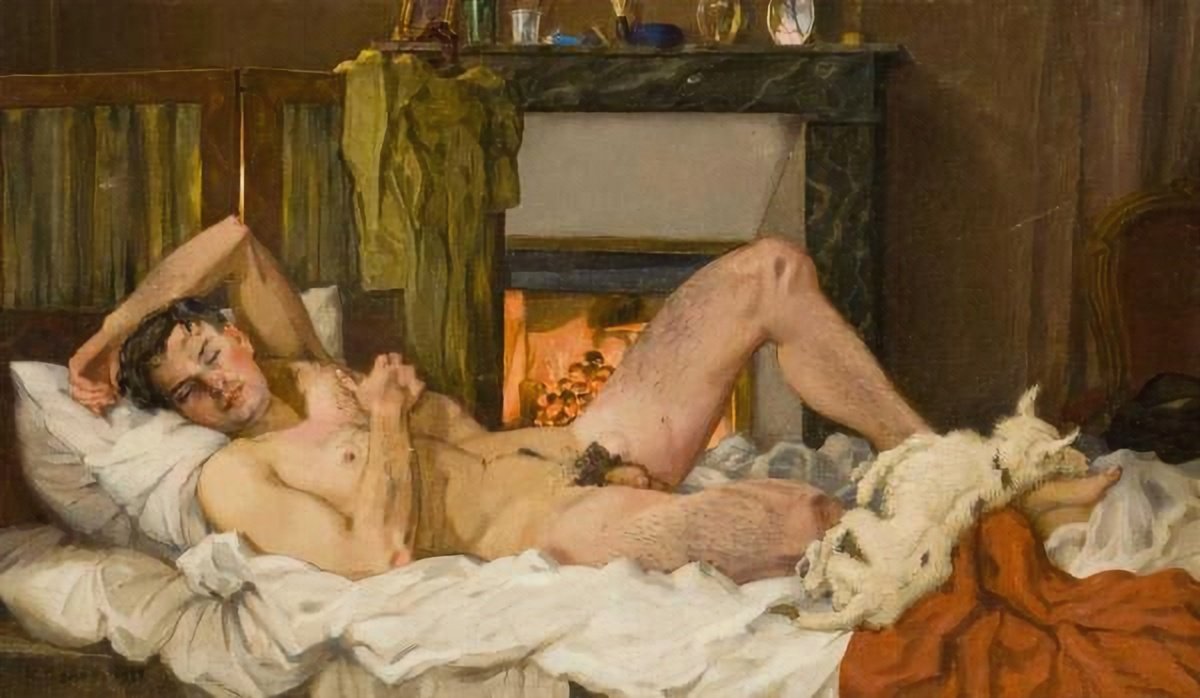
Reclining male nude, 1938
When you scan the history of Russian art, names like Kandinsky, Malevich, and Chagall tend to dominate. Yet among the silken masks and rococo fantasies of the late Imperial and émigré periods sits Konstantin Andreyevich Somov (1869–1939), a figure whose personal life and aesthetic reflect the tensions of sexuality, exile, and repression in the turning century. (Wikipedia)
His work offers more than decorative eroticism: it becomes a site of coded resistance, self-expression, and struggling identity. He was associated with the World of Art movement, a collective that rebelled against academic constraints and embraced sensuality, beauty, and symbolism. For LGBTQ+ history, Somov is important not only for his talent but also for his unapologetic engagement with homoerotic subjects at a time when both Tsarist and Soviet society harshly policed sexuality.
Context: Queer Lives under the Tsar and the Soviets
- In the Russian Empire, same-sex relations were criminalized from 1866 onward: punishments could include confiscation of property, dismissal from positions, even exile. (DailyArt)
- Despite that, in certain elite, bohemian, and artistic circles, same-sex desire circulated via coded language, private salons, and erotic literature. Somov and his peers were part of this subculture. (DailyArt)
- After the Bolshevik Revolution (1917), censorship and shifting mores complicated public expression of homosexuality. In the Soviet period, queer lives were marginalized, erased, or criminalized (especially later under Stalin). Somov’s later years in exile spared him some of the worst Soviet repression, but his legacy would still be sanitized or censored in Soviet art historiography. (GL Review)
Because of that, Somov’s open (or semi-open) queerness is all the more remarkable. Somov belonged to an artistic world shaped by European decadence and Russian symbolism. He admired the works of Aubrey Beardsley and James McNeill Whistler, weaving influences of sensual line and provocative subject matter into his canvases. His art often celebrated male beauty in a way that subtly resisted the rigid masculinity Soviet ideology demanded. His life and works became a quiet form of defiance, even though he often avoided direct political statements.
Somov’s Biography: Desire, Disguise, and Exile
- Somov was socially part of the Mir Iskusstva (“World of Art”) movement. That group embraced aestheticism, internationalism, performer identities, costume, and theatricality. Its members included other queer or queer-adjacent figures (e.g. Diaghilev). (GL Review)
- He is known to have had a longtime male companion, Methodiy (Mefodii) Lukyanov. (Wikipedia)
- In his later years in Paris he had a younger male muse / model, Boris Snejkovsky (Snezhkovsky), who appeared in several paintings and drawings. (Gods and Foolish Grandeur)
- For Le Livre de la Marquise (1907–19), Somov created a cycle of erotic illustrations to French 18th-century texts. Some editions pushed boundaries especially after the 1917 loosening of censorship. (Wikipedia)
- In private correspondence and diaries, Somov sometimes used cipher or foreign languages to obscure erotic references—presumably to evade censorship or prying eyes. (Wikipedia)
Somov’s paintings are often steeped in coded eroticism. Male nudes, languid figures, and flirtatious depictions of intimacy reflect his attraction to men. While explicit representation of homosexuality was impossible under the conservative gaze of his era, Somov’s art spoke in whispers and gestures recognizable to queer audiences then and now. This queerness positioned him precariously in Soviet history. After the Russian Revolution, the brief decriminalization of homosexuality (1917–1933) allowed a temporary flowering of queer culture, but when Stalin reinstated criminal penalties in 1933, Somov’s work and personal life were once again overshadowed by risk and silence.
Reading Queerness in Somov’s Art
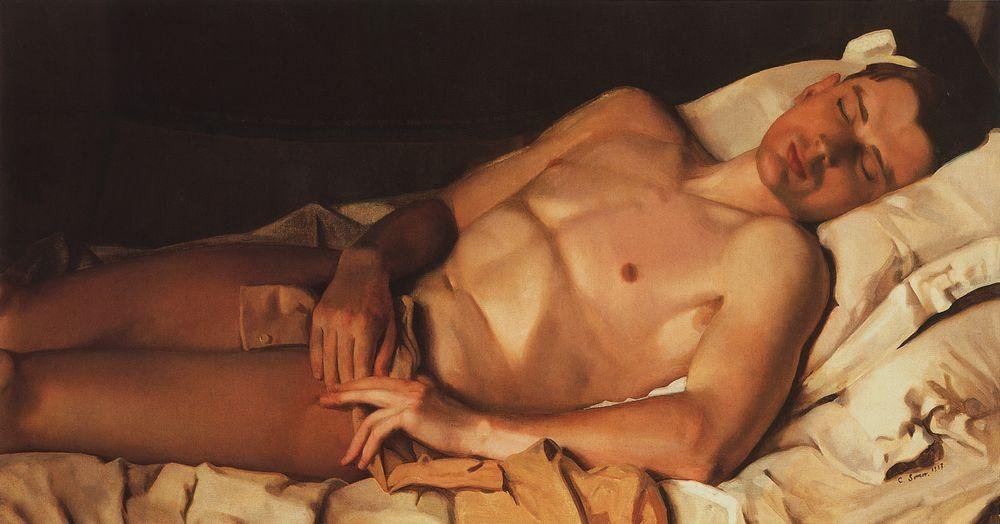
Naked young man, 1937
Somov’s art is rich in visual strategies that speak to queerness.
| Strategy | What it does | Examples / works to see |
|---|---|---|
| Costume, masquerade, and role-play | Masks, elegant costume, harlequin motifs let Somov play with identity and gender fluidity. | “Harlequin and Death” (c. 1907), masquerade scenes in his illustrations. (DailyArt) |
| Ambiguous / androgynous form | Figures whose gender is soft, faces masked or obscured, bodies partially concealed. This ambiguity allows for multiple readings (hetero, homo, queer). | Many “Marquise” scenes and lovers in Le Livre de la Marquise. (GL Review) |
| Male nudes and erotic portraiture | Especially in his late Paris period, Somov painted male nudes and portraits of Snejkovsky. These works carry more literal queer valence. | “The Boxer” (1933). (DailyArt) |
| Erotic print / illustration | In Le Livre de la Marquise, Somov illustrated erotic texts, sometimes quite explicitly, particularly in post-1917 editions. | Illustrated volumes of Le Livre de la Marquise (1907–19). (Wikipedia) |
| Symbolic references (rainbows, masks, classical allusion) | Somov occasionally used rainbow motifs and leaned on rococo/classical allusion to cloak eroticism behind myth and costume. | The Rainbow (1927). (Wikipedia) |
Somov’s use of costume and mask is not mere decoration. It becomes a buffer—a means to present desire without exposing identity, to flirt with queerness in an environment of surveillance and taboo.
Somov & Soviet Censorship: Erasures and Afterlives
- In Soviet times, his homosexuality, erotic works, and exile status made him politically inconvenient. His biography was often censored or sanitized. (Wikipedia)
- Many erotic drawings or works were excluded from official exhibitions or archives. Some that remained were reattributed, cropped, or left unpublished. (GL Review)
- For decades, Somov was largely seen as decorative or minor, not a queer pioneer. Only recently have scholars revisited his work with queerness in focus. In 2019, the Russian Museum in St. Petersburg held a centenary exhibition that reintroduced Somov more fully. (Wikipedia)
- Even today, in Russia, queer readings of Somov are politically risky. The very idea that he lived “openly” as a gay man is contested. (GL Review)
This erasure is not incidental: it mirrors broader Soviet (and post-Soviet) patterns of suppressing queer lives and rewriting the past.
Why Somov Matters for LGBTQ+ History
- He lived a queer life—openly in artistic circles—in a period and place where that was dangerous.
- He encoded sexuality into aesthetic form—costume, mask, metaphor, and rococo disguise.
- He experienced exile—a fate shared by many queer artists fleeing revolution or authoritarianism.
- His erasure reveals cultural violence—how queer history is overwritten, hidden, fragmented.
- His revival shows the work of queer recovery—modern scholars and curators peeling back layers to reclaim queer visibility.
Somov’s story tells us: queer history isn’t only about coming out or rights. It’s about survival, stealth, interpretation, and the politics of memory.
Key Works
- Le Livre de la Marquise (1907–19) — illustrated erotic anthology.
- The Rainbow (1927) — one of his most famous paintings. (Wikipedia)
- The Boxer (1933) — late oil painting of a male figure. (DailyArt)
- Portrait of Alexander Blok (1907). (Wikipedia)
- Additional works, self-portraits, and nudes can be found on WikiArt.
Additional Works
- The Rainbow (1927) — View on Wikipedia
- The Boxer (1933) — View on DailyArt
- Harlequin and Death (c. 1907) — View on DailyArt
- Portrait of Alexander Blok (1907) — View on Wikipedia
- Le Livre de la Marquise Illustrations (1907–19) — View sample illustrations on WikiArt
- Male Nude Studies (Paris period) — Browse on WikiArt