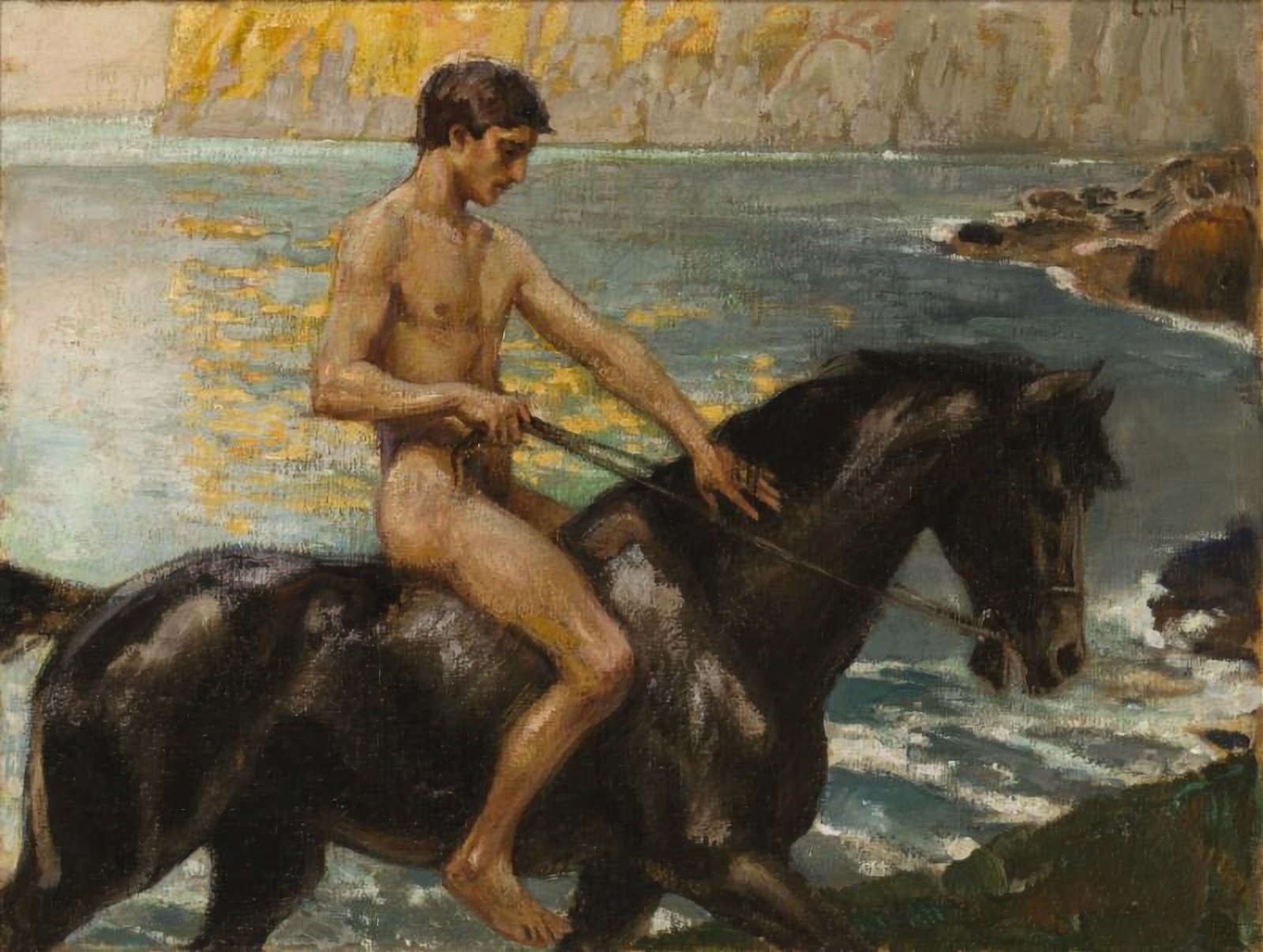
Ludwig von Hofmann: Reiter am Strand, c1890 Öl auf Leinwand. Want the print? https://gayriot.shop/products/ludwig-von-hofmann-reiter-am-strand-1890-wall-art?variant=43644037201971
Ludwig von Hofmann (1861–1945) was a German painter, graphic artist, and designer whose work bridged Symbolism, Art Nouveau, and early Modernism. Known for his lush, dreamlike depictions of nudes in nature, Hofmann created idyllic visions of Arcadia—worlds of leisure, intimacy, and sensuality. While his name is less familiar today, his paintings shaped queer aesthetics in early 20th-century Europe and continue to resonate with LGBTQ+ audiences.
His work is best known for its dreamlike landscapes filled with youthful, often nude figures. But from an LGBTQ+ perspective, Hofmann’s art does more than illustrate allegory or classical themes. His paintings encode queer desire, intimacy, and utopian community at a time when same-sex love was criminalized in Germany under Paragraph 175.
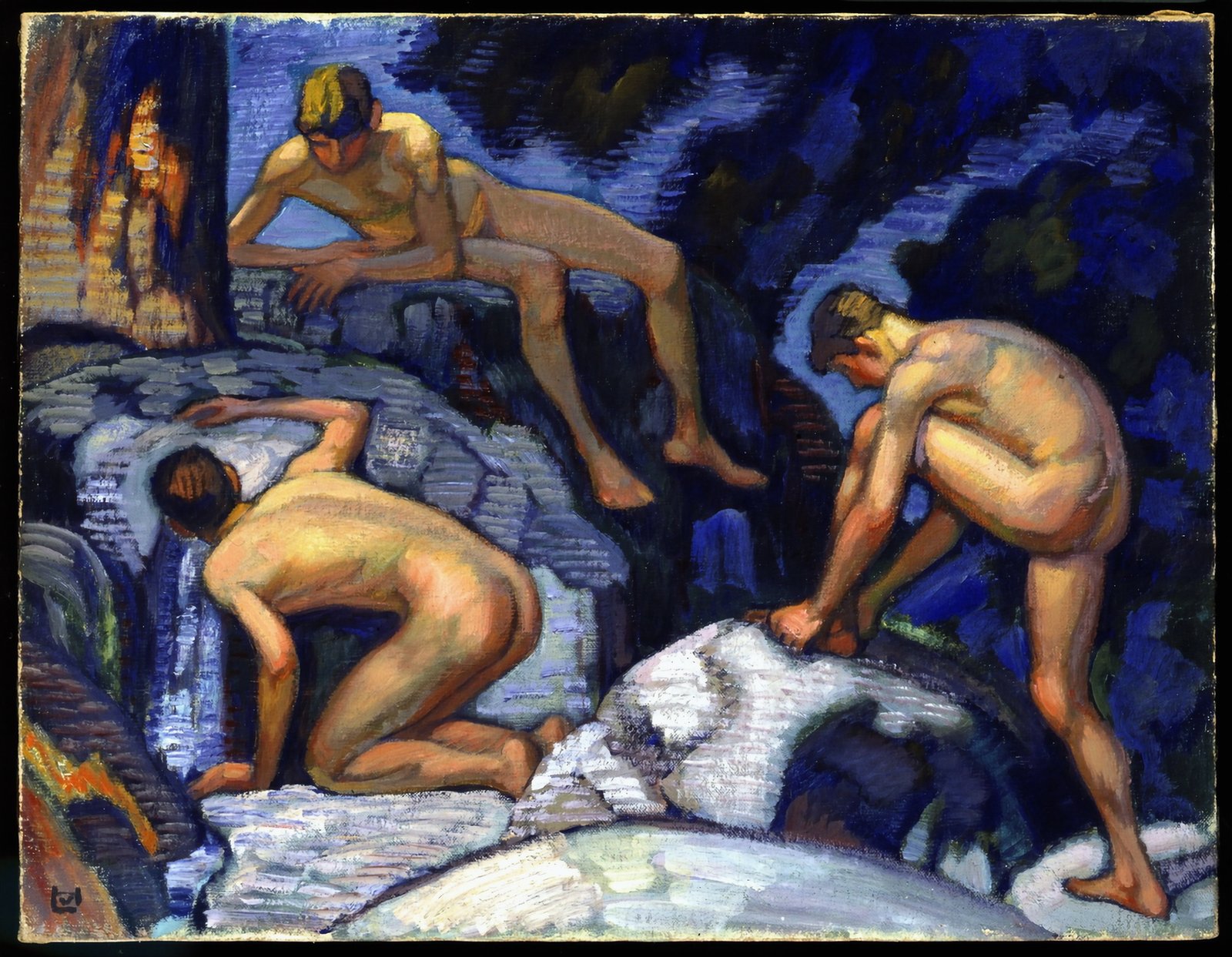
Ludwig von Hofmann: Die Quelle, 1913. Want the print? https://gayriot.shop/products/ludwig-von-hofmann-die-quelle-2?variant=43644019212339
Myth, Desire, and Queer Subtext
Hofmann’s work often drew on classical mythology and pastoral themes. His paintings are filled with languid young men and women, bathing, reclining, or wandering through landscapes untouched by industrial modernity. While cloaked in allegory, the homoerotic undertones are undeniable.
For queer viewers, Hofmann’s canvases offered coded expressions of desire. At a time when homosexuality was criminalized and socially taboo, his depictions of male beauty and physical closeness provided a visual language for same-sex attraction. These “safe” mythological frames allowed Hofmann to explore sensuality and intimacy while avoiding overt scandal.
Male Beauty as Central Theme
Unlike many of his contemporaries, Hofmann placed the nude male figure at the heart of his work. Where academic painters emphasized heroic muscularity or mythological narratives, Hofmann’s depictions carried tenderness and erotic charge. The men in his art are often youthful, languid, and androgynous. They gather in groups, interact with one another, or simply exist in sensuous harmony with nature.
For queer viewers then and now, Hofmann’s work resonates as more than decorative fantasy. It offers a vision of male intimacy that could not be expressed openly.
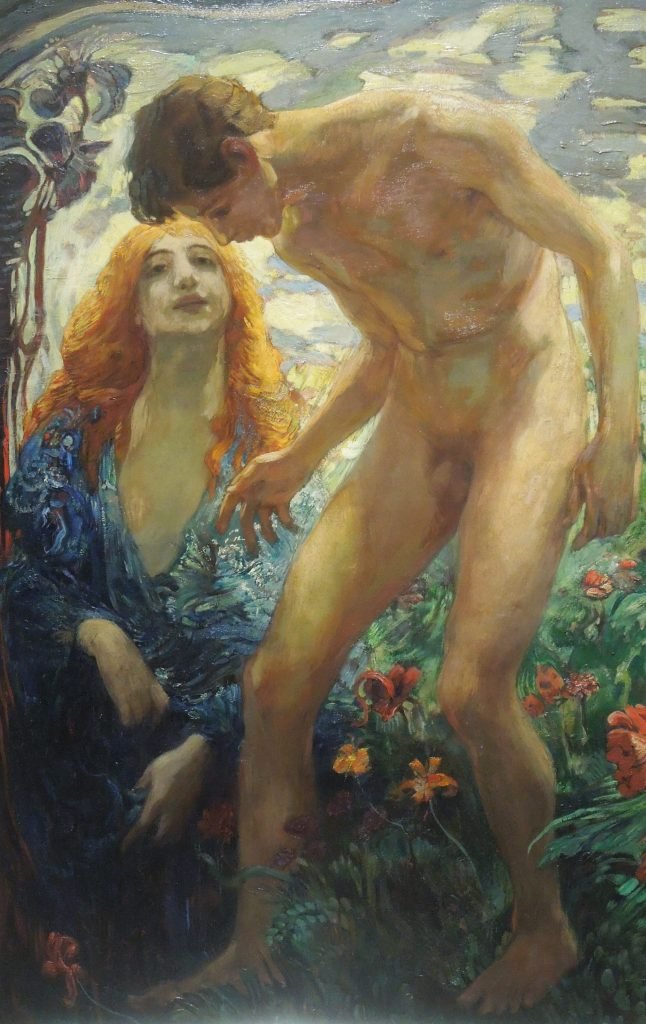
Ludwig von Hofmann – Narcissus, 1890-1900
Key Works Through a Queer Lens
Frühlings Erwachen (Awakening of Spring)
This painting shows groups of young men in a lush natural setting, some intertwined in gestures of intimacy. The male body is idealized, yet not distant—it is approachable, youthful, and alive with desire. For queer audiences of the time, such imagery could be read as a celebration of homoerotic community hidden in plain sight.
Badende Jünglinge (Bathing Youths)
Bathing scenes were central to Hofmann’s practice. In Badende Jünglinge, nude male figures are shown at ease, their physicality central to the painting’s allure. Unlike academic nudes that emphasized classical detachment, Hofmann’s youths exude warmth, camaraderie, and understated eroticism.
Arcadian Landscapes
Hofmann’s repeated return to Arcadian imagery—a mythical pastoral paradise—can also be seen as a queer utopian vision. These spaces, far removed from societal judgment, suggest a longing for freedom, acceptance, and the possibility of lives unburdened by repression.
Frühling (Spring, c. 1900)
In Frühling, Hofmann places a group of nude figures under blossoming trees. Unlike classical allegories of spring, the figures here are not posed as deities or historical actors. Instead, they appear as ordinary young men, enjoying each other’s company in a timeless Arcadian setting. The painting invites the viewer into a world where male companionship is both natural and celebrated.
The homoerotic charge comes not from overt sexuality, but from the gentle physicality of the figures—their proximity, the softness of their gestures, and the absence of any heterosexual framing.
Der Frühlingstag (Spring Day, c. 1896)
This painting shows men and women gathered in a meadow, yet the male figures draw the eye. They lean toward one another, touch shoulders, or recline in positions that suggest intimacy. Hofmann often used mixed-gender settings, but the men’s interactions carry a distinct tenderness, suggesting that male bonding was central to his vision of beauty.
Seen through a queer lens, Der Frühlingstag can be read as an attempt to normalize same-sex closeness within the broader aesthetics of nature and renewal.
Idyll (c. 1908)
One of Hofmann’s most striking works, Idyll presents nude men resting together near a body of water. Their bodies overlap and intertwine, not in a way that suggests mythological struggle or competition, but in quiet companionship. The pastoral setting heightens the sense of a protected queer space, where men are free to exist beyond the moral codes of urban society.
In queer art history, works like Idyll stand out as visual utopias. They offer a world where beauty and desire between men can unfold without repression.
Hofmann and the Queer Avant-Garde
Hofmann was part of the artistic currents that influenced the Jugendstil (German Art Nouveau) and early modernist movements. His work intersected with circles of writers and artists who explored sexuality, gender, and identity in ways that often challenged conservative norms.
Though rarely named explicitly as a queer artist, his subjects and visual strategies place him firmly within the lineage of LGBTQ+ cultural history. Like contemporaries such as Thomas Mann in literature or Magnus Hirschfeld in activism, Hofmann’s art opened space for coded expressions of queer life in Germany before World War II.
Queer Utopias in Nature
Hofmann’s repeated use of Arcadian landscapes reflects a strategy used by many queer artists of his era. Nature becomes a metaphor for liberation, a place outside surveillance where different kinds of relationships can thrive. His vision resonates with the “life reform” movements of early 20th-century Germany, which encouraged nudism, outdoor living, and bodily freedom. For Hofmann, this embrace of natural beauty also created a coded visual language for queer desire.
Place in Jugendstil and Queer Modernism
As part of Jugendstil, Hofmann contributed to a broader artistic culture that emphasized sensuality, flowing lines, and organic forms. Yet his work pushed further into queer territory than many of his peers. Artists like Franz von Stuck or Arnold Böcklin hinted at homoeroticism through mythological scenes, but Hofmann brought the male body forward with intimacy and tenderness.
In this sense, Hofmann anticipates later queer artists who embedded desire and community into their art, even under censorship.
Legacy
Ludwig von Hofmann’s paintings are now seen as more than decorative idylls. They are part of a longer tradition of queer-coded art that used mythology, allegory, and beauty as vehicles for desire and self-expression. For today’s LGBTQ+ audiences, his work offers both a window into queer history and an affirmation of continuity—a reminder that queer longing has always found ways to surface, even in restrictive times.
For LGBTQ+ history, Ludwig von Hofmann’s work is more than an aesthetic curiosity. His paintings represent a coded queer archive, where visions of companionship, longing, and utopia could survive despite repression. They show how queerness shaped European modernism not through declarations, but through subtle and persistent imagery.
In his depictions of youthful men at ease with each other and their surroundings, Hofmann created spaces of queer possibility—images that continue to speak to modern viewers about desire, intimacy, and the search for freedom.
Sources and Further Viewing
- Ludwig von Hofmann – Wikimedia Commons collection
- Ludwig von Hofmann works – Art Institute of Chicago
- Ludwig von Hofmann digital collection – Europeana