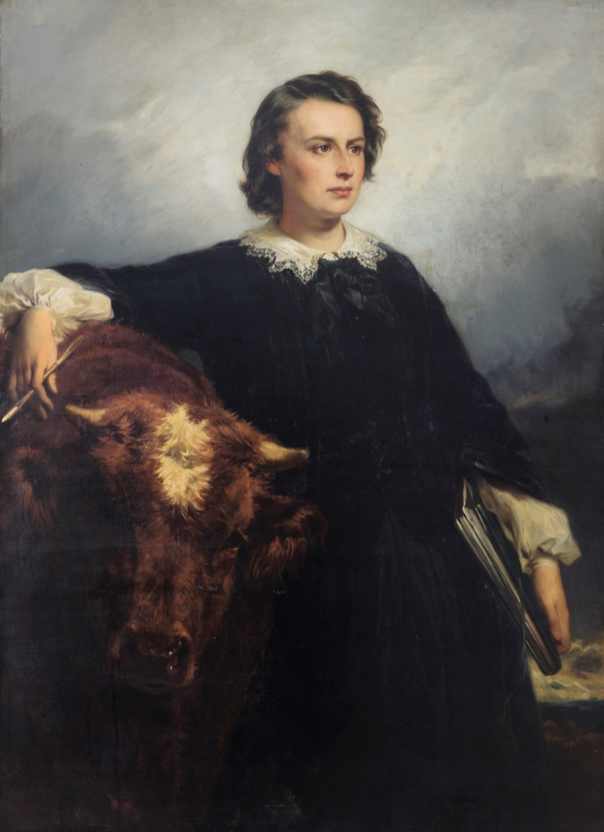
Edouard-Louis Dubufe, PORTRAIT OF ROSA BONHEUR WITH A BULL, 1857
Rosa Bonheur (1822–1899) matters to art history. She also matters as an early figure in LGBTQ+ history. She was a French realist painter and sculptor known for her detailed, vibrant animal paintings. She achieved fame in her lifetime, won major awards, and shaped what it meant for a woman to succeed in a field dominated by men. Her life and work offer a clear lens for understanding how gender norms and same-sex relationships intersected with artistic achievement in the 19th century. (britannica.com)
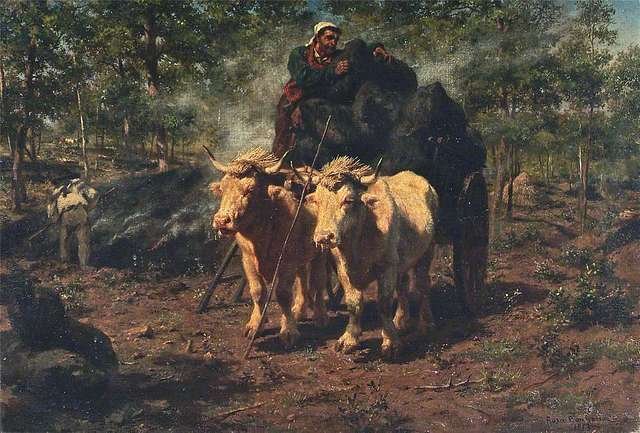
The Charcoal Burners; Aberdeen Art Gallery & Museums, 1899
Bonheur earned a rare level of professional authority for a woman in her era. She exhibited at the Paris Salon from the 1840s onward and won high honors from the French state, including the Grand Cross of the Legion of Honour. Her painting The Horse Fair made her internationally known, and works like Ploughing in the Nivernais and Haymaking in the Auvergne are standard entries in surveys of 19th-century realist painting. (National Museum of Women in the Arts)
From a modern LGBTQ+ perspective her life breaks the mold. She lived in long-term relationships with women. She lived openly with Nathalie Micas for over forty years, then with American painter Anna Klumpke. For decades she and her partners lived together at her estate. Some biographies describe Bonheur as a lesbian who referred to Micas as a “sister” and Klumpke as a life partner. (women.greenparty.org.uk)
Bonheur also challenged gender norms in public life. In mid-19th century France women wearing trousers in public was unlawful without a permit. She obtained a permis de travestissement to wear pants so she could work closely with animals at markets, fairs, and slaughterhouses. She cut her hair short, smoked in public, and moved in social and professional spaces often closed to women. (National Museum of Women in the Arts)
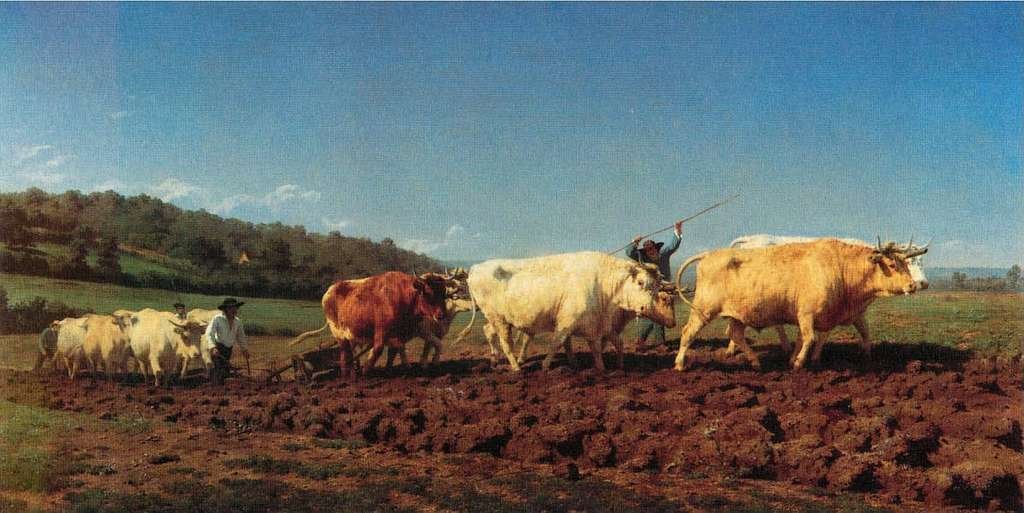
Laboruage nivernais, 1849
None of her major works depict explicit queer themes. Her lesbian life and her artistic focus on animals don’t intersect in obvious iconography. However, her personal choices represented a lived defiance of rigid gender expectations. From a queer historical view, Bonheur’s life expands how we see women’s autonomy in the 19th century, and how same-sex relationships and gender expression shaped public presence long before modern LGBTQ+ identities were named. (liverpoolmuseums.org.uk)
Here is a concise reference table of her major works, their dates, and where they are held.
| Title | Year | Location | Link for reference |
|---|---|---|---|
| Ploughing in the Nivernais | 1849 | Musée d’Orsay, Paris | https://en.wikipedia.org/wiki/Ploughing_in_the_Nivernais (Wikipedia) |
| The Horse Fair | 1852-1855 | Metropolitan Museum of Art, New York | https://fr.wikipedia.org/wiki/Le_March%C3%A9_aux_chevaux (Wikipedia) |
| Haymaking in the Auvergne | 1855 | Château de Fontainebleau | https://en.wikipedia.org/wiki/Haymaking_in_the_Auvergne (Wikipedia) |
| Weaning the Calves | 1879 | Metropolitan Museum of Art, New York | https://en.wikipedia.org/wiki/Weaning_the_Calves (Wikipedia) |
| King of the Forest | 1878 | Private collection | https://en.wikipedia.org/wiki/King_of_the_Forest (Wikipedia) |
| Pyrenean Shepherd Offering Salt to his Sheep | 1864 | Musée Condé, Chantilly | https://en.wikipedia.org/wiki/Pyrenean_Shepherd_Offering_Salt_to_his_Sheep (Wikipedia) |
Bonheur’s artistic skill has been recognized by major museums. Her choice of subjects, her professional success, and her personal life all challenge simple narratives about 19th-century womanhood and sexuality. From a queer viewpoint she matters as a figure who lived outside expected norms and whose work remains central in art history. (National Museum of Women in the Arts)