
Paul Cadmus built his career on accuracy. He worked in egg tempera, a medium that forces the artist to slow down and commit to detail. That discipline suited his interest in the human body. It also gave weight to subjects that mainstream institutions preferred to avoid. He placed queer desire, coded behavior, and public tension at the center of American art during a period ruled by censorship and restraint.
Cadmus trained at the Art Students League and mastered academic drawing early. Instead of using that skill for polite subjects, he turned it toward the lives of sailors, laborers, bohemians, and friends in queer social circles. He understood how bodies carried meaning. You see it in the tension of a jawline, the curve of a shoulder, or the glance between two men in uniform. These choices were deliberate. They made desire visible without compromise.
His early years in New York shaped this focus. He lived in Greenwich Village during the 1930s, when the neighborhood held a mix of artists, drag performers, political radicals, and queer communities. Many of these networks survived through quiet signals and shared spaces. Cadmus recorded them with unusual clarity. His work now serves as evidence of a social world that rarely reached archives or official histories.
Source: Smithsonian American Art Museum, https://americanart.si.edu
Source: Hyperallergic coverage of Cadmus and PaJaMa, https://hyperallergic.com
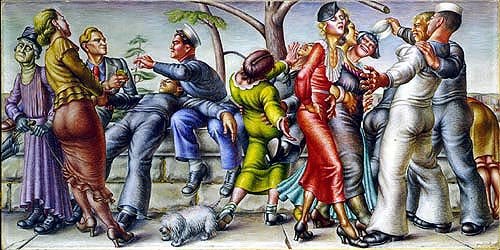
His decisive moment came in 1934 with The Fleet’s In!. The painting showed sailors drinking, flirting, and drifting toward intimacy. The U.S. Navy reacted at once and pulled the work from a federal exhibition. Officers claimed it insulted military honor. The removal created national coverage. Cadmus became known as an artist who told the truth about public life even when institutions tried to prevent it.
Source: MoMA, artist page, https://moma.org
Source: The Met Museum, Cadmus holdings, https://metmuseum.org
He did not retreat after the controversy. He painted more sailors, more nightlife, and more street scenes. He continued to show how desire shaped everyday interactions. His work stands out because it treats queer life as ordinary. He did not sensationalize it. He observed it, recorded it, and gave it technical rigor.
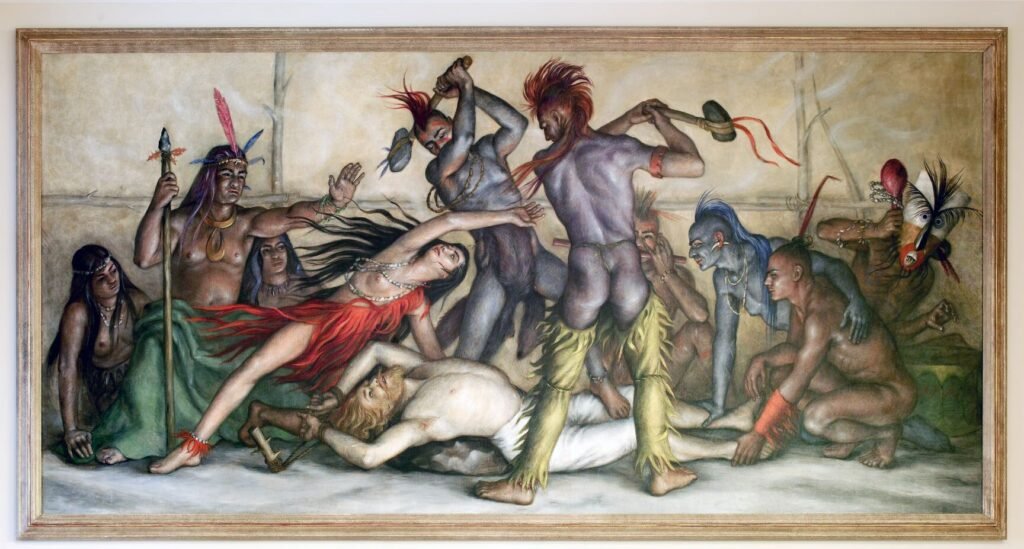
Pocahantas Saving the Life of Captain John Smith, 1939
His collaboration with Jared and Margaret French added another layer. The PaJaMa photographs were small staged images taken on beaches, in apartments, and in quiet outdoor settings. The group played with identity, composition, and intimacy. These photographs are now key sources for scholars studying mid century queer social life. They show friendship and desire carried with ease even when public culture refused to acknowledge it.
Source: Aperture, PaJaMa archive, https://aperture.org
Below is a chart of Cadmus’s central works and their significance.
| Title | Date | Location / Collection | Importance |
|---|---|---|---|
| The Fleet’s In! | 1934 | Navy Art Collection, prints at MoMA and The Met | Made queer desire visible in uniformed life, triggered national censorship, reshaped debate on sexuality in public art. |
| Sailors and Floosies | 1938 | Whitney Museum | Extended his study of coded interactions, mapped public behavior along the Hudson River, reinforced his role as a social observer. |
| Seeing the New Year In | 1939 | Exhibited at Whitney Annual | Captured Greenwich Village nightlife, revealed how queer networks shaped party culture. |
| The Seven Deadly Sins, Lust | 1945 | The Met | Used classical technique to center male eroticism and treat desire with seriousness and skill. |
| Greenwich Village Cafeteria | 1934 | MoMA | Documented social mixing in public cafés, highlighted how queer communities used shared spaces. |
| Pocahontas Saving the Life of John Smith | 1938 | Richmond post office mural | Used models from queer circles, raised concerns among oversight bodies, revealed how public commissions controlled representation. |
| Male Nude Drawings | 1930s to 1980s | Morgan Library, DC Moore, private collections | Formed the core of his practice, set standards for anatomical accuracy, influenced later queer artists. |
| PaJaMa Photographs | 1937 to 1950 | Museum archives including MoMA | Preserved moments of intimacy and friendship during a period of legal and cultural pressure. |
Cadmus offers a record of a world that existed in plain sight but went unrecognized by major institutions for decades. His work is valuable not only for its craft but for its insistence on visibility. He treated queer life as part of the social fabric of the United States. That choice carries weight today because it anchors queer history in documented evidence rather than memory alone.
If you want the piece prepared for publication with title heads or formatted HTML, I can produce that.


