Sometime around 1923, Romaine Brooks painted herself. She placed the canvas in the tradition of formal portraiture, the kind that announces a person of consequence. But the figure staring back from it — top hat, riding coat, grey-washed Paris ruins behind her — announced something that formal portraiture didn’t usually accommodate. Here was a woman dressed as no woman was supposed to dress, in clothing that belonged to men, gazing at the viewer with an expression that one art historian described as either frightened or condemning, or possibly both at once. The self-portrait wasn’t hidden. It was exhibited. It was reproduced. It was intended to be seen.
This is worth sitting with for a moment. In 1923, in Paris, a lesbian woman painted herself in men’s clothes and called it a self-portrait. Not an allegory, not a costume piece, not a mythological conceit. A self-portrait. Androgyny. This is who I am. And then she showed it to the world.
A Gothic Childhood and an Inherited Fortune

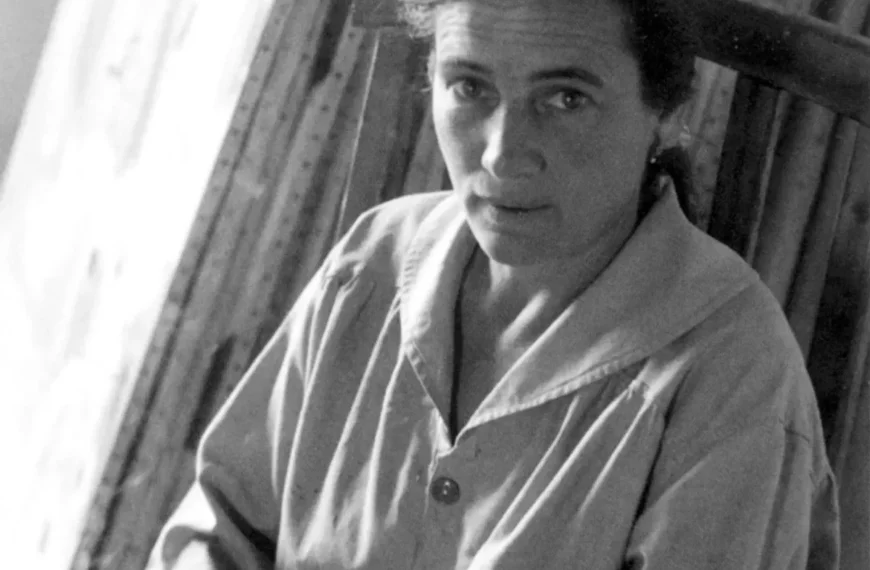
Beatrice Romaine Goddard was born in Rome in 1874 to wealthy American parents who were, by most accounts, spectacularly unsuited to parenthood. Her father left before she had any real memory of him. Her mother, Ella Waterman Goddard, became emotionally abusive and organised her emotional life around her son St. Mar, who was profoundly mentally ill. Brooks had “a Gothic childhood replete with a mad cousin in the attic, an abusive and cruel mother, a conservative and cold sister and an insane brother,” as her biographer Cassandra Langer describes it. She was beaten and humiliated. Living in a mansion, she often had to fend for herself.
Her unpublished memoir, No Pleasant Memories, gives the childhood its due title. She described her mother as “hostile to the slightest show of intelligence, and even more so to any display of personal talent.” The desire to draw, she said, was stronger than her fear of punishment — and punishment came regularly.
Her mother died in 1902. Brooks, by then in her late twenties, inherited a fortune that, in today’s values, runs to something north of $300 million. This inheritance gave her a latitude that other women artists could only dream of — the freedom to refuse commissions she didn’t want, to paint subjects that no patron would have commissioned, to live exactly as she chose in a city that was, if you had enough money, more forgiving than most. It also meant she didn’t need to convert her politics into activism. Her money did what advocacy might otherwise have done: it bought her freedom. That’s an important distinction for how we understand her, and it’s a complicated one.
There was a brief, disastrous marriage to John Ellingham Brooks in 1903. He was gay. She was gay. The arrangement appears to have been one of mutual convenience rather than attraction, and it collapsed quickly. She took his name and kept it, then spent the rest of her life in Paris, working.
Paris, the Salon, and the Queer Network
Brooks gave her first solo show to rave reviews in 1910 at the prestigious Durand-Ruel gallery in Paris. One of the works, Azalées Blanches (White Azaleas) — a nude reclining on a couch — drew comparisons to Goya’s Naked Maja and Manet’s Olympia from contemporary critics. The comparison was a compliment and also a slight: it positioned her work in relation to men who had already established the right to paint female nudes. What nobody quite said out loud was that a woman painting a nude woman was different, and that Brooks knew exactly what she was doing.
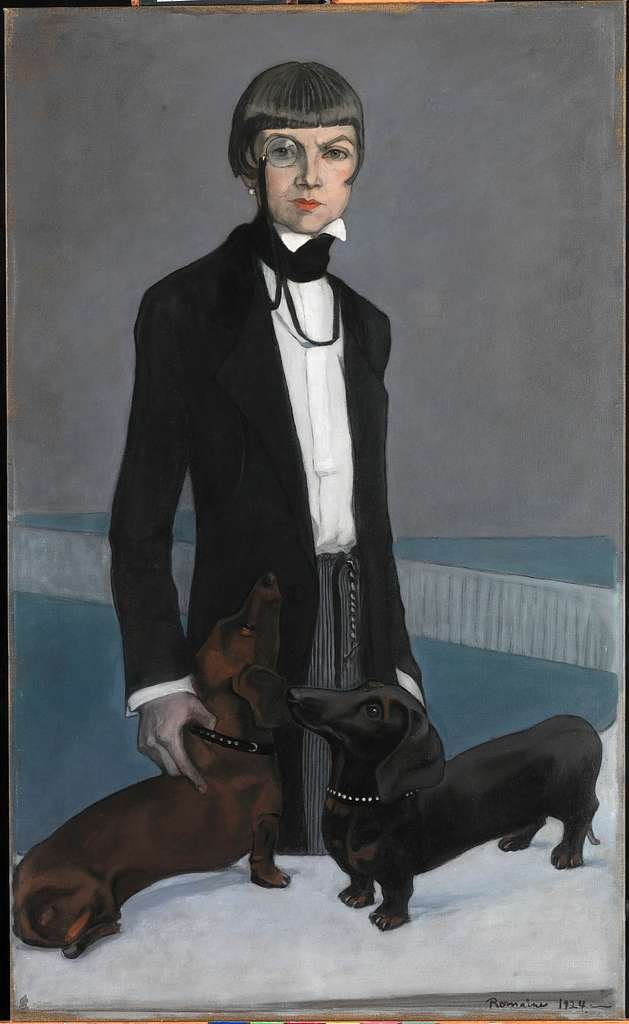
Una, Lady Troubridge, 1924
The Paris she moved in was a particular kind of world. After the First World War, it became the gathering point for a queer cultural elite whose significance to 20th-century art and literature is impossible to overstate and frequently understated. Gertrude Stein and Alice Toklas on the Right Bank. Djuna Barnes, Willa Cather, Natalie Barney. For over 60 years, Barney held a salon at her home on 20 Rue Jacob on the Left Bank that brought together radical writers and artists from around the world. James Joyce came. Ezra Pound. Colette. Anatole France. This was not a marginal gathering. It was, for a significant stretch of the early 20th century, the most important literary and artistic salon in Europe.
Brooks was part of this world not just as a social presence but as its visual chronicler. She painted the people she loved and the people she found interesting, which were often the same people, and she painted them in a way that made no apologies for what they were. She brought a visibility to lesbian identity through her renderings of androgynous, often cross-dressed, usually powerful and self-possessed women. The portraits weren’t celebrations in any simple sense — they were too sharp and too clear-eyed for that. But they were records. The community existed. Brooks made it permanent.
Ida Rubinstein: Love and Its Likenesses
The relationship that produced some of Brooks’s most important work began in 1911 at a performance of The Martyrdom of St. Sebastian, when she encountered Ida Rubinstein, the Russian dancer and actress who had been excommunicated by the Parisian archbishop for her role in the production and who had, earlier in her career, been institutionalized by her own family after a performance of Salome’s dance. Rubinstein was the “Lady Gaga of her day” — extravagant, magnetic, controversial, and utterly committed to spectacle.
Brooks painted her again and again. Le Trajet (The Crossing), 1911, shows Rubinstein as a nude figure floating in a dark void, ambiguous between sleep and death. It’s a painting that asks, quietly but insistently, whether a woman’s interior life can ever be fully seen — the tension between the body made completely visible and the identity it contains, which will never be fully recovered or revealed. La France Croisée (The Cross of France), made in 1914, transforms her into the personification of France at war, standing against burning Ypres in a nurse’s cape. Brooks drove an ambulance during the war. Rubinstein served at the front. The painting is political and personal at once, a monument to a woman Brooks was in love with, rendered as a public icon. Reproductions of it exhibited at the Bernheim Gallery in Paris in 1915 raised money for the Red Cross, and Brooks was awarded the Cross of the Legion of Honour by the French government in 1920 — the red spot on her lapel in the famous 1923 self-portrait.
The relationship with Rubinstein lasted about three years and ended badly. Rubinstein, according to art historians, had wanted something more settled — a farm somewhere, a life together. Brooks wasn’t interested. She may already have been falling in love with someone else.
Natalie Barney: Fifty Years
In 1915, Brooks and Natalie Clifford Barney became lovers. They would remain in each other’s lives for fifty years, which is either a great love story or a complicated arrangement depending on which letters you read, and probably both.
Barney was a writer, a playwright, a poet, and the most famous lesbian in Paris — having published her first love poetry collection to women under her own name at a time when that was genuinely audacious. She was also, constitutionally, opposed to monogamy. She had many overlapping long and short-term relationships, including romances with poet Renée Vivien, dancer Armen Ohanian, and aristocrat Élisabeth de Gramont. For a stretch, Brooks, Barney, and the Duchess de Gramont existed in a kind of romantic trio, living together until de Gramont’s death in 1954.
Despite their deep bond, the two women maintained near total independence, living in a home with separate wings and both having relationships, some serious, with other women. Brooks maintained, with some consistency, that she was only fully herself when alone. This is not the usual thing someone says about the person they spent fifty years with, and it deserves to be taken seriously rather than dismissed as affectation. She was someone who had been badly hurt by intimacy from the very beginning of her life. The idea that she managed a deep partnership while also insisting on radical solitude doesn’t seem contradictory — it seems like someone who learned, very young, to protect herself.
Brooks’s 1930 portrait of Barney, Natalie Barney (La Baronne Emile D’Erlanger), is noticeably warmer than much of her other work. Softer. Less formal. It suggests the comfort and love she found in Barney’s company in a way that the portraits of other women don’t quite manage. For someone as guarded as Brooks, that’s significant.
The Portraits as Queer Archive
What makes the 1920s portraits genuinely remarkable, and genuinely important to LGBTQ art history, is that they constitute something like an archive of a community. She painted Russian dancer Ida Rubinstein, pianist Hannah “Peter” Gluckstein, and her romantic partner of more than 50 years, writer Natalie Barney, among many others. But the most discussed, perhaps, is Una, Lady Troubridge, painted in 1924.
Una Troubridge was the partner of Radclyffe Hall, author of The Well of Loneliness — the 1928 novel that became the central text of lesbian identity in the 20th century, immediately prosecuted for obscenity in Britain and banned in the US. Troubridge appears in the portrait in a tailored man’s morning suit, monocle in place, two dachshunds at her feet, her gaze directed at the viewer with a quality of absolute authority. Brooks described it in a letter as “a sign of the age which may amuse future feminists.” She seems to have intended it as a caricature, at least in part — the portrait so upset Troubridge that she refused to acknowledge it was her — but what the painting actually does, whatever its internal intention, is make a butch lesbian look exactly as powerful as any aristocrat in the history of portrait painting. The form of the portrait — its scale, its confidence, its classical references to control and status — is doing work the subject probably didn’t want it to do and that history absolutely needed it to do.

Peter (A Young English Girl), 1923-24
Peter (A Young English Girl), from 1923-24, shows Hannah Gluckstein, the painter known simply as Gluck, in androgynous dress, rendered with the same spare grey palette Brooks used for everything. Gluck is depicted as exactly what she was: a young person whose gender presentation challenged every expectation their world had of them. Brooks saw them clearly. She painted what she saw.
For the Smithsonian’s curator Joe Lucchesi, what you’re seeing across this body of work is “an LGBT subculture in the active process of trying to define itself.” That’s exactly right. These aren’t incidental portraits of women who happened to be queer. They’re a conscious record. The community knew it was making history, even when the rest of the world wasn’t watching.
The War Years and the Complicated Legacy
Here is where things become genuinely difficult, and where honest accounts of Brooks’s life have to resist the temptation of either hagiography or simple condemnation.
Brooks spent the Second World War in Italy with Barney. She had a long and deep relationship with the poet and fascist theorist Gabriele D’Annunzio, one of the few men she is known to have been romantically involved with, and D’Annunzio’s association with the development of Fascism in Italy, alongside Brooks’s later expressions of sympathy for Mussolini’s Italy, tainted her reputation badly. She was, like many upper-class Americans of her class and generation, a bigot when it came to Jews — a phrase that names the reality while also contextualizing it in a way that neither dismisses it nor makes it the whole story.
What makes this genuinely complicated rather than simply damning is that Barney, Brooks’s partner of fifty years, was partly Jewish. Rubinstein, the great love of her earlier life, was Jewish. Living with Barney in Fascist Italy was a “daunting challenge” that required constant navigation to avoid having Barney arrested. Brooks protected her. That doesn’t cancel the antisemitism. It does make it harder to reduce Brooks to a single thing.
Biographer Cassandra Langer takes issue with the simple “fascist” label, arguing for a more contextualised reading of a personality shaped by upper-class conservatism, genuine trauma, and the particular political confusions of her class and era. This seems right as a historical method. It doesn’t require us to excuse anything, but it does require us to understand.
After the war, Brooks produced very little new work. The last decades of her life — she died in Nice in 1970, at 96 — were largely artistically quiet. The work had been made. The community it documented had dispersed and, in many cases, died. Natalie Barney outlived her by two years.
The Smithsonian and the Question of Recovery
Brooks donated the majority of her known work to the Smithsonian American Art Museum shortly before her death, which is why roughly half of her surviving output is now in a single institution. The 1986 exhibition at the Smithsonian treated her sexuality, by the curator’s own later admission, in fairly “coded” terms. Natalie Barney barely appeared in the catalogue, despite fifty years of partnership. By 2016, the museum had mounted its most frank exhibition yet. The Self-Portrait is back on the wall. The community it belonged to is named plainly.
Her reputation has gone up and down in the way that her biographer accurately compares to a stock market. She was famous in the first three decades of the century, obscured by the war years and by the dominance of abstraction in the decades that followed, and is now in the middle of a sustained recovery — partly by feminist art history, partly by queer art history, and partly by the simple fact that her paintings are extraordinary.
The grey palette that initially drew critics to Whistler comparisons is, on longer acquaintance, completely her own. There is something in Brooks’s greys that has no equivalent in other painting — a quality of light that is neither cold nor warm but watchful, as if the paintings are paying close attention to something they haven’t fully decided whether to trust. For someone who spent ninety-six years deciding the same thing about the world, it seems right.
Major Works
| Title | Date | Medium | Current Location |
|---|---|---|---|
| Self-Portrait | 1923 | Oil on canvas | Smithsonian American Art Museum, Washington DC |
| Una, Lady Troubridge | 1924 | Oil on canvas | Smithsonian American Art Museum, Washington DC |
| La France Croisée (The Cross of France) | 1914 | Oil on canvas | Smithsonian American Art Museum, Washington DC |
| Le Trajet (The Crossing) | 1911 | Oil on canvas | Smithsonian American Art Museum, Washington DC |
| Ida Rubinstein | 1917 | Oil on canvas | Smithsonian American Art Museum, Washington DC |
| Peter (A Young English Girl) | 1923–24 | Oil on canvas | Smithsonian American Art Museum, Washington DC |
| Azalées Blanches (White Azaleas) | 1910 | Oil on canvas | Smithsonian American Art Museum, Washington DC |
| Natalie Barney (La Baronne Emile D’Erlanger) | c. 1925 | Oil on canvas | Smithsonian American Art Museum, Washington DC |
| Chasseresse (The Huntress) | 1920 | Oil on canvas | Smithsonian American Art Museum, Washington DC |
| The Jester at Home | 1930 | Oil on canvas | Smithsonian American Art Museum, Washington DC |
| Renata Borgatti au Piano | c. 1920 | Oil on canvas | Smithsonian American Art Museum, Washington DC |
| La Baronne Emile D’Erlanger | c. 1924 | Oil on canvas | Smithsonian American Art Museum, Washington DC |
| Drawings for No Pleasant Memories (unpublished memoir) | c. 1930–34 | Ink/pencil on paper | Smithsonian American Art Museum, Washington DC |
A Note on What Stays
There’s a version of the Brooks story that presents her primarily as a biographical curiosity — the rich lesbian in Paris, the top hat, the fifty years with Natalie Barney, the complicated fascism chapter. That version sells her short, and it sells her work short.
What she actually did was harder and stranger than that. She maintained an independent artistic vision for decades in a city where being a woman figurative painter while Picasso and Matisse were actively dismantling figuration required real stubbornness. She used a palette so restricted — those greys, those near-blacks — that the paintings look like they’re made of a single substance, which turns out to be some form of attention. She painted a community that mostly went unpainted and left a record that only now, a century later, is beginning to be read as what it is.
Declaring who she is in the 1923 Self-Portrait is, in the Smithsonian’s own words, “ultimately a transgressive act for a LGBTQ+ person.” Yes. It’s also a great painting. The transgression and the quality aren’t separate things. She was an artist who understood that how you see, and who gets to be seen, are the same question.
The painting is still at the Smithsonian. The hat. The ruins. The eyes that could be frightened or condemning. It has been there since she gave it away, just before she died, at ninety-six.
Sources and further reading: Smithsonian American Art Museum — Romaine Brooks · The Art of Romaine Brooks — SAAM Exhibition · The World Is Finally Ready to Understand Romaine Brooks — Smithsonian Magazine · Romaine Brooks — TheArtStory · A Lesbian Artist Who Painted Her Circle — Hyperallergic · 7 Works by Romaine Brooks — TheCollector · Inside the Secret Life of Romaine Brooks — Ms. Magazine · I’d Always Felt Romaine Had a Secret — Gay & Lesbian Review · Romaine Brooks: A Life — Lambda Literary · Unpacking the Contradictions of Romaine Brooks — Penn/Omnia · Una, Lady Troubridge — SAAM · La France Croisée — SAAM · Love of Ida Rubinstein and Romaine Brooks — Daily Art Magazine · Artist Romaine Brooks — Smithsonian Women’s History Museum · Romaine Brooks — Legacy Project Chicago