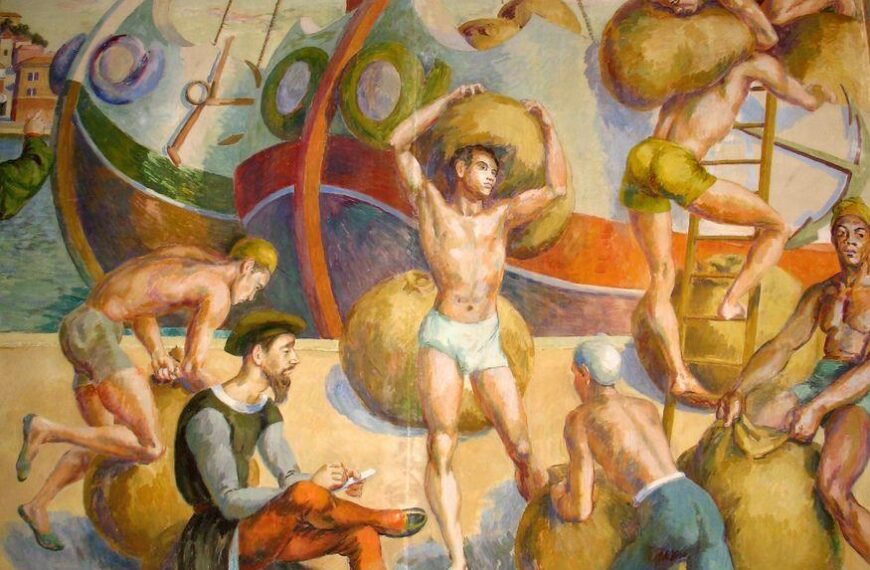
Acrobats, 1916
Charles Demuth spent his career painting two kinds of pictures. In public, he was the watercolorist of flowers and fruit, and later the Precisionist who turned grain elevators and factory smokestacks into something close to religious architecture. In private, he was painting bathhouses, sailors, and men touching each other with an ease that had almost no precedent in American art. Both bodies of work came from the same hand, in the same decades, and neither one was a disguise for the other. They were simply addressed to different audiences.
Lancaster, Paris, and a body that never fully cooperated
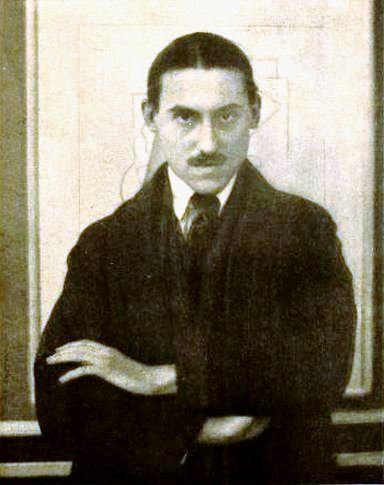
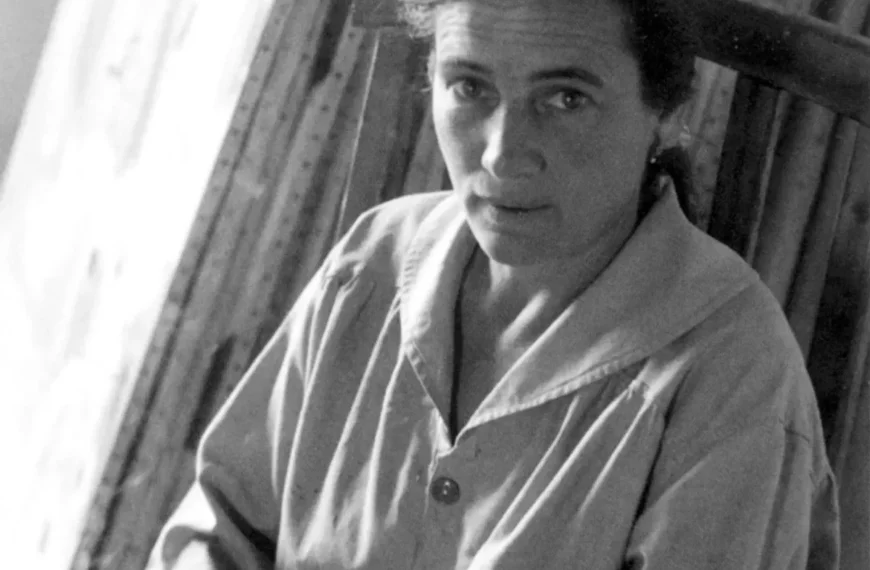
Charles Demuth by Alfred Stieglitz, 1922
Demuth was born in 1883 (died 1935) in Lancaster, Pennsylvania, into a well-off merchant family, and lived there for most of his life in the house that’s now the Demuth Museum. A childhood hip disease, possibly Perthes, left him lame and bedridden for a stretch as a boy; his mother handed him crayons and watercolors to keep him occupied, and that’s more or less where the painting started. He trained at the Pennsylvania Academy of the Fine Arts in Philadelphia, where he met the poet William Carlos Williams at his boarding house. The two stayed close for the rest of their lives, and Williams later supplied, indirectly, the inspiration for Demuth’s best-known painting.
Paris changed things for him in a specific way. Demuth studied there across several stretches between 1907 and 1914, moving through the same avant-garde circles as Gertrude Stein and, later, Marcel Duchamp. The Parisian scene was considerably more relaxed about his homosexuality than home was, and it was there that he met Marsden Hartley, who became both a close friend and something of a guide into the wider modernist world — Hartley is the one who introduced him to Alfred Stieglitz, whose circle Demuth joined once he was back in New York.
By most accounts Demuth wasn’t secretive with the people around him. He kept a long-term relationship with Robert Locher, an interior and stage designer, from around 1909 onward, and the two remained connected for decades even as the exact terms of the relationship — romantic partnership, close friendship, some blend of both — were never spelled out for outsiders. In his will, Demuth left his watercolors to Locher and the bulk of his oil paintings to Georgia O’Keeffe, whose careful placement of them in major museums did a great deal to secure his reputation after his death.
Two publics, two bodies of work
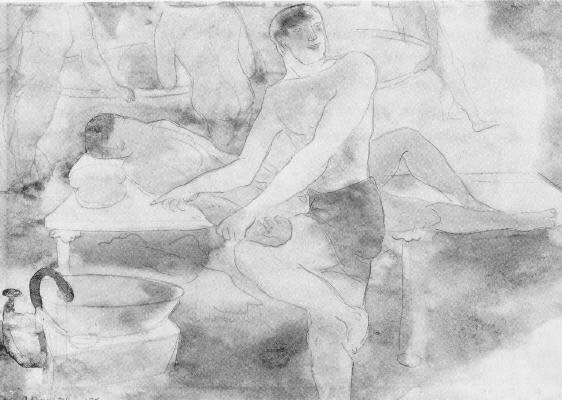
Turkish Bath, 1916
In New York, Demuth was a regular at the Lafayette Baths, a Turkish bathhouse in the East Village, and he made a series of watercolors between roughly 1916 and 1918 depicting the scene there directly — men undressed, in conversation, in evident intimacy with each other. These were never shown publicly in his lifetime. They weren’t meant to be. Demuth kept a strict line between the paintings he sold and exhibited and the ones he made for himself and for friends who moved in the same circles, and the bathhouse watercolors, along with later scenes of sailors and nightclub patrons, sat firmly on the private side of that line.

Three Sailors, 1917
That’s the context that matters here, more than any modern reading of scandal or courage. In the United States in the 1910s and 1920s, sodomy laws were in force in every state, and there was no public market, and no legal safety, for openly homoerotic art. Painting a gay bathhouse scene wasn’t an act of protest so much as a form of documentation, made by someone who assumed only the right people would ever see it. Demuth wasn’t alone in the impulse — his friend Marsden Hartley worked through similar territory with more symbolic distance — but Demuth’s water colors are unusually direct for the period, closer to reportage than allegory.
The exception, and the one time this material collided with his public career, came with Distinguished Air (1930), based on a short story by Robert McAlmon set in a Berlin nightclub. The painting shows a gay male couple and a straight couple both admiring Constantin Brancusi’s overtly phallic sculpture Princess X, with one man’s gaze drifting somewhere it clearly shouldn’t for polite company. Several exhibitions declined to show it. Demuth’s response, according to some accounts, was to keep making similarly candid work rather than pull back from the subject.
Meanwhile the public Demuth kept building the reputation that made him famous: the poster portraits paying tribute to friends like Williams and O’Keeffe, and the Precisionist paintings of Lancaster’s industrial skyline that turned grain elevators into monuments. My Egypt, his 1927 painting of a Lancaster grain elevator, and I Saw the Figure 5 in Gold, from the following year, are generally considered the peak of that side of his output, and neither one reads as coded in any sexual sense. They’re a separate project entirely, made by the same eye that made the bathhouse scenes, for a public that had no idea the other work existed.
Where the work is now
| Work | Year | Where it’s held |
|---|---|---|
| Turkish Bath with Self-Portrait | 1918 | Private collection |
| After Sir Christopher Wren | 1920 | Metropolitan Museum of Art, New York |
| Aucassin and Nicolette | 1921 | Columbus Museum of Art |
| My Egypt | 1927 | Whitney Museum of American Art, New York |
| I Saw the Figure 5 in Gold | 1928 | Metropolitan Museum of Art, New York |
| Distinguished Air | 1930 | Whitney Museum of American Art, New York |
| Buildings, Lancaster | 1930 | Whitney Museum of American Art, New York |
Beyond these, the Demuth Museum in Lancaster, built in the house he shared with his mother, holds around forty works spanning his whole career, along with archival material. It’s the fullest single collection anywhere, though the Whitney and the Met each hold pieces that count among his most important.
A life, read plainly
Demuth developed diabetes in his thirties and was among the first people in the United States to receive insulin as treatment, which likely extended a life otherwise heading toward an earlier close. He died in Lancaster in 1935, at fifty-one, still working when his health allowed it. What survived him was a double body of work that was never meant to be reconciled into a single, tidy story — a public career built on flowers and factories, and a private one built on men at the baths, made without apology and without much thought that anyone outside his circle would ever need to judge it one way or the other.
Sources
- The Westmoreland Museum of American Art — Celebrating LGBTQIA+ Artists in the Collection: Charles Demuth
- TheArtStory — Charles Demuth
- Wikipedia — Charles Demuth
- Wikipedia — I Saw the Figure 5 in Gold
- Queer Art History — Charles Demuth (1883–1935)
- Gay Influence — Charles Demuth
- Hirschl & Adler Galleries — Charles Demuth
- The Phillips Collection Blog — Same Sex in the City: Charles Demuth & Francis Bacon
- Whitney Museum of American Art — My Egypt
- Whitney Museum of American Art — Distinguished Air
- Whitney Museum of American Art — Charles Demuth
- The Metropolitan Museum of Art — I Saw the Figure 5 in Gold
- Smarthistory — Charles Demuth, I Saw the Figure 5 in Gold