The Cathedrals of Broadway, 1929

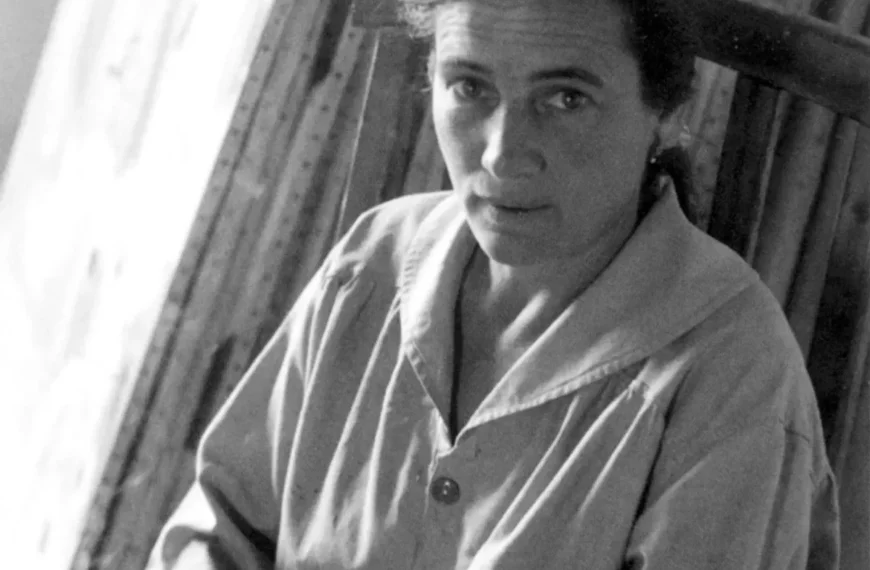
Florine Stettheimer in her Bryant Park garden, 1917-1920
Florine Stettheimer (1871–1944) painted New York between the two world wars in colors that looked like nobody else’s: cake-frosting pink, smoldering red, blazing yellow-white. Her subjects were parties, self-portraits, department stores, beaches, Broadway. On the surface, the work reads as exuberant socialite documentation. Look closer and it’s something else — a steady, deliberate record of queer New York at a time when simply being visible was an act of nerve.
Life
Stettheimer was born in Rochester, New York, in 1871, the fourth of five children in a wealthy German-Jewish family. Her father left before the children were grown, and her mother Rosetta moved the family to New York City. She studied at the Art Students League from 1892, then spent years in Europe absorbing Symbolist and Post-Impressionist painting before being stranded in Bern at the outbreak of World War I. She returned to New York in 1914 and never really left.
What happened next was the salon. Together with her sisters Carrie and Ettie, Florine hosted a flourishing salon in Midtown Manhattan between roughly 1915 and 1930. The regulars included Marcel Duchamp, Alfred Stieglitz, Carl Van Vechten, Charles Demuth, Marsden Hartley, Avery Hopwood, Man Ray, and Gaston Lachaise. Many of them were gay or bisexual, and that mattered — because the Stettheimer salon was, by contemporary accounts, one of the only avant-garde gathering places in New York where sexuality and queerness were openly acknowledged and discussed. Their LGBTQ+ guests felt more at ease there than at comparable salons run by married couples.
In 1916, the only solo exhibition of her work during her lifetime took place at Knoedler & Company in Manhattan — twelve paintings, none of which sold. After that, she mostly refused to exhibit publicly. She showed her work in her home, to people she chose, framed in gilt frames she designed herself, hung on walls she controlled. Duchamp often called her a “bachelor,” playing on the French bachelier, or “new woman,” a term associated with early feminists. He meant it as a compliment.
She died in New York on May 11, 1944. Just two years later, Duchamp and the critic Henry McBride organized a retrospective of her work at the Museum of Modern Art — the museum’s first retrospective of work by a woman artist. After her death, her paintings were donated to museums across the United States. Columbia University holds the largest single collection, over 65 paintings, drawings, and decorative works.
Her Own Sexuality

A Model (Nude Self-Portrait), c 1915-16
Worth being direct about this: Stettheimer’s own sexuality remains largely unknown to us. She never married. She never, as far as the record shows, had a long-term romantic partner of any gender. Duchamp called her a bachelor. Her cousin was Natalie Clifford Barney, the American expatriate who ran the most famous lesbian salon in Paris — Stettheimer almost certainly visited it during her years in Europe. Whether that kinship was more than genealogical, we don’t know.
What we do know is that she was generationally wealthy, never constrained to marry for financial security, and spent her entire adult life embedded in queer social networks that she painted with clear-eyed affection. The freedom, playful sensuality, and gender euphoria in her work resonate with present ideas of queer community, even if we can’t put a label on her own desires. That may be the point. Stettheimer seems to have found categories uninteresting.
The Queer Portrait Gallery
The most direct evidence of Stettheimer’s engagement with queer life is in her portraits, and the deliberate coding she built into them.
Her portraits of several gay friends include references to their homosexuality. The most discussed is her 1922 Portrait of Carl Van Vechten — Van Vechten was a gay writer, critic, and photographer central to the Harlem Renaissance, and the red tie and purple socks in the painting are coded signals to his queerness. She surrounded him with books he’d written, a typewriter with her own name spelled out in the keys, and a mask of his actress “wife” — the picture is a portrait of a gay man’s life assembled with intimacy and dry wit. The painting is now at Yale University Art Gallery.

Le Fete du Duchamp, 1917
Her portrait of Duchamp, painted around 1923, presents him in a gray suit on one side of the canvas and includes a second, rose-colored portrait of his feminine alter ego Rrose Sélavy on the other. Duchamp had invented Rrose Sélavy as a drag persona — Stettheimer painted both versions of him, side by side, as if the duality were simply a fact of his life worth documenting.
Henry McBride, her longtime champion and friend, appears in another 1922 portrait. McBride was a gay American art critic who wrote for the New York Sun, and Stettheimer painted him with the same care and specificity she gave everyone she loved. Her 1930 Portrait of Virgil Thomson — Thomson was a gay composer who would later collaborate with Gertrude Stein — now adorns the cover of Nonesuch Records’ recording of Four Saints in Three Acts and is held by the Art Institute of Chicago.
Four Saints in Three Acts
The most public expression of Stettheimer’s relationship to queer culture was the opera. In the mid-1930s, she created the stage designs and costumes for Gertrude Stein and Virgil Thomson’s avant-garde opera Four Saints in Three Acts. The opera had an all-black cast, a libretto by Stein that defied conventional plot structure, and sets by Stettheimer that became an immediate sensation. She built a cyclorama of cellophane and feather trees — cellophane was still a new material — and covered the stage in iridescent, theatrical light.
The production reflected a complex intersection of Black and white, queer and straight, avant-garde and mainstream subcultures. Stein was a lesbian. Thomson was gay. Stettheimer was the cousin of Natalie Barney. The premiere took place at the Wadsworth Atheneum in Hartford, Connecticut, on February 8, 1934, then transferred to Broadway where it ran to full houses. The maquettes Stettheimer made for the costumes and scenery — wire, crepe paper, thread, feathers, sequins, cellophane — are now held at Columbia University’s Butler Library.
The Cathedrals and the Self
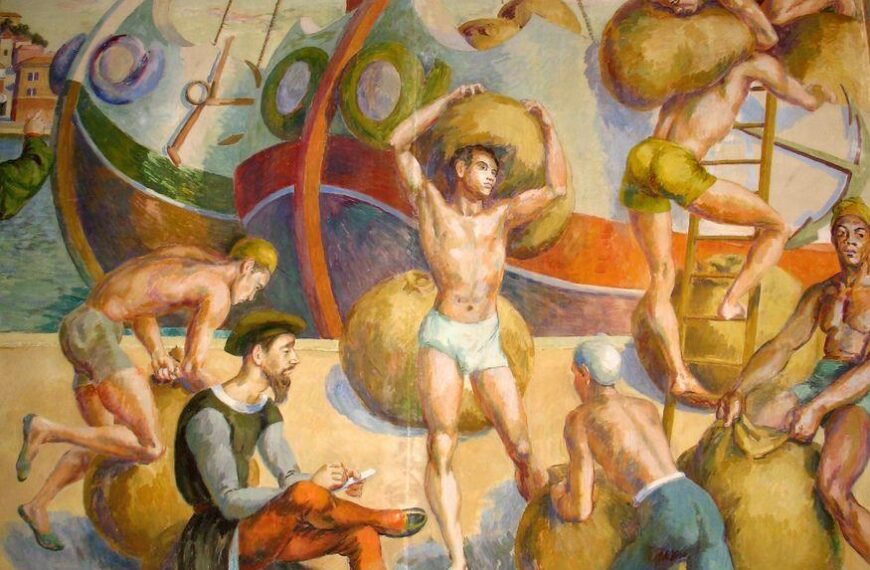
The four Cathedrals paintings — Broadway (1929), Fifth Avenue (1931), Wall Street (1939), and Art (1942) — are her most famous works, all now at the Metropolitan Museum of Art. They are crowded, symbolic canvases, each five feet tall, each depicting one of New York’s secular “places of worship.” They simultaneously celebrate and parody four components of Manhattan life: entertainment, commerce, finance, and art. Her gay friends appear throughout them — cameos in the crowd, recognized by those who know what to look for.
The Cathedrals of Art (1942) is the most personal and the strangest. It shows the directors of MoMA, the Met, and the Whitney presiding over their respective institutions while Stettheimer herself appears at lower right. She was still working on it when she died.
Her self-portraits are a separate category of audacity. She created what is considered the first full-length nude self-portrait by a female artist, a painting that stares out at the viewer with something between coyness and challenge. At a time when dresses were only beginning to show the ankle, a self-portrait like this was unthinkable. In Studio Party (Soirée) (c. 1917–1919), she painted the nude self-portrait hanging in her studio while a mixed-gender party takes place in front of it — men and women both looking at her body. The gender fluidity of who is invited to look is deliberate.
The gender ambiguity of her figures throughout her work was a provocative, even queer choice; her famously feminine depiction of the dancer Vaslav Nijinsky in Music (1920) is a striking instance of this.
Why She Stays Hidden
Stettheimer’s recurrent disappearance from art history has multiple causes. Her style was eccentric and intensely personal. For a time, her work was dismissed as too feminine; later it was called too bourgeois. The queer dimensions of her subject matter went unremarked for decades, partly because there was no critical framework in mainstream art history for discussing them, and partly because the portraits required knowing who the subjects were.
Scholar Richard Lane called Miyagawa Chōshun a “neglected genius”; Barbara Bloemink, Stettheimer’s biographer and the curator of her 1995 Whitney retrospective, has spent years making the same case for her. Stettheimer’s reputation keeps experiencing what one critic described as “convulsive rediscoveries” — a surge of attention, then decades of neglect, then another surge. The 2017 retrospective at the Jewish Museum was her first major US solo show in over twenty years. A new biography by Bloemink arrived in 2022.
Her own decisions complicated things. She refused to sell. She refused to exhibit broadly. She wrote a book of poetry, Crystal Flowers, that was only published — privately, posthumously — by her sister Ettie in 1949. She controlled what was seen, by whom, and when. Given that she was documenting queer life in an era when being outed could destroy a person’s reputation or worse, that control may have been both practical and protective.
Best-Known Works
| Title | Date | Current Location |
|---|---|---|
| A Model (Nude Self-Portrait) | c. 1915 | Columbia University, New York |
| Studio Party (Soirée) | c. 1917–1919 | Yale University Art Gallery, New Haven |
| Lake Placid | 1919 | Museum of Fine Arts, Boston |
| Asbury Park South | 1920 | Fisk University Galleries, Nashville |
| Portrait of Carl Van Vechten | 1922 | Yale University Art Gallery, New Haven |
| Spring Sale at Bendel’s | 1921 | Philadelphia Museum of Art |
| Portrait of Virgil Thomson | 1930 | Art Institute of Chicago |
| The Cathedrals of Broadway | 1929 | Metropolitan Museum of Art, New York |
| The Cathedrals of Fifth Avenue | 1931 | Metropolitan Museum of Art, New York |
| The Cathedrals of Wall Street | 1939 | Metropolitan Museum of Art, New York |
| The Cathedrals of Art | 1942 | Metropolitan Museum of Art, New York |
| Family Portrait II | 1933 | Museum of Modern Art, New York |
Further Reading
- Hyperallergic: The Queer Utopias of Florine Stettheimer
- Hyperallergic: Florine Stettheimer: Feminist Provocateur
- Gay & Lesbian Review: Camp Art in the Age of Modernism
- History Is Gay Podcast: Florine Stettheimer’s Gay Salon (Interview with Barbara Bloemink)
- Metropolitan Museum of Art: An Eyegay for Florine Stettheimer
- Whitney Museum: Florine Stettheimer
- Columbia University: Florine Stettheimer at Columbia
- Barbara Bloemink, The Life and Art of Florine Stettheimer (Yale University Press, 1995)
- Crystal Flowers: Poems and a Libretto (Turtle Point Press, 2010 reissue)