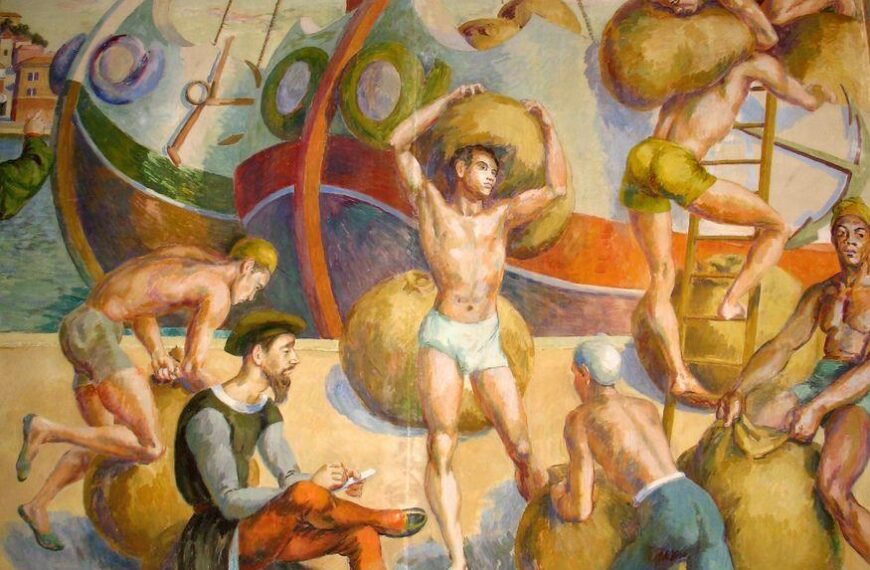
Youth in White Trousers, 1929
Most Tuke retrospectives arrive with the same disclaimer bolted to the wall text: subject matter that might trouble a modern viewer, context that must be handled carefully, a painter of his time. The content could be best described as “predatory” in current language. Fair enough, but up to a point. But the disclaimer tends to crowd out the more interesting story, which is that Henry Scott Tuke spent four decades building an entire visual language around desire between men, in a country where that desire was a criminal offense, and got away with it by calling it sunlight.
A Quaker painter in a circle of “Uranians”

Tuke was born in York in 1858 (died 1929) into a prominent Quaker family; his father, Daniel Hack Tuke, was a well-known psychiatrist whose own professional circle intersected, awkwardly, with the emerging study of what the Victorians called “sexual inversion.” Havelock Ellis trained under the elder Tuke before co-writing Sexual Inversion with John Addington Symonds — a book Daniel Hack Tuke actively opposed. Symonds, meanwhile, was one of Henry’s closest friends.
That’s the strange double life running through Tuke’s biography: a respectable painter from a respectable family, orbiting some of the most openly homosexual intellectuals of his generation. He trained at the Slade under Alphonse Legros and Edward Poynter, spent time in Florence and Paris, and crossed paths there with Oscar Wilde. By the 1880s he had settled into the artistic circle later associated with Newlyn, in Cornwall, before deciding the place felt too crowded and moving on to Falmouth in 1885 — the town where he’d spend the rest of his life.

The Bathers, 1922
It was in Falmouth that Tuke found his subject. He bought a boat, then several, converting an old French brigantine into a floating studio, and started painting the local fishermen and boys who swam and sailed in the harbour. He befriended his models — men like Edward “Johnny” Jackett, who stayed close to Tuke for years even after marrying, and whose relationship with the painter has never been definitively pinned down as sexual or simply devoted. Tuke also kept close company with openly gay men of the era, among them the historian Horatio Brown, who lived in Venice and whom Tuke visited and painted. Whether Tuke himself acted on any of it remains, by design and by history’s gaps, an open question. As one Art UK essay on his work puts it plainly: his sexuality cannot be confirmed, even as he clearly embraced the Uranian world around him.
The Uranians were a loose group of poets and writers — Symonds among them, along with Charles Kains-Jackson, editor of The Artist and Journal of Home Culture — who looked to ancient Greece for a vocabulary of male love that Victorian England refused to supply. Tuke’s paintings gave them exactly the imagery they were after: young men on beaches, unhurried, unclothed, lit like classical statues but placed in the present tense rather than myth. Poets wrote sonnets about his pictures. Critics, for the most part, saw only wholesome outdoor scenes and English coastal light.
The paintings, and what they were actually doing

Boy on a Beach, 1912
Tuke’s early work leaned on classical subjects — boys posed as Hermes or Cupid — which critics found stiff. From the 1890s onward he dropped the mythology and painted what was in front of him: local boys fishing, diving, lounging in boats. The shift mattered. Once the figures were ordinary Cornish teenagers instead of gods, the homoerotic charge didn’t disappear — if anything it sharpened, because there was no myth left to hide behind. Historian Michael Hatt has described Tuke’s world of bathing youths as a kind of heterotopia, a separate space where alternative erotic narratives could exist without ever being named as such.
Tuke was, by most accounts, careful and by the standards of the period responsible: he asked parental permission before painting boys nude and paid his models above the going rate. None of that erases the more uncomfortable edges of the work by today’s standards, particularly its fixation on adolescent bodies, which is precisely why current exhibitions handle it with more scholarly caution than his own contemporaries ever did.
His reputation faded hard after his death in 1929, and it was only in the 1970s, with the first generation of openly gay artists and collectors, that his work was rediscovered and re-read through what’s now called the queer gaze. Elton John became a serious collector; a Tuke original reportedly passed to him from Freddie Mercury’s estate. In 2017, Tate Britain placed Tuke in its Queer British Art 1861–1967 exhibition, formally folding him into a queer art-historical canon that his own era never would have used that language to describe.
Where the work is now
| Work | Year | Where it’s held |
|---|---|---|
| The Misses Santley | 1880 | York Art Gallery |
| Dinner Time (Ambrose Rouffignac in the Sail Loft) | 1883 | Penlee House Gallery & Museum, Penzance |
| Our Jack | 1886 | Royal Cornwall Polytechnic Society Tuke Collection, Falmouth |
| All Hands to the Pumps! | 1888–89 | Tate, London |
| Bathers | 1888–89 | Leeds Art Gallery |
| August Blue | 1893–94 | Tate, London |
| Ruby, Gold and Malachite | 1902 | Guildhall Art Gallery, London |
| Nude Study | 1928 | Royal Cornwall Polytechnic Society Tuke Collection, Falmouth |
Falmouth Art Gallery, which Tuke co-founded in 1894, still holds the bulk of his archive through the Royal Cornwall Polytechnic Society’s Tuke Collection — 277 works in total, most of them never widely exhibited. The Tate pieces are the ones most people encounter first, since both were acquired for the national collection during Tuke’s lifetime, an unusually strong vote of institutional confidence for a painter working almost exclusively in male nudes.
Reading him now
Tuke never wrote down what he was doing, and the people closest to him mostly didn’t either, which is its own kind of answer. What he left instead is a few hundred paintings of young men existing in ordinary daylight, looked at with an attention that Victorian critics were somehow willing to call wholesome. Whether that counts as coded resistance, quiet self-expression, or something closer to exploitation depends a great deal on which painting is in front of you and who’s doing the looking. Tuke built his entire career in that gap, and it’s still where his work sits.
Sources
- Art UK — Henry Scott Tuke: capturing light and the homoerotic gaze
- The Gay & Lesbian Review — Henry Scott Tuke: Homoeroticism in a Time of Illegality
- Queer Kernow — Henry Scott Tuke (1858–1929)
- OutStories Bristol — Henry Scott Tuke (1858–1929)
- UCL Researchers in Museums — Art and Psychiatry: Henry Scott Tuke
- Victorian Web — Review of “Henry Scott Tuke,” edited by Cicely Robinson
- Wikipedia — Henry Scott Tuke
- Wikipedia — August Blue
- Watts Gallery — Henry Scott Tuke exhibition
- Cornish Masters — Henry Scott Tuke
- Cornwall Artists Index — Henry Scott Tuke