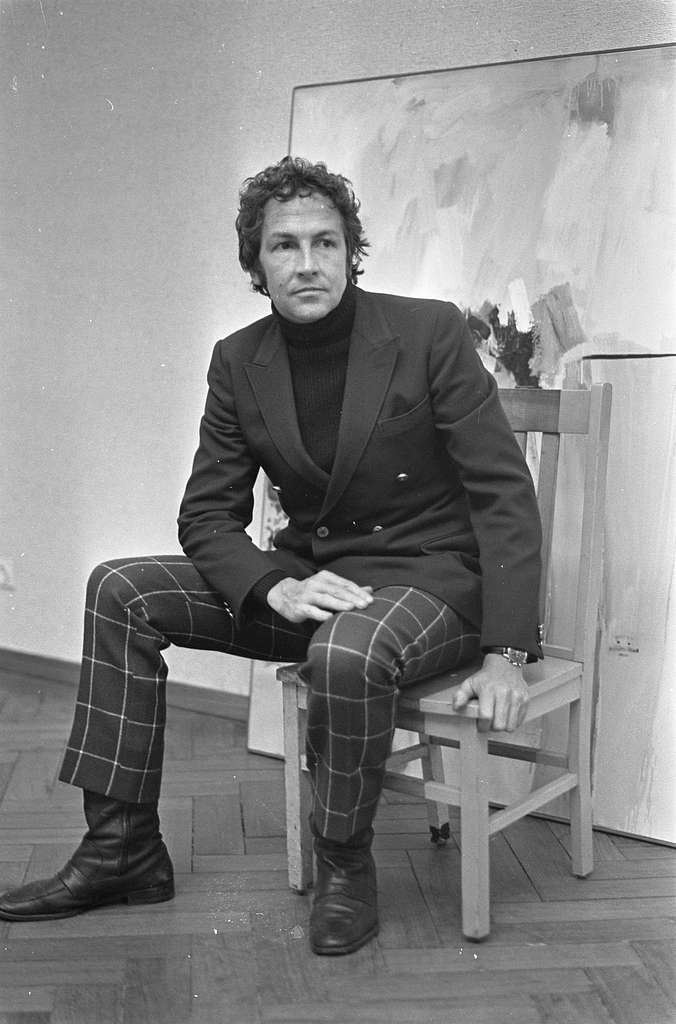
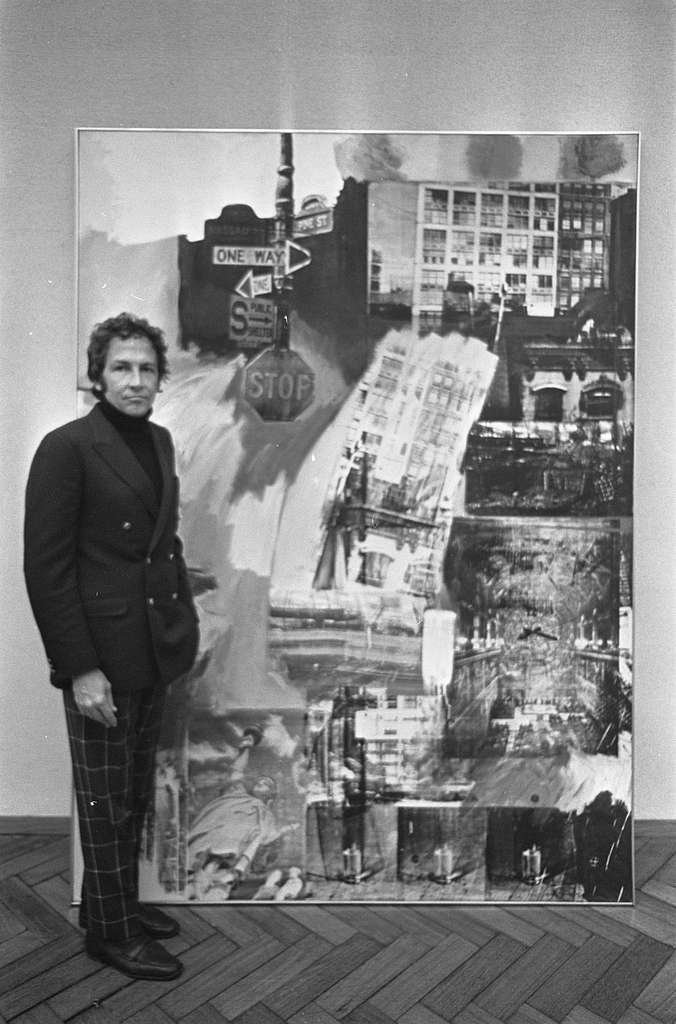
Robert Rauschenberg, Stedelijk retrospective, Amsterdam, 1968
Robert Rauschenberg (1925–2008) was an American artist whose work reshaped art in the mid‑20th century by dissolving boundaries between painting and sculpture, and between art and life itself. He was a central figure in movements including Neo‑Dada, Pop art, and Conceptual art, known for integrating everyday, found objects into art to reflect lived experience. (Wikipedia)
Rauschenberg’s Combines—a term he coined for works that are part painting and part sculpture—challenged traditional hierarchies in art. By bringing discarded materials and common media into museums and galleries, he expanded what could be considered fine art. (rauschenbergfoundation.org)
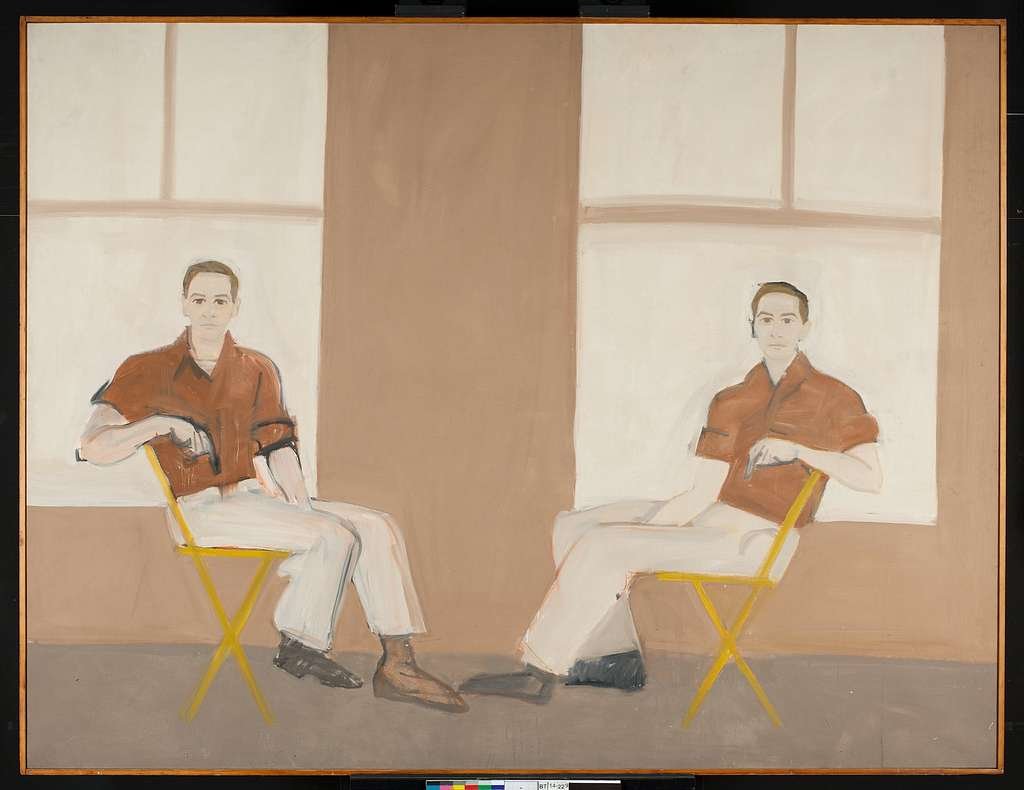
Alex Katz. Double Portrait of Robert Rauschenberg, 1959
From a queer cultural lens, Rauschenberg occupies an important place. He moved comfortably across boundaries in both his personal life and his artistic communities. After his marriage ended in 1953, he had a romantic and creative relationship with Cy Twombly, followed by a significant partnership with fellow artist Jasper Johns from 1954 to 1961. These relationships unfolded within a circle of artists, dancers, and composers that included Merce Cunningham and John Cage, figures now recognized in retrospective scholarship for their interconnected queer histories and collaborations. (Artsy)
This matters because Rauschenberg’s art does more than innovate form; it reflects a kind of fluid identity and collective creative process that resonated with queer aesthetics long before art history widely acknowledged it. His work often collapsed binaries: male and female, high and low culture, inside and outside, public and private. That collapse of categories has a parallel in queer approaches to identity and expression. (Artsy)
Below is a concise table of some of Rauschenberg’s most significant works, with dates, current homes, and why they matter from both art‑historical and LGBTQ+ contextual viewpoints.
| Work | Year | Location (Typical Collection) | Why it Matters (Art + Queer Context) |
|---|---|---|---|
| Monogram | 1955–59 | Multiple collections, including Museum of Modern Art, NY | A Combine that epitomizes his break from conventional painting; merging found objects and paint reflects Rauschenberg’s ethos of inclusion and fluid integration of disparate elements. (rauschenbergfoundation.org) |
| Bed | 1955 | Many retrospective exhibitions | A quilt, sheet, and pillow from his own life smeared with paint; interpreted as self‑portraiture and literal imprint of the artist’s life, resonating with queerness as embodied expression. (Lexology) |
| Erased de Kooning Drawing | 1953 | Collections often include archival reproductions | Conceptually radical act of erasure that challenged hierarchy; a gesture of removal that opens space for reinterpreting norms, resonant with queer reworking of dominant narratives. (Wikipedia) |
| Reservoir | 1961 | Smithsonian American Art Museum, Washington, D.C. | A Combine with clocks and wheels that evokes time, cyclic experience, and everyday life—breaking art into lived temporality, inclusive of multiple life rhythms. (Wikipedia) |
| Autobiography | 1968 | Often shown in major retrospectives | A printed montage blending personal imagery and indexical traces; a literal mapping of identity that pushes against fixed representation. (rauschenbergfoundation.org) |
| Earth Day poster | 1970 | Various environmental and museum collections | Rauschenberg’s social engagement for ecological awareness shows art’s role in societal concerns beyond aesthetics. (rauschenbergfoundation.org) |
Rauschenberg’s art remains influential not only for its formal breakthroughs but also for how it reframed what art can include—life, chance, collaboration, and identity. By working across media and with collaborators from diverse backgrounds, he helped lay a foundation for later generations of artists who see fluid identities and collective meaning as central to creative expression.
Overall, Rauschenberg’s legacy is best understood not simply as technical innovation, but as expanding the scope of artistic expression in ways that resonate deeply with queer frameworks of openness, transformation, and plurality. (Artsy)