
Naked man in front of a tree, 1930
There’s a recurring tension in LGBTQ+ history between honoring the people who made same-sex desire visible, at enormous personal risk, and being honest about what some of them actually did. Wilhelm von Plüschow sits squarely in that tension, and the case against pretending otherwise is getting harder to dismiss.
He was, by any fair measure, one of the earliest photographers to treat the male nude as a serious subject. He was gay at a time when that word had barely been invented as a category. He faced arrest, imprisonment, and eventual exile for his work. Some of his photographs hang today in galleries and auction houses. And he was convicted, twice, of crimes involving minors.
How you hold all of that at once probably says something about where you stand on art, history, and the limits of retrospective sympathy.
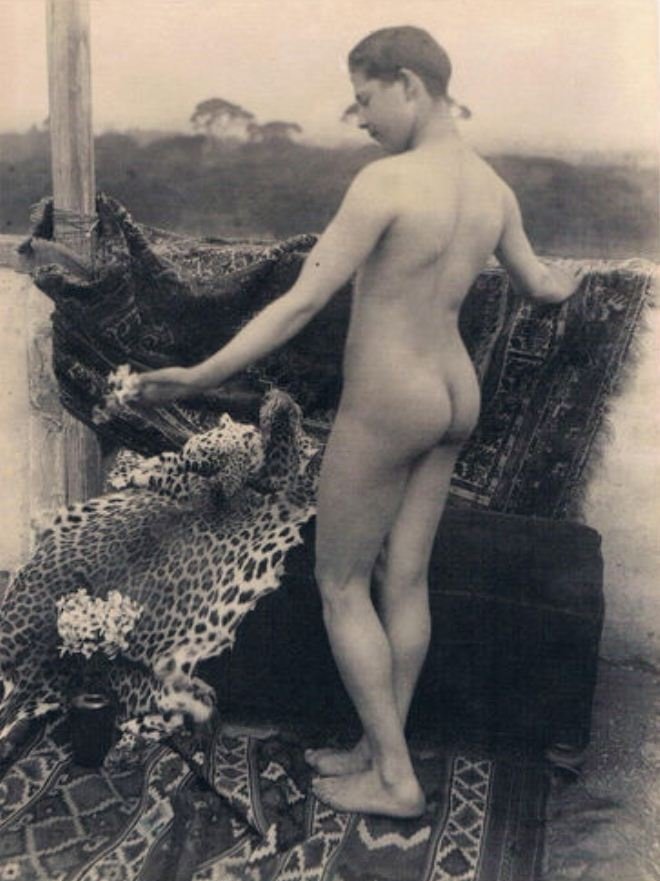
1903-1907
Who He Was
Wilhelm Plüschow was born in Wismar, Germany, on 18 August 1852, the eldest of seven children in a family with a quietly complicated pedigree. His father, Friedrich Carl Eduard Plüschow, was an illegitimate son of Frederick Louis, Hereditary Grand Duke of Mecklenburg-Schwerin, which meant Wilhelm grew up with proximity to aristocratic networks without quite belonging to them — the kind of position that perhaps makes a young man want to go somewhere he can reinvent himself.
In the early 1870s, he did exactly that. He moved to Rome, changed his name from Wilhelm to the Italian equivalent Guglielmo, and got a job as a wine merchant. He didn’t stay a wine merchant for long.
By the mid-1870s he had moved to Naples and set up a photographic studio at Via Mergellina, near the Posillipo hill, with a private garden at Rampa di Posillipo 55 that gave him views of the Bay of Naples and Vesuvius. The location wasn’t accidental. Posillipo was fashionable and scenic. It also gave him access to the networks of wealthy foreign tourists and bohemian expatriates who were quietly making southern Italy a destination for European gay men fleeing the legal and social pressures of home.
He was a cousin of Wilhelm von Gloeden — the more famous German photographer of Sicilian boy nudes based in Taormina — and it was Plüschow who first taught Gloeden the technical side of photography when Gloeden arrived in Italy in the late 1870s. That detail tends to get forgotten. Gloeden went on to become the better-known name; Plüschow ended up as the footnote. Given what happened to Plüschow later, it may be just as well.
The Work
Plüschow’s photographs follow a template that’s immediately recognizable once you’ve seen it. Young Italian males — mostly adolescents, mostly from working-class Neapolitan families — posed nude or draped in classical fabric against Arcadian backdrops. Props from antiquity: urns, wreaths, draped columns, ruins. Compositions that invoke Greek kouroi and Roman statuary. Albumen prints, carefully finished, sometimes gold-toned, numbered in his catalogue system and stamped with his studio mark.
The aesthetic had a name, or at least an idea behind it: the classicist tradition of the male nude, the Hellenist fantasy of a Mediterranean where same-sex desire had once been not just tolerated but celebrated. The Uranian poets in England, a loose circle of writers who idealized relations between men and boys with reference to ancient Greece, were among his admirers. His photographs circulated among European and American collectors, often through discreet networks, sometimes under the guise of artistic reference material.
He received formal commissions too. Baron Jacques d’Adelswärd-Fersen — a French aristocrat who had fled Paris after a sex scandal involving schoolboys and had taken up residence on Capri with his teenage lover Nino Cesarini — hired Plüschow to photograph Nino at Villa Lysis, dressed as a Roman emperor and as a Christian saint. The commission was explicit in its purpose: to glorify and preserve the boy’s beauty. Copies were widely circulated, possibly sold. The context here is not ambiguous.
Among his models, the one who becomes most interesting with historical distance is Vincenzo Galdi, a Neapolitan born in 1871 who was probably also one of Plüschow’s lovers. Galdi started as a model at around sixteen, became Plüschow’s studio assistant, and eventually a photographer in his own right and an art gallery owner. That trajectory — poor boy, model, lover, apprentice, professional — is either a story about opportunity and mentorship or a story about exploitation, and probably contains elements of both.
The Legal Trouble, Stated Plainly
In 1902, Plüschow was charged with common procuration and seduction of minors and sentenced to eight months in prison. Italian authorities confiscated a significant portion of his archive.
Another scandal followed in 1907. In 1910, he left Italy for good and returned to Berlin, where he stayed until his death on 3 January 1930.
This is the part of his biography that any honest account has to sit with. He was not prosecuted under a blanket anti-homosexuality law that swept up gay men for loving other adults. The charges specifically concerned minors. And as academic analysis of his work makes clear, Plüschow’s models were predominantly boys aged 12 to 18, recruited from Naples’ poorest families, often found on the streets. Payment was involved. The power imbalance between a wealthy German expatriate photographer with aristocratic connections and a hungry Neapolitan street boy is not subtle.
The IEMed (European Institute of the Mediterranean) published a scholarly analysis that describes this explicitly as a power relationship between an adult male of the upper class and a minor from the proletariat, and argues that the classical framing — the togas, the Arcadian backdrops, the references to ancient Greek pederasty — functioned as cultural cover for what was, at its base, the sexual exploitation of economically vulnerable children.
That argument is hard to dismiss. The poverty of his models was not incidental to how they were obtained or what they were asked to do.
The LGBTQ+ Context: Where It Gets Complicated
Here’s where honest LGBTQ+ history gets uncomfortable.
For much of the late 19th century, the kind of photography Plüschow and Gloeden were producing existed in an almost total legal and cultural void. Homosexuality as an identity category was barely invented — the term itself dates to 1869. There were almost no cultural spaces in which adult gay men could see their desires represented, let alone celebrated. The photographs circulated through Europe and America served a real need: gay men who had no literature, no institutions, no publicly acknowledged community bought these images because they were among the only evidence that people like them had ever existed.
The V&A museum, in its exhibition on the history of photography and the body, acknowledged Plüschow as a key homoerotic photographer of the late 19th century whose work fed directly into the aesthetics popular in homosexual circles of the time. Artnet lists his photographs in its artist database. Auction houses — Freeman’s, Bassenge, Swann, Chiswick — sell his albumen prints regularly, sometimes for significant sums.
An academic paper published in Italian American Review describes Plüschow as more transgressive than Gloeden, a “sexual outlaw” whose work deliberately challenged Victorian moral codes through the visibility of male homoerotic desire. Some writers position him as a proto-queer pioneer — someone who held up a mirror to same-sex attraction at a moment when doing so could land you in prison, and sometimes did.
The Leveret, writing about his work in the context of gay art history, suggests he may be “more relevant than Gloeden” as a pioneer of contemporary gay culture, if somewhat less aesthetically polished.
The tension is real. The visibility he created mattered. The harm embedded in how he created it also mattered. These are not competing claims that cancel each other out — they’re both true at the same time, and anyone who wants to write about him honestly has to hold them simultaneously.
Photographer or Pornographer? Both is Probably the Answer
The question framed in the title of this piece doesn’t have the clean answer we might prefer.
Wikipedia notes that his photography “is recognized for its artistic merits” but is considered somewhat inferior to Gloeden’s because of less graceful lighting and the “sometimes strangely stilted poses” of his models. That’s a polite way of saying his eye was good but not exceptional. Technically, his albumen prints show real skill — attention to tonal gradation, careful composition, an understanding of how Mediterranean light interacts with skin and stone. The classical framework he built his work within was not random; it was a genuine artistic tradition with roots going back centuries, and he understood it.
At the same time, his images were more overtly sexualized than Gloeden’s. Where Gloeden often produced images that, whatever their subtext, could pass as pastoral studies or ethnographic documentation — and they were, in fact, featured in publications like National Geographic — Plüschow’s work was less restrained, more nakedly erotic. Scholars have noted that the absence of female or adult male equivalents in his main body of work points toward a targeted erotic intent rather than universal artistic exploration.
He sold these images commercially to a discreet clientele. He made some explicitly to order, for wealthy clients like Fersen who wanted specific boys in specific poses. When his assistant Vincenzo Galdi made photographs under Plüschow’s name that went further — Wikipedia notes that Galdi’s work “lacked elegance, often featured females, and generally tended to border on the pornographic” — the implication is that Plüschow’s own work sat just on the respectable side of that line. Just.
The honest assessment is probably this: some of his work is genuinely artistic by any reasonable standard, and some of it was made to function as erotic material for gay men with a taste for adolescent boys, and the line between the two categories in his catalogue is not always distinct. Calling him solely an artist ignores the prosecution record. Calling him solely a pornographer ignores the craft and the real cultural function his work served in a period when gay men had almost nothing else.
What he cannot be called, under any contemporary ethical framework, is blameless with respect to the boys he photographed. The classical drapery and the Arcadian props do not change who those boys were, where they came from, or what the power imbalance between them and him actually looked like.
What Remains
Plüschow died in Berlin in 1930, in relative obscurity. His photographs survived him in scattered collections across Europe and America, sometimes attributed to Gloeden, sometimes to Galdi, sometimes correctly to himself. The Italian authorities had already destroyed part of his archive in 1902.
His photographs now sell at auction for hundreds to several thousand dollars each. They are held in museum collections. They appear in academic papers on the history of homoerotic photography and on the construction of Mediterranean masculinity as a fantasy object for northern European gay men.
The research project at the Huygens Institute on the “polder model” of Dutch governance — comparing different cooperative governance traditions — makes a useful analogy here: some historical institutions are worth understanding on their own terms, in their own context, without either glorifying them uncritically or erasing them because they’re uncomfortable. Plüschow belongs to that category.
He was a gay man in a period of intense legal and social persecution who created photographs that served as evidence of gay male desire at a time when almost nothing else did. He was also a man who obtained those photographs from working-class children in conditions that modern child protection law would rightly treat as exploitation.
Both of those things are true. The question isn’t which one cancels the other. The question is whether we can look at history clearly enough to hold both at once.
Sources
- Wikipedia: Guglielmo Plüschow — biography, convictions, legacy
- Wikipedia: Wilhelm von Gloeden — for comparative context and the Galdi attribution question
- Wikipedia: Nino Cesarini — on the Villa Lysis commissions
- Wikipedia: Villa Lysis — on the Fersen/Capri context
- Grokipedia: Guglielmo Plüschow — detailed biography and critical analysis
- Grokipedia: Vincenzo Galdi — on the model-to-photographer trajectory
- Academia.edu: The Scandalous Bodies of Guglielmo Plüschow (Italian American Review, 2013) — academic paper comparing Plüschow and Gloeden
- IEMed (European Institute of the Mediterranean): Priapus’ Odyssey — on the Arcadian/Mediterraenan photographic tradition and power dynamics
- V&A Museum Blog: Last Week of ‘The History of Photography: The Body’ — museum framing of Plüschow in gay photography history
- The Leveret: The Art of Guglielmo Plüschow — essay on his place in gay art history
- Artnet: Guglielmo von Plüschow — artist profile and auction records
- Find a Grave: Wilhelm Plüschow — biographical details
- Gayety (Substack): Guglielmo Plüschow: Pioneer Photographer of Male Nude Portraiture in the 1800s — queer history framing
- QueerPlaces / Elisa Rolle: Nino Cesarini — on the Fersen commission and Villa Lysis photographs


