
Sarah Bernhardt by Paul Nadar, 1878
Sarah Bernhardt (1844–1923) was a French actor. She shaped modern celebrity before there was such a thing as celebrities, challenged gender , and became one of the most famous performers in the world. From an LGBTQ+ perspective, her legacy runs deeper than fame. Bernhardt challenged gender expectations, played male roles at the height of her career, and cultivated a public persona that blurred the lines between femininity, masculinity, performance, and identity.
She did this in a period when women were expected to be discreet, obedient, and socially contained, and acting was the social kiss of death. Bernhardt was none of those things.
Born Henriette-Rosine Bernard in Paris, she adopted the stage name Sarah Bernhardt and began performing professionally in the 1860s. By the late 19th century, she had become an international phenomenon, touring Europe and the United States and redefining what it meant to be a star.
The Smithsonian has described her as “the first modern celebrity,” and the description fits. She managed her public image with skill, used photography as publicity, and ensured the world talked about her voice, her looks, her scandals, and her brilliance.
Famous Works and Why They Matter
Bernhardt’s most famous performances were often built around emotional intensity, tragedy, and bold female characters, but she also became legendary for playing men, which is central to her queer cultural impact.
Below are some of her most notable roles, including stage and early film.
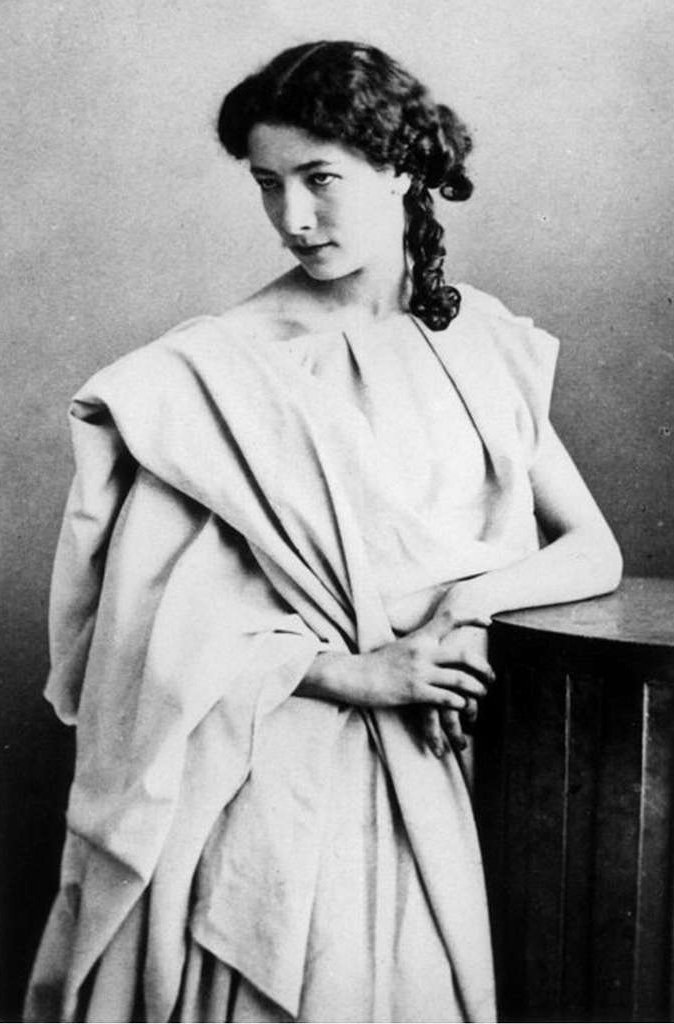
Sarah Bernhardt, 1862
Famous Roles and Productions
| Work / Role | Year(s) | Medium | Why It Matters |
|---|---|---|---|
| La Dame aux Camélias (Marguerite Gautier) | 1870s onward (major success by 1878) | Stage | Cemented her fame and established her as the leading tragic actress of her era. |
| La Tosca (Floria Tosca) | 1887 | Stage | One of her signature roles, mixing political drama, desire, and violence. |
| Phèdre (Phèdre) | late 1800s | Stage | A defining classical role, reinforcing her as an actor of intellectual and emotional range. |
| Hamlet (Hamlet) | 1899 stage, filmed 1900 | Stage + Film | A landmark gender-bending performance, one of the clearest examples of her challenging gender roles. |
| Le Duel d’Hamlet | 1900 | Film | One of the earliest film recordings of Shakespeare, and one of the earliest filmed examples of a woman performing a male hero. |
| La Tosca | 1908 | Film | Helped legitimize early cinema by bringing serious theatre to film audiences. |
| La Dame aux Camélias | 1911 | Film | A major example of her influence crossing from stage to screen. |
| Adrienne Lecouvreur | 1912 | Film | Reinforced her reputation as a dramatic legend in the new medium of film. |
Gender-Bending as Queer Cultural Power
Bernhardt’s decision to play male roles was not a novelty act. She played them seriously, with the full force of her talent, and audiences took her seriously. Her Hamlet became one of her most famous performances, and the filmed duel from Hamlet in 1900 remains a key moment in both theatre and film history.
This matters from an LGBTQ+ perspective because it publicly disrupted the rigid gender expectations of her time. It suggested something radical: gender could be performed, inhabited, and reshaped. Scholars have pointed to her work as a serious early example of gender transgression through theatre.
In an era when queer lives were forced into secrecy, performance became a space where desire, identity, and gender nonconformity could appear in plain sight.
Bernhardt’s Relationships and Queer Readings
Bernhardt’s private life has been debated by biographers for decades, but her close bond with French painter Louise Abbéma stands out. Abbéma painted her repeatedly, and the two were deeply connected socially and artistically.
Some LGBTQ+ historians and cultural writers interpret their relationship as romantic or at least emotionally intimate in ways that reflect same-sex desire and attachment. Their partnership has become part of how Bernhardt is remembered in queer cultural history.
It is important to be careful with historical labels. Bernhardt did not live in a time where modern LGBTQ+ identities existed in public terms. Still, her life fits into a recognizable queer pattern: intense same-sex relationships, public defiance of gender expectations, and a persona that refused to conform.
Why Sarah Bernhardt Still Matters
Bernhardt’s importance is not only historical. Her career still speaks directly to queer audiences and queer artists today.
She matters because:
- She proved gender could be fluid on major stages.
She treated male roles as legitimate art, not parody, which helped normalize cross-gender performance. - She shaped queer-coded celebrity culture.
She built a public identity that blurred boundaries between “respectable” and “scandalous,” feminine and masculine, private and public. - She helped legitimize film as a serious medium.
Her early film appearances were part of cinema’s transition from novelty entertainment to cultural art form. - She gave queer audiences a figure to recognize.
Even without explicit labels, her image signaled possibility: that a person could live outside expectations and still dominate public life.
In many ways, Sarah Bernhardt offered a blueprint that later queer performers would follow: fame as self-invention, identity as performance, and public visibility as power.
Why her work matters for LGBTQ+ history
She challenged gender norms in performance
Bernhardt often chose roles against the norms of her time. She played men in both theatre and film. She was one of the first famous actors to do this on major stages. Scholars see her male roles as early gender bending in performance.
She also wore men’s clothing in public at times when women usually did not. This made her presence more visible and unusual.
Her personal life and relationships
Bernhardt had close emotional relationships with women. One of the best-known was with painter Louise Abbéma. Abbéma painted her, traveled with her, and worked with her. Some historians describe their bond as romantic or deeply intimate.
Their partnership produced art that spoke to audiences interested in same-sex affection. It also helped make Bernhardt’s public image more complex and intriguing.
Her public identity
Bernhardt shaped her own public image deliberately. She wrote memoirs, posed for photographers, and controlled how newspapers talked about her. This self-creation made her more than an actor. She became a cultural figure people talked about in terms of appearance, behavior, and personality.
For queer audiences, her life showed that someone could cross conventional boundaries and still succeed at the highest level. Her celebrity gave visibility to people who lived or felt outside norms.
Further Reading and Sources
Sarah Bernhardt biography (Wikipedia)
https://en.wikipedia.org/wiki/Sarah_Bernhardt
Smithsonian Magazine on Bernhardt as a modern celebrity
https://www.smithsonianmag.com/smart-news/paris-exhibition-celebrates-sarah-bernhardt-the-first-modern-celebrity-180982174/
Bernhardt’s stage and film roles list (including Hamlet duel film)
https://en.wikipedia.org/wiki/Roles_played_by_Sarah_Bernhardt
Film History scholarship on Bernhardt’s role in early cinema
https://www.jstor.org/stable/10.2979/filmhistory.25.1-2.154
Gender performance analysis (academic source via Taylor & Francis)
https://www.tandfonline.com/doi/abs/10.1080/0740770X.2012.685836
The Gay & Lesbian Review on Bernhardt and Abbéma
https://glreview.org/article/the-first-lesbian-image-makers/


