
Born into the industrial north of England when homosexuality was a criminal offence, David Hockney spent more than six decades painting the truth of his own life without apology. What that meant — and what it cost — is a story that belongs not just to art history but to the history of gay liberation itself.
There is a photograph that captures something essential about David Hockney. He is standing in Los Angeles in the mid-1960s, blond hair dyed from a Clairol television advertisement that had said everyone should go blonde, thick glasses on, cigarette in hand, grinning. Behind him: perpetual California sun. The image is of a man who has arrived somewhere — somewhere not just geographical but psychological. He had left behind a country that would have imprisoned him for who he was and found, in the warmth of the Pacific coast, a city that did not particularly care.
Hockney has been called many things across a career now stretching past seven decades: Britain’s greatest living artist, a Pop Art pioneer, a technological adventurer, a portraitist without equal. All of those things are true. But the more foundational truth is simpler: he is a gay man who decided, at the age of twenty-three, in 1962, seven years before homosexuality was partially decriminalised in England and Wales, that he was not going to pretend to be anything else. That decision shaped every canvas, every print, every shimmering swimming pool he ever painted.
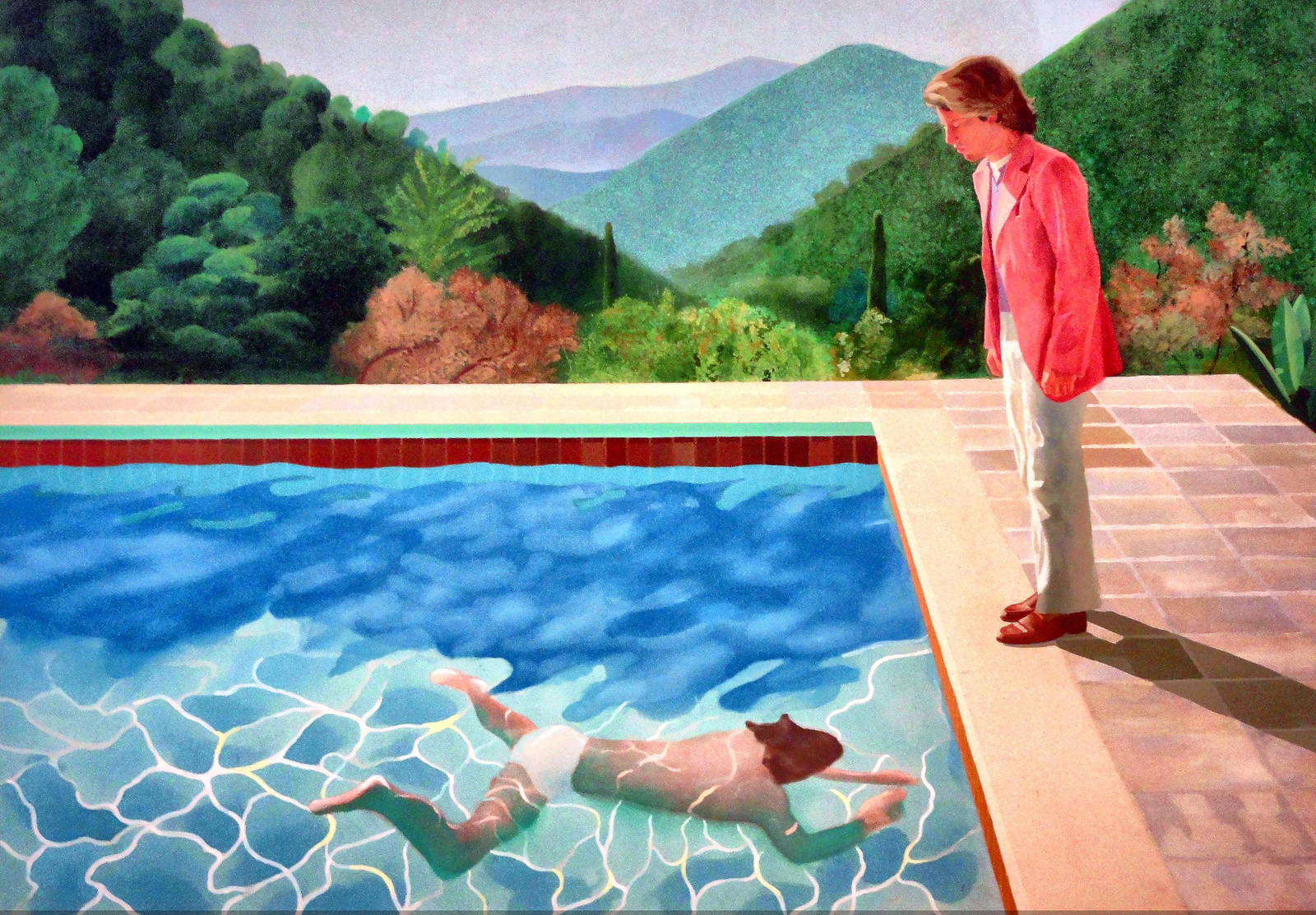
Portrait of an Artist ( Pool with Two Figures) 1972, acrylic on canvas, private collection
From the placard: Metropolitan Museum of Art
Bradford to Bohemia
David Hockney was born on 9 July 1937 in Bradford, West Yorkshire, the fourth of five children of Kenneth and Laura Hockney. The city was industrial, working-class, and Methodist in its moral outlook — not the most obvious origin story for one of the twentieth century’s great champions of pleasure and visibility. His father, a conscientious objector in the Second World War, passed on one lesson that Hockney has repeated throughout his life: don’t worry too much what the neighbours think. He took it to heart.
He enrolled at Bradford College of Art in 1953, then won a place at the Royal College of Art in London, arriving in October 1959 at the age of twenty-two, provincial and eager. London was on the verge of becoming something extraordinary — the Swinging Sixties were still years away but gathering — and the RCA was alive with ambition. He met R.B. Kitaj, Frank Bowling, and Peter Blake, and found himself among the cohort that would announce the arrival of British Pop Art. But what London also gave him, perhaps more importantly, was Bohemia. “In 1961, homosexuality was illegal, but I never gave it a thought,” he later recalled. “The Bohemian world was different. There weren’t people telling you off because you weren’t prim and proper or respectable. You were a free spirit and did what you wanted to do.”
The first openly gay men he encountered were at the College itself. What he found in that small community of artists and eccentrics was something unavailable in Bradford: permission. Not legal permission — that would take another seven years — but social permission, the permission of people who simply did not think his sexuality was a problem worth discussing.
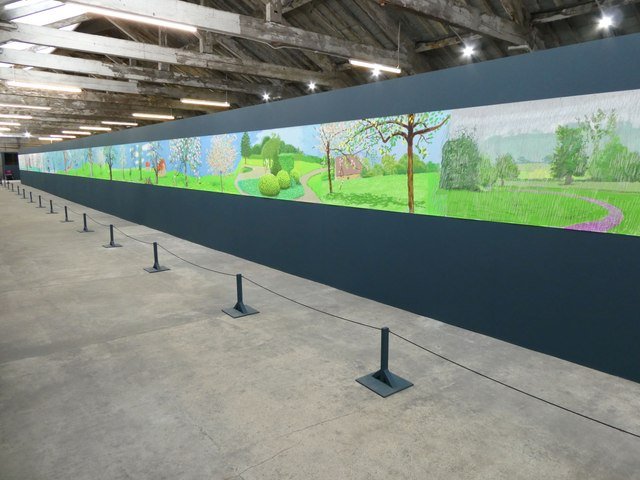
Display of David Hockney’s ‘A Year in Normandie’ at Salts Mill, Saltaire by Jeremy Bolwell
Homosexual Propaganda, Openly Declared
Between 1960 and 1962, Hockney produced a body of work that addressed his homosexuality with a directness that, in the context of the time, amounted to a form of courage bordering on recklessness. In his own words, “What one must remember about some of these pictures is that they were partly propaganda of something that hadn’t been propagandised, especially among students, as a subject: homosexuality. I felt it should be done. Nobody else would use it as a subject because it was a part of me.”
The early works are extraordinary documents. We Two Boys Together Clinging (1961), shown at the Whitechapel’s Young Contemporaries Exhibition, depicts two men in a tender embrace; its title is drawn from a Walt Whitman poem, the gay American poet being one of Hockney’s touchstones. The word “QUEEN” appears in the painted surface. Doll Boy (1960–61) is a coded tribute to Cliff Richard, whom Hockney found sexually attractive and whose pop song Living Doll gave the painting its title — while other students pinned up photographs of women on their walls, Hockney put up pictures of Richard, as an act of quiet, sardonic declaration. The Love paintings of 1960 were the earliest works in which he explored same-sex desire directly, combining abstract expressionist surfaces with scrawled text and figures in ways that required a viewer to look carefully but rewarded those who did. Kaisarion with All His Beauty (1961), produced in response to the gay Alexandrian Greek poet Constantine Cavafy, was among his first print works to encode homosexual desire in art-historical reference.
These were not safe choices. A man in England in 1961 could face prison for a consensual sexual act with another man. Hockney knew this. He came out publicly at twenty-three — not as a political statement in the contemporary sense, but as an extension of the same Bohemian refusal to pretend. “When you said you were gay in the 1960s, people said it was illegal,” he recalled. “Well, I said, ‘I lived in Bohemia, and Bohemia is a tolerant place.'” The curator Ian Alteveer, writing for the Metropolitan Museum retrospective, describes this body of early work as celebrating “a latent politicization of his blatant sexuality” — a generation before gay liberation as a movement took organised form.
At the same time, his first visit to New York in 1961, funded by the earnings from A Rake’s Progress, gave him a glimpse of America’s possibilities. The semi-autobiographical etching series A Rake’s Progress (1961–63) depicts a young gay man’s emerging identity in that first New York encounter, including, with characteristic wit, a plate featuring a bottle of Lady Clairol — the hair dye brand Hockney used to go blond for the first time. New York was not yet the Stonewall city it would become, but it was freer than London, and California — which he first visited in 1964 and where he would eventually settle — was freer still.
California: Light, Swimming Pools, and a Gay Utopia
In 1964, Hockney moved to Los Angeles. The official explanation usually involves the sunshine and the swimming pools, which is partly true. But the deeper reason, which he has been candid about throughout his life, was that California offered something Britain could not: the ability to live as a gay man without constant legal jeopardy. Gay culture was booming in Los Angeles at a time when in England it remained criminal. The city’s tolerance — imperfect and informal, but real — was not incidental to Hockney’s move. It was central to it.
The swimming pools that dominate the paintings of this period are not simply beautiful images of Californian affluence, though they are that too. They are also, in context, something more charged: representations of queer leisure, of the bodies of men in water, of an outdoor culture whose homoeroticism was always understood by those who looked carefully. The pools are sunlit, clean, impossible-seeming — images of a freedom that was simultaneously literal (you could, in Los Angeles, be gay without going to prison) and symbolic (here was a world where the rules were different).
A Bigger Splash (1967) is probably his most famous single work. A diving board. A house. Palms. Brilliant blue water erupting into white foam from an unseen figure who has just dived in. The canvas captures a moment too fast to see — Hockney noted that a real splash exists for only a fraction of a second, so he took two weeks to paint it, an act of deliberate, almost perverse care. It became an icon of California dreaming, but it is also a painting about desire and its objects, about the male body entering water, about someone present yet invisible.
Man Taking Shower in Beverly Hills (1964) is more direct. A nude male figure stands under running water, viewed from behind. There is no coded language here, no Whitman reference needed: this is simply a painting of a man’s body in a domestic space, treated with the same matter-of-fact gaze with which artists had painted women’s bodies for centuries. The claim being made — that the male body, the gay gaze, the homosexual domestic interior were all legitimate subjects for paint — was quiet but unmistakable.
Peter Schlesinger: Love as Subject
In 1966, while teaching a summer course at UCLA, Hockney met Peter Schlesinger, then eighteen years old, who would become his lover, his muse, and the primary human subject of his most celebrated work of the late 1960s and early 1970s. Their relationship lasted until around 1971, when Schlesinger ended it — and the breakup became, at Hockney’s own expense and partly without his knowledge, the subject of Jack Hazan’s documentary film, also titled A Bigger Splash (1973), which followed Hockney through the dissolution of the relationship with unsettling intimacy.
Schlesinger appears in Peter Getting Out of Nick’s Pool (1966), in a series of intimate etchings of 1968–69, and, most famously, in Portrait of an Artist (Pool with Two Figures) (1972) — the painting that in 2018 sold at Christie’s for $90.3 million, at the time the highest price ever achieved at auction for a work by a living artist. The painting shows a young man in a pink jacket standing at the edge of a pool, looking down at another figure swimming beneath the surface; the clothed and the submerged, the observed and the observer, desire rendered as a complex spatial puzzle. Schlesinger himself has pushed back on the “break-up painting” narrative, insisting it was “more conceptual than emotional,” but the painting’s emotional weight — the distance between the two figures, the coldness of the water, the sense of something being watched and not reached — is palpable regardless of its genesis.
Hockney’s long engagement with C.P. Cavafy, the gay Alexandrian Greek poet, also belongs to this period. His Illustrations for Fourteen Poems from C.P. Cavafy (1966–67) — thirteen etchings with minimalist line drawings depicting homoerotic scenes — responded to a poet who had, decades earlier, written with radical candour about same-sex desire, longing, and the bodies of men. For Hockney, encountering Cavafy’s work as a student had been a revelation: evidence that someone had dared to write openly, beautifully, and without apology about what Hockney himself was living. The Cavafy illustrations are among his most directly queer works — spare black-and-white line drawings of embracing men, of naked bodies on beds, of the kind of intimacy that English law still formally prohibited.
The AIDS Crisis: Loss as Formation
If the 1960s and 1970s were years of liberation and pleasure, the 1980s brought a devastation that reshaped Hockney’s world and his work. The AIDS epidemic tore through the gay communities of Los Angeles and New York with a ferocity that is still difficult to comprehend. Hockney lost friends at a rate that he has described only with great difficulty. “The first person to die of AIDS that I knew was in 1983,” he told one interviewer, “and then for ten years it was lots of people.” In Randall Wright’s 2014 documentary Hockney, he observes with quiet devastation: “When I think of all those people… New York would be different had they not died. There would be Bohemia still.” He has estimated that roughly two-thirds of his friends died in the crisis. He could not keep a list; there were too many names.
The loss was profound and profoundly personal, but Hockney is not primarily an elegiac artist. His response to grief has consistently been to paint — portraits of the friends still living, landscapes, flowers, anything that insists on the presence and beauty of the world. His usual reaction to the death of someone close, as Christopher Simon Sykes documents in his biography, was to spend time painting portraits of other friends: a form of bearing witness, of holding people in view. The AIDS crisis also deepened Hockney’s commitment to visible queer life. In a world where gay men were dying in stigmatised silence, the act of painting gay love, gay domesticity, gay friendship — openly, luxuriously, without qualification — was not trivial.
Henry Geldzahler, the curator and art critic who was one of Hockney’s closest friends and whose death from AIDS-related complications in 1994 affected him deeply, appears in several of Hockney’s most important portraits and double portraits of the period. The painting Henry Geldzahler and Christopher Scott (1969), showing Geldzahler on a sofa with his young companion, is among Hockney’s most quietly powerful portraits of gay coupledom — two men in a domestic interior, painted with exactly the same gravity and attention that Gainsborough or Sargent would have brought to a society couple.
The Double Portraits: Queer Domesticity Made Visible
One of Hockney’s most consistent contributions to LGBTQ+ visibility is his series of double portraits, painted roughly between 1968 and 1975. These large-scale works — nearly life-size, painted over weeks or months of intensive sittings — depict couples in their homes with a psychological acuity that has few equals in twentieth-century painting.
Christopher Isherwood and Don Bachardy (1968) shows the novelist and his much younger partner in their Santa Monica living room. Isherwood, openly gay since the 1930s and one of the first writers in the English language to address homosexual experience directly in fiction, was a crucial touchstone for Hockney: an older gay man who had refused concealment and survived. The painting depicts the couple with an equality and affection that was, in the context of 1960s representation, genuinely radical. Same-sex couples simply did not appear in serious painting in this way.
Mr and Mrs Clark and Percy (1970–71), perhaps his most famous double portrait, depicts not a gay couple but a straight one — the fashion designer Ossie Clark and his wife, textile designer Celia Birtwell, at whose wedding Hockney was best man. Yet the painting belongs in this account because it is, among other things, a statement about the legitimate place of domestic intimacy in serious art — a statement made by a gay man who was simultaneously representing such intimacy in his portrayals of gay couples. The Tate acquired the work soon after its completion, and it remains one of the most visited paintings in the collection.
George Lawson and Wayne Sleep (1973–75), one of the lesser-discussed but most openly tender of the series, depicts the ballet dancer Wayne Sleep with his then-partner, the arts administrator George Lawson. Two men, at home, in love, painted with exactly the same gravitas as any married couple in a commissioned society portrait. In a country where their relationship had been legally impossible until six years before, the painting is quietly momentous.
The Later Career: Joy as a Political Act
The trajectory of Hockney’s career in the decades since the AIDS crisis can be understood, in part, as an insistence on pleasure in the face of loss. His return to Yorkshire in the late 1990s, initially drawn back by the terminal illness of his friend Jonathan Silver, led to an extraordinary late phase of landscape painting — the East Yorkshire countryside in all seasons, painted with a vividness and emotional extravagance that confounded expectations of what a landscape painter in his sixties should be doing. Bigger Trees Near Warter (2007), a fifty-canvas work measuring more than four and a half by twelve metres, was donated to the Tate. The Arrival of Spring series, begun in 2011, used both traditional canvas and iPad drawing to capture the seasonal transformation of the Woldgate road with such intensity that the trees seemed almost to be performing.
The iPad itself is characteristic. Hockney has never been able to resist a new technology, and his adoption of digital drawing tools in the 2000s — drawing on his iPhone first, then his iPad, sending the images to friends every morning like illustrated letters — was entirely consistent with a career that had moved through Polaroid, photocollage, fax machine, and laser photocopier. He has always been interested in how we see, not just what we see. His 2001 book Secret Knowledge, which proposed that Old Masters from Van Eyck onwards had used optical devices including the camera obscura to produce their hyper-realistic effects, provoked a controversy in art history circles that has never entirely settled. Whether or not one accepts the Hockney-Falco thesis, the book reveals the same obsessive curiosity about perception, technology, and representation that has driven every phase of his work.
Through all of it — the pools, the portraits, the landscapes, the digital drawings, the opera set designs, the photographic joiners — the queer perspective remains the constant. Curators at the Palm Springs Art Museum’s 2024 Q+ Art initiative observed that “Hockney throughout his career is showing you a queer perspective on the world that’s outside the norm.” This is not an after-the-fact reclamation. It has been Hockney’s own framing from the beginning. The queer gaze — attentive to beauty, alive to pleasure, accustomed to seeing the world from an oblique angle — is not incidental to his art. It is its method.
Some Complications
An honest account of Hockney’s place in LGBTQ+ history requires some nuance. He has been a more complicated figure than the simple narrative of gay liberation hero allows.
He has, at various points, been sceptical about the direction of gay politics and culture. In interviews, he has expressed reservations about same-sex marriage — not as opposition but as a sort of Bohemian lament: “These days, even the gays, they want to get married. I’m glad that I’ve lived when I have. It was freer.” In 2015, he described contemporary gay aspirations toward conventional domesticity as “boring,” and lamented what he saw as the disappearance of the transgressive freedom of the earlier decades. These are the views of a man formed in a particular time and place, for whom the Bohemian lifestyle was genuinely radical and genuinely liberating — and who is not entirely wrong that some of what was lost when gay life became more mainstream deserves to be mourned, even while celebrating the legal and social protections that mainstream acceptance brought.
He has also sometimes resisted the identity label itself. Not as denial — he has been openly, publicly, and consistently gay throughout his adult life — but as a creative artist’s insistence that his work exceeds any single category. The queer dimension of his painting is real, but so is the Bradford dimension, the Yorkshire dimension, the Cézanne dimension, the Picasso dimension. He is not reducible to his sexuality any more than any other person is. What makes him remarkable is the completeness with which he integrated it: it did not need to be bracketed or explained or apologised for, and so it wasn’t.
The Legacy
The scale of Hockney’s influence on LGBTQ+ art and culture is not easily measured, precisely because so much of it operates at the level of permission. For generations of gay, lesbian, bisexual, and queer artists who came after him, his example demonstrated something that was not obvious and cannot be assumed: that you could be openly queer, that you could paint the subjects of your own gay life, that you could do it without disguising or coding or apologising, and that the work could be recognised as great rather than merely tolerated as eccentric. Museum curator Bill Arning has put it well: “As someone who has always felt that the history of queer image-making needs to be available in a clear, concise form for tomorrow’s art students, just as the legacy of African-American artists is today, Hockney’s place in this tradition is paramount.”
In 2025, his largest ever exhibition, David Hockney 25, took over the entire Fondation Louis Vuitton in Paris, with more than 400 works spanning 1955 to 2025. He turned eighty-eight on 9 July of that year and, by all accounts, was still working in his studio every day. The retrospective confirmed what the record-breaking 2018 auction had suggested: that he is not merely beloved but definitively canonical. His place in the history of Western art is secure.
But his place in queer history matters just as much, and may prove just as durable. He was there — blond-haired, bespectacled, unashamed — at the moment when being a gay artist in Britain required a specific kind of nerve. He did not form a movement, write manifestos, or march under banners. He just painted what he saw, who he loved, what gave him pleasure, and kept doing it for seven decades. In the end, that turned out to be one of the more consequential acts of queer resistance of the twentieth century.
Major Works: A Selected Chronology
| Title | Year | Medium | Notes |
|---|---|---|---|
| Portrait of My Father | 1955 | Oil on canvas | Among Hockney’s earliest known works; first work sold publicly |
| Woman with a Sewing Machine | 1954 | Oil on canvas | Bradford period; early figurative work |
| Composition (Thrust) | 1960 | Mixed media on board | RCA student work; early homoerotic imagery and text |
| The Love Paintings (series) | 1960 | Oil on canvas | First direct explorations of same-sex desire |
| Doll Boy | 1960–61 | Oil on canvas | Coded homage to Cliff Richard; graffiti-style text |
| We Two Boys Together Clinging | 1961 | Oil on canvas | Two men embracing; title from Walt Whitman; shown at Whitechapel |
| Kaisarion with All His Beauty | 1961 | Etching | From C.P. Cavafy’s poem; first coded queer print work |
| A Rake’s Progress (series) | 1961–63 | Etchings (16 prints) | Semi-autobiographical; depicts gay identity emerging in New York |
| Domestic Scene, Los Angeles | 1963 | Oil on canvas | Two men; explicit homoerotic source material (beefcake magazines) |
| Man Taking Shower in Beverly Hills | 1964 | Acrylic on canvas | Nude male in domestic interior; early California painting |
| The Hollywood Collection (series) | 1965 | Lithographs | California arrival; first LA-themed print series |
| Illustrations for Fourteen Poems from C.P. Cavafy | 1966–67 | Etchings (13 prints) | Openly homoerotic line drawings; landmark queer print cycle |
| Peter Getting Out of Nick’s Pool | 1966 | Acrylic on canvas | First major painting featuring Peter Schlesinger; won John Moores Prize 1967 |
| A Bigger Splash | 1967 | Acrylic on canvas | Canonical California image; Tate collection |
| The Splash | 1966 | Acrylic on canvas | Smaller precursor to A Bigger Splash; sold for £2.9m in 2006 |
| Beverly Hills Housewife | 1966–67 | Acrylic on canvas | Large-scale; quintessential LA period work |
| Christopher Isherwood and Don Bachardy | 1968 | Acrylic on canvas | Gay couple in domestic interior; landmark double portrait |
| Henry Geldzahler and Christopher Scott | 1969 | Acrylic on canvas | Double portrait; Geldzahler later died in AIDS crisis |
| Peter Schlesinger (etching) | 1968 | Etching and aquatint | Intimate portrait of Hockney’s lover |
| Mr and Mrs Clark and Percy | 1970–71 | Acrylic on canvas | Most-visited work at Tate; Hockney was best man at wedding |
| Portrait of an Artist (Pool with Two Figures) | 1972 | Acrylic on canvas | Features Schlesinger; sold for $90.3m in 2018 |
| George Lawson and Wayne Sleep | 1973–75 | Acrylic on canvas | Double portrait; gay couple in domestic setting |
| My Parents | 1977 | Oil on canvas | Bradford; father died year after completion |
| Paper Pools (series) | 1978 | Coloured and pressed paper pulp | 29 unique works; domestic intimacy of California life |
| The Conversation (Henry Geldzahler and Raymond Foye) | 1980 | Oil on canvas | Geldzahler and partner; testament to gay friendship |
| Pearblossom Highway #2 | 1986 | Photographic collage (joiner) | Major photocollage work; American landscape |
| Hockney’s Alphabet | 1991 | Fax-machine works/prints | Experimental technology period |
| Secret Knowledge (book) | 2001 | Publication | Hockney-Falco thesis; Old Masters and optics |
| Self-Portrait with Red Braces | 2003 | Watercolour | One of over 300 self-portraits produced across career |
| Bigger Trees Near Warter | 2007 | Oil on 50 canvases | Largest painting; donated to Tate Britain |
| The Arrival of Spring in Woldgate, East Yorkshire | 2011 | iPad drawings/prints (51 works) | Yorkshire landscape series; digital and traditional |
| 82 Portraits and 1 Still-life | 2013–16 | Oil on canvas | Each sitter painted over three consecutive days; RA exhibition 2016 |
| Queen’s Window | 2018 | Stained glass, Westminster Abbey | Commission; designed on iPad |
| A Year in Normandie | 2020 | iPad digital drawing, 220-panel frieze | Made during COVID lockdown; 298ft frieze of seasonal change |
| Do Remember They Can’t Cancel the Spring | 2020 | iPad drawings | Made in Normandy during COVID; celebratory series |
| 25th June 2022, Looking at the Flowers (Framed) | 2022 | Photographic drawing on paper | Five-sheet work; artist within his own studio |
| David Hockney 25 (exhibition) | 2025 | Retrospective, Fondation Louis Vuitton | 400+ works; largest exhibition of his career |
Sources
Biographical and career: Wikipedia, David Hockney (updated 2026); Britannica, David Hockney (updated March 2026); TheArtStory, David Hockney (ongoing); The David Hockney Foundation Chronology; MyArtBroker, David Hockney’s Artistic Journey (January 2026).
LGBTQ+ analysis: Pallant House Gallery, Exploring LGBTQ+ Themes in Hockney to Himid (2022); GAYLETTER, David Hockney at the Met (2017); National Gallery of Australia, David Hockney: Symbolic Expressions of Queer Experience (2020); The Gay & Lesbian Review, David Hockney’s Great Yes to Life (2018); OutSmart Magazine, Portrait of the Artist as a Gay Man (2016); BØWIE Creators, David Hockney’s Simple Queer Pleasure; Palm Springs Art Museum / WWD, David Hockney’s Queer Identity Explored (2024); MyArtBroker, Queer Identity in David Hockney’s Cavafy Illustrations and Erotic Prints (2026); Rogue Art Historian Substack, Canvas, Polaroid, Pixel: Hockney’s Triumphant Celebration of Gay Life (June 2025).
Early career and RCA: Royal College of Art, David Hockney (2012); Walker Art Gallery blog, David Hockney: Early Reflections (2014); A Rabbit’s Foot, The Early Years of David Hockney (June 2025); Artnet News, 8 Times David Hockney Broke the Rules (July 2025).
Peter Schlesinger: Wikipedia, Peter Schlesinger; MyArtBroker, Peter Schlesinger by David Hockney; Vice, David Hockney’s Romantic Breakdown (2024); Sperone Westwater Gallery.
AIDS crisis and biography: Artnet News, Documentary Shows Hockney’s Rage Against the Art Machine (2016); TheArtStory; Kirkus Reviews, Life of David Hockney (Cusset novel); The Spectator, review of Christopher Simon Sykes biography (April 2024).
Major works and exhibitions: Tate, 80 Years in 8 Works; Artsy, 6 Iconic David Hockney Artworks in His Major Paris Show (2025); Artnet News, 14 Iconic Works (2017); Richard Gray Gallery; Fondation Louis Vuitton, David Hockney 25 (2025).


