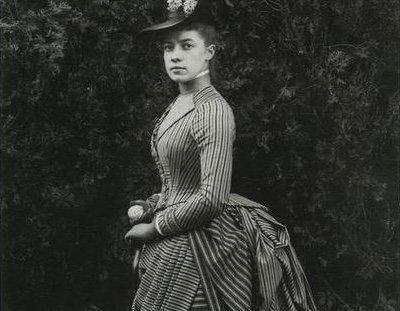
Elizabeth Alice Austen photographed queer life in Victorian America with a clarity nobody at the time had words for — and spent her final years in a poorhouse.
Alice Austen was born on Staten Island in 1866. Over the next fifty years, she created more than 7,000 glass-plate negatives and prints. She photographed street vendors, immigrants, cyclists, sporting events, and, quietly, persistently, the intimate lives of the women she loved. She is now recognized as one of the most important documentary photographers in American history and a foundational figure in queer visual culture.
Here is what took longer to say: she spent 55 years in a devoted loving relationship with her life partner Gertrude Tate, 30 years of which they lived together in her home, which is now the Alice Austen House Museum and a nationally designated site of LGBTQ+ history.
Those two facts, the photographs, the relationship, are not separate. Understanding one without the other doesn’t really work.
The camera her uncle handed her
Austen received her first camera at around ten years old from an uncle who was a Danish sea captain. Another uncle, a chemistry professor, showed her how to develop the glass plates she exposed. An upstairs closet at the family home was converted into a darkroom. She took meticulous notes on the photographic process and never really stopped.
Clear Comfort
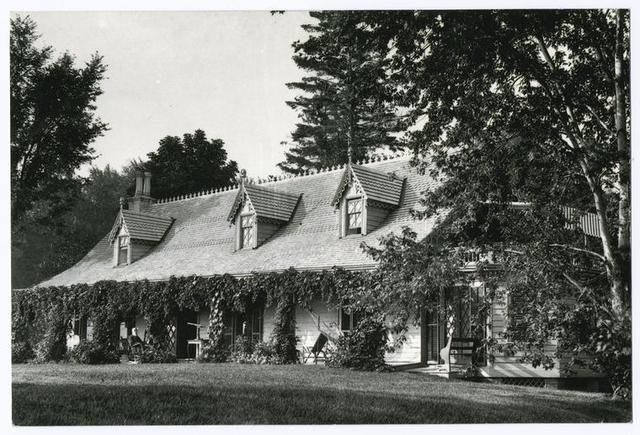
The house was called Clear Comfort, a Gothic Revival cottage on the Staten Island shoreline with a view across New York Harbor. From that vantage point she would have witnessed the assembly of the Statue of Liberty in 1886, immigrants arriving at Ellis Island, and World War I soldiers returning from the front — and she photographed much of it.
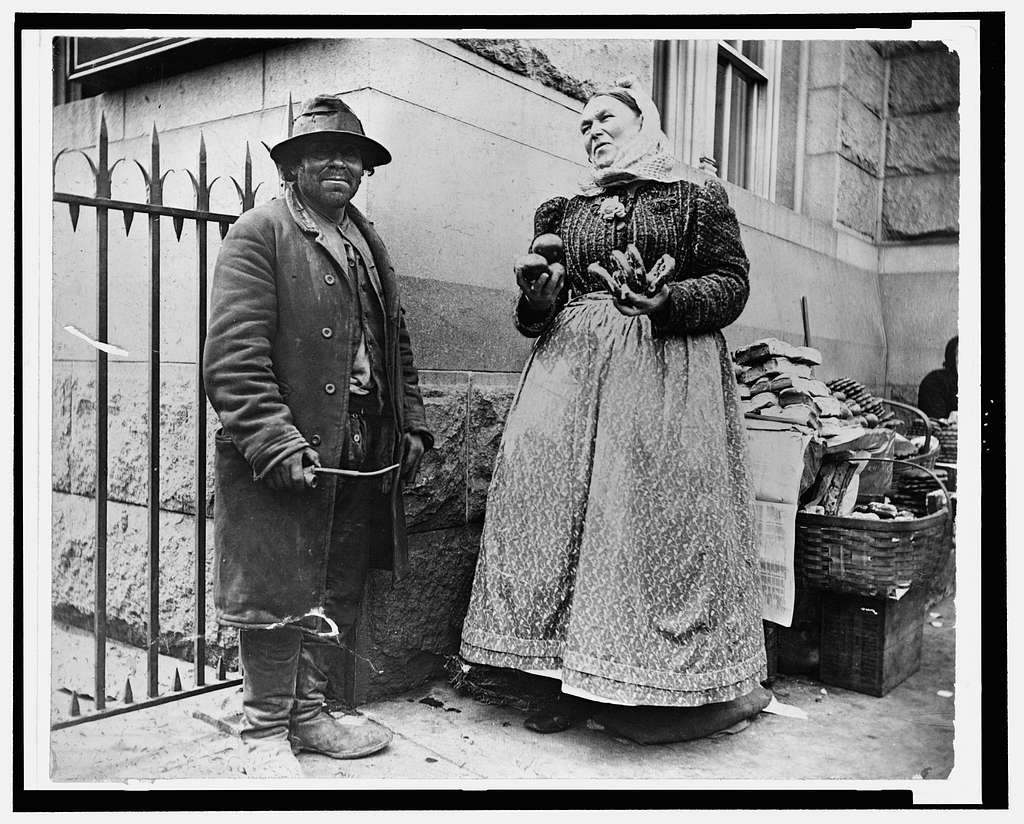
By the 1890s she was hauling 50 pounds of equipment through Manhattan, shooting from moving trains, capturing street life in ways that prefigure documentary photography as a discipline. A generation before Berenice Abbott, another trailblazing lesbian photographer, created her iconic series Changing New York, Austen was already capturing the city during its most rapid period of transformation.
But it’s the private photographs that keep drawing people back.
What she was actually doing with that camera
In one iconic image, Trude & I (1891), Austen and her childhood friend Gertrude Eccleston wear masks, corsets, and calf-length skirts, arms intertwined. Both are smoking — an act women could be arrested for at the time. In The Darned Club (1891), taken in Clear Comfort’s garden, Austen and three female friends are framed as two embracing couples. Another photograph from the same year, Julia Martin, Julia Bredt and Self Dressed Up as Men, features exactly that — friends in male drag, complete with phony mustaches and cigarettes.
Austen later said of these photographs: “We did it just for fun.” Behind the fun was a rebellious impulse. At 25, she had begun to doubt the worth of “the larky life” and its ultimate goal, matrimony.
Was she conscious of making queer images? This is where historians get careful, and rightly so. As Janice Monger, executive director of the Alice Austen House, puts it: “Everyone wants ‘evidence.’ We don’t have anything explicitly written that says they were lesbians.” But looking at Austen’s photographs and other documents, scholars including Lillian Faderman contend there is no question about the nature of her relationships. “It’s hard to imagine the kind of willful ignorance about homosexuality that existed in earlier eras,” Faderman says.
What is especially significant about Austen’s photographs is that they provide rare documentation of intimate relationships between Victorian women. Her depiction of her non-traditional lifestyle and that of her friends, although intended for private viewing, is the subject of some of her most critically acclaimed photographs.
Intended for private viewing. That phrase is doing a lot of work. Austen wasn’t making propaganda or manifesto. She was making a record of her own life, for herself. That we now have access to it is partly accident, partly the determination of people who understood what they were looking at.
Gertrude Tate
In 1899, Alice met the woman who would become her life partner: Gertrude Amelia Tate (1871–1962). Gertrude, who Alice sometimes called “Trude,” taught both dance and kindergarten. The two women quickly fell into what Gertrude’s family described as a “wrong devotion.” Today we would call it falling in love.
They visited regularly, traveled Europe together, and in 1917 Gertrude moved into Clear Comfort. Alice’s friends knew her for decades, and they loved Tate. “Tate was delightful and very capable. They were accepted as a couple,” says Bonnie Yochelson, author of Too Good to Get Married: The Life and Photographs of Miss Alice Austen (Fordham University Press, 2025).
For a while, that was enough. Then the 1929 stock market crash took everything.
When the crash caught Austen in its crosshairs, her financial standing collapsed. She refused to sell Clear Comfort, took out mortgages not for daily expenses but to continue traveling with Tate. Austen sold family heirlooms. Tate taught dance. They opened a tea room on the lawn with a view of passing ships. Eventually foreclosure was inevitable.
In 1945, Austen and Tate — then in their seventies — were evicted from Clear Comfort for good. Tate and Austen were separated by her family’s rejection of their relationship and by poverty. Gertrude was taken in by relatives who refused to accept Alice. Alice was sent to the Staten Island Farm Colony — a poorhouse. Tate visited her weekly.
In 1951, historian Oliver Jensen discovered her photographs, which had been transferred to the Staten Island Historical Society. Jensen helped publish the photos in Life magazine and other outlets, raising enough funds to move Austen to a private nursing home. She died on June 9, 1952, shortly after appearing on the cover of Life. The final wishes of Austen and Tate to be buried together were denied by their families.
Gertrude Tate lived until 1962. Alice lived until 1972.
The long argument about who she was
The Alice Austen House opened as a museum in 1985, but for years, it told an incomplete story. Even this institution, dedicated to exploring Austen’s life and work, promoted varying narratives of its former resident. One of Austen’s biographers, Ann Novotny, referred to Tate as Austen’s “companion” in her 1976 biography, but as her “lover” in an article she wrote for a feminist art magazine the following year.
In a 1994 demonstration, the Lesbian Avengers marched around the grounds calling it a “National Historic Lesbian Landmark” and distributed pamphlets demanding that Austen and Tate’s same-sex relationship be acknowledged. It took more than two decades after that for the museum to fully follow through.
It wasn’t until 1970, nearly 20 years after her death, that her relationship with Tate was formally celebrated for what it was, and her home added to the LGBT Historic Sites — the first in New York City devoted to a woman to receive that designation. The National Register of Historic Places nomination was amended in 2017 to explicitly include its significance to LGBT history.
The reluctance to name things plainly is its own kind of history. It’s worth noting that the people most resistant to acknowledging Austen’s lesbianism were often the same institutions charged with preserving her legacy.
Where the work is now
For most of the past 80 years, Austen’s archive sat at the Staten Island Historical Society. When she was evicted from Clear Comfort in 1945, she entrusted her collection of over 7,500 original prints and negatives to her longtime friend Loring McMillen at the Historical Society. The collection includes more than 2,600 cellulose nitrate negatives, over 2,000 glass plate negatives, 1,500 photographic prints, and more than 300 additional items yet to be digitized.
In June 2025, Historic Richmond Town repatriated Alice Austen’s photographic archive to the Alice Austen House after more than 80 years. A major collections project launched in late 2025 to digitize and publish the entire archive online.
The photographs are, finally, home.
Major works: a reference table
| Work | Date | Description | Current location |
|---|---|---|---|
| Trude & I Masked, Short Skirts | August 6, 1891 | Austen and Gertrude Eccleston in corsets and masks, smoking; arms intertwined | Alice Austen House, Staten Island |
| The Darned Club | October 29, 1891 | Austen with Eccleston, Julia Lord, and Sue Ripley in Clear Comfort’s garden, framed as two embracing couples | Alice Austen House, Staten Island |
| Julia Martin, Julia Bredt and Self Dressed Up as Men | October 15, 1891 | Three women in male drag with phony mustaches and cigarettes | Alice Austen House, Staten Island |
| Mrs. Snively, Julie & I in Bed | August 29, 1890 | Austen and friends Eliza Snively and Julia Martin; self-timed shutter release | Alice Austen House, Staten Island |
| Street Types of New York | 1896 | Documentary portrait series of Manhattan street vendors, workers, and immigrants | Alice Austen House / Historic Richmond Town archive |
| Quarantine Station series | c. 1890–1895 | Commissioned series documenting the Staten Island quarantine station processing mass immigration | Alice Austen House, Staten Island |
| Alice and Gertrude Tate in a rowboat, Scotland | 1903 | Travel photograph of the couple in Scotland; one of many European travel images made for Tate | Alice Austen House, Staten Island |
| World’s Columbian Exposition, Chicago | 1893 | Hundreds of photographs documenting the exposition | Historic Richmond Town / Alice Austen House |
| Bicycling for Ladies illustrations | 1895–1896 | Series of photographs used as basis for illustrations in Violet Ward’s 1896 cycling book | Alice Austen House, Staten Island |
| Hoffman and Swinburne Islands / Quarantine | c. 1890–1901 | Documentation of immigrant quarantine facilities off Staten Island’s eastern shore | Alice Austen House, Staten Island |
Why it still matters
There are photographers who get written out of history because their work wasn’t good enough. Austen isn’t one of them. She was written out — or written around — because of who she loved and how openly she recorded it. The deliberate vagueness around her relationship with Tate wasn’t confusion. It was a choice, made repeatedly over decades, by institutions and individuals who found it easier to call Gertrude a “companion” than to say the obvious thing.
That’s changing. The archive is back at Clear Comfort. The museum is telling the full story. Bonnie Yochelson’s 2025 biography exists. The digitization project is underway.
But Austen died in a nursing home, separated from the woman she’d spent her adult life with, buried apart from her against her explicit wishes. That’s the part that doesn’t get tidied up by institutional recognition, however overdue. It’s just what happened, and it’s worth knowing.
Sources: Alice Austen House Museum (aliceausten.org); Historic Richmond Town / Staten Island Historical Society (historicrichmondtown.org); NYC LGBTQ Historic Sites Project (nyclgbtsites.org); Artsy, “Over 100 Years Later, Photographer Alice Austen Is Finally Being Recognized as an LGBTQ Icon” (2019); LGBTQ Nation (2021); NBC News (2025); PetaPixel (June 2025); The Marginalian (2021); Gotham Center for New York City History; NYC Parks; Bonnie Yochelson, Too Good to Get Married: The Life and Photographs of Miss Alice Austen (Fordham University Press, 2025); Ann Novotny, Alice’s World (Chatham Press, 1976); Lillian Faderman and Phyllis Irwin, “Alice Austen and Gertrude Tate: A Boston Marriage on Staten Island,” Historic House Trust NYC (Fall 2010).